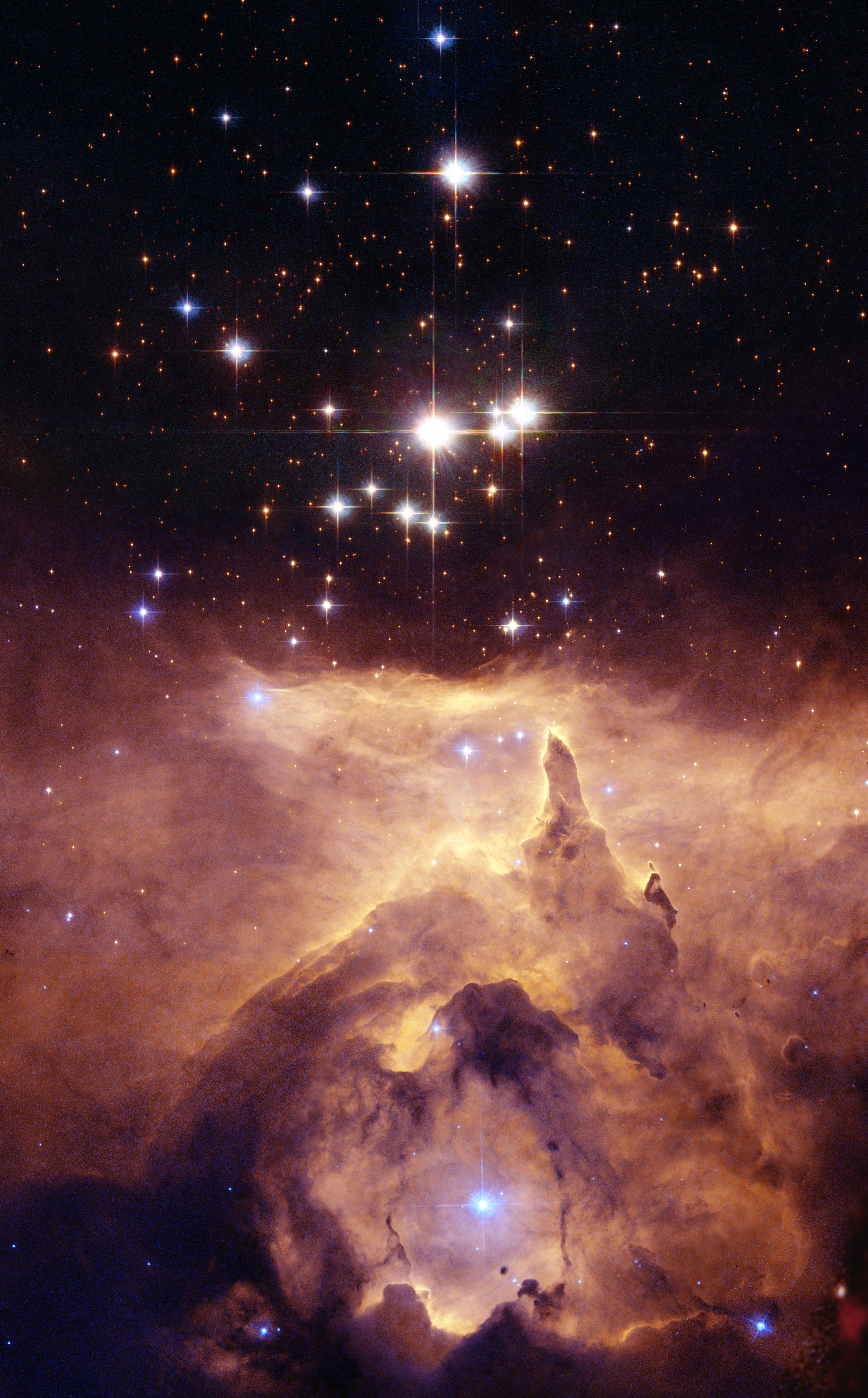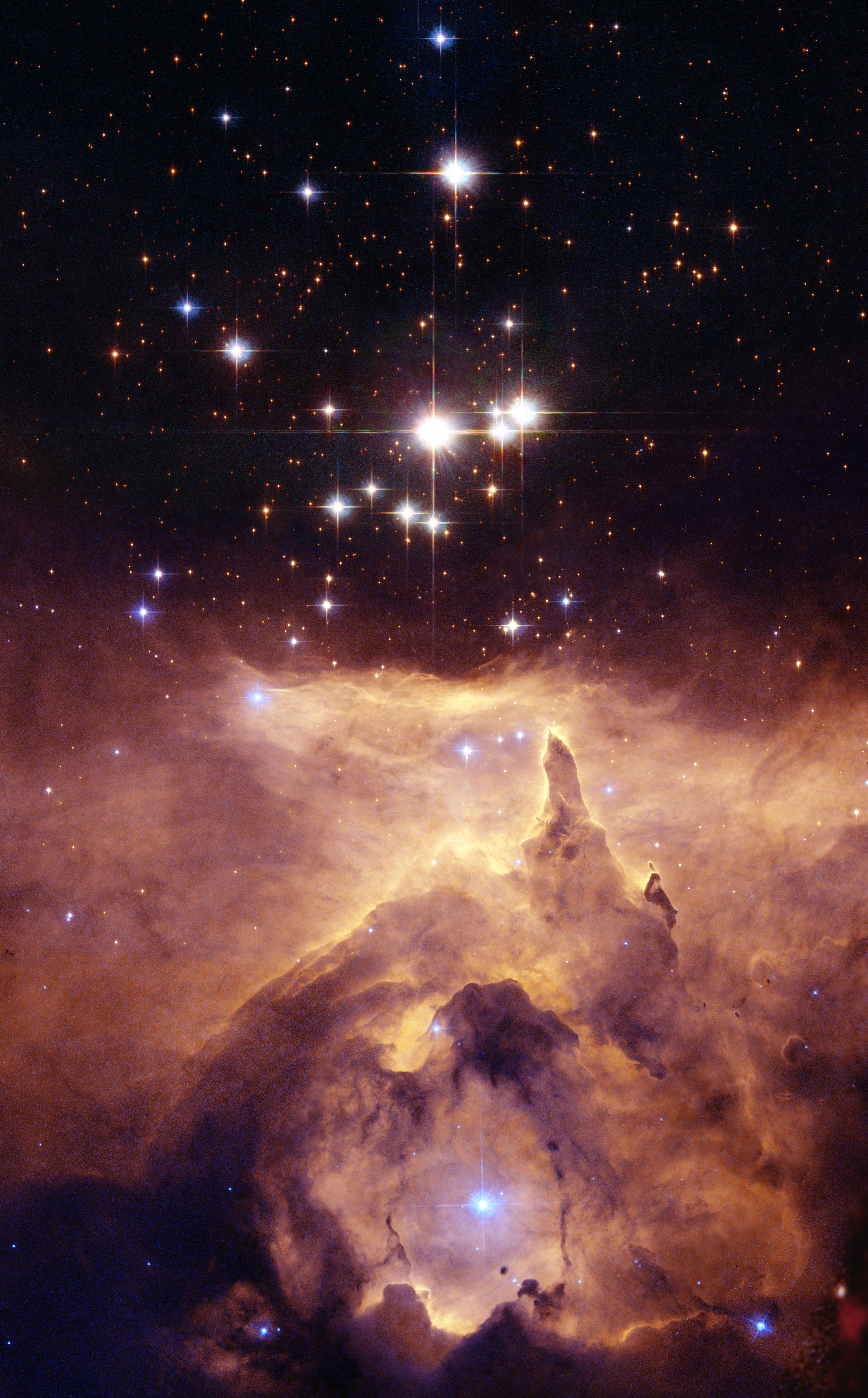
For reasons unknown, NGC 6357 is forming some of the most massive stars ever discovered. One such massive star, near the center of NGC 6357, is framed above carving out its own interstellar castle with its energetic light from surrounding gas and dust. In the greater nebula, the intricate patterns are caused by complex interactions between interstellar winds, radiation pressures, magnetic fields, and gravity. The overall glow of the nebula results from the emission of light from ionized hydrogen gas. Near the more obvious Cat's Paw nebula, NGC 6357 houses the open star cluster Pismis 24, home to many of these tremendously bright and blue stars. The central part of NGC 6357 shown spans about 10 light years and lies about 8,000 light years away toward the constellation of the Scorpion.
Por razones desconocidas, NGC 6357 está formando algunas de las estrellas más masivas jamás descubiertas. Una de estas estrellas masivas, cerca del centro de NGC 6357, se muestra en la imagen superior tallando su propio castillo interestelar con su luz energética que interactúa con el gas y el polvo circundantes. En la mayor nebulosa, los patrones intrincados son causados por complejas interacciones entre vientos interestelares, presiones de radiación, campos magnéticos y gravedad. El brillo general de la nebulosa resulta de la emisión de luz del gas de hidrógeno ionizado. Cerca de la más obvia nebulosa del Gato de Garra, NGC 6357 alberga el cúmulo estelar abierto Pismis 24, hogar de muchas de estas estrellas extremadamente brillantes y azules. La parte central de NGC 6357 mostrada abarca aproximadamente 10 años luz y se encuentra a unos 8000 años luz de distancia en dirección a la constelación de Escorpión.