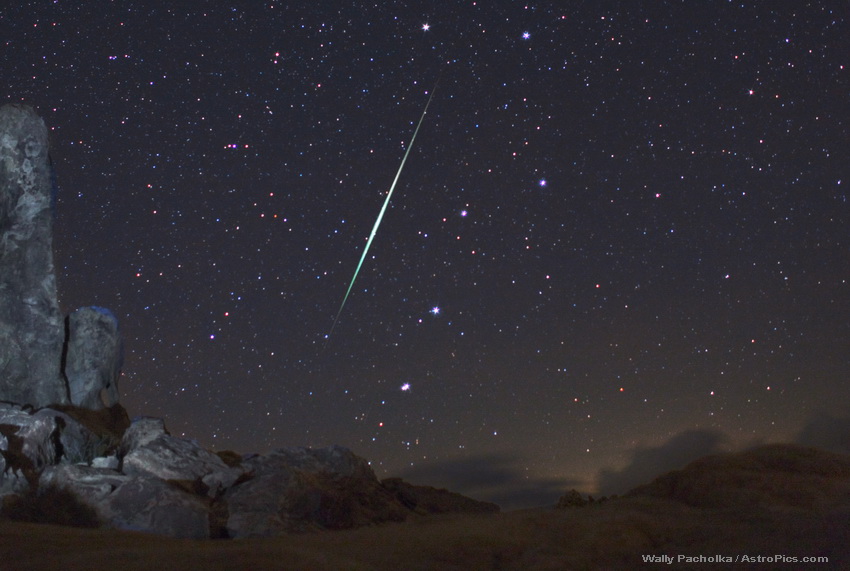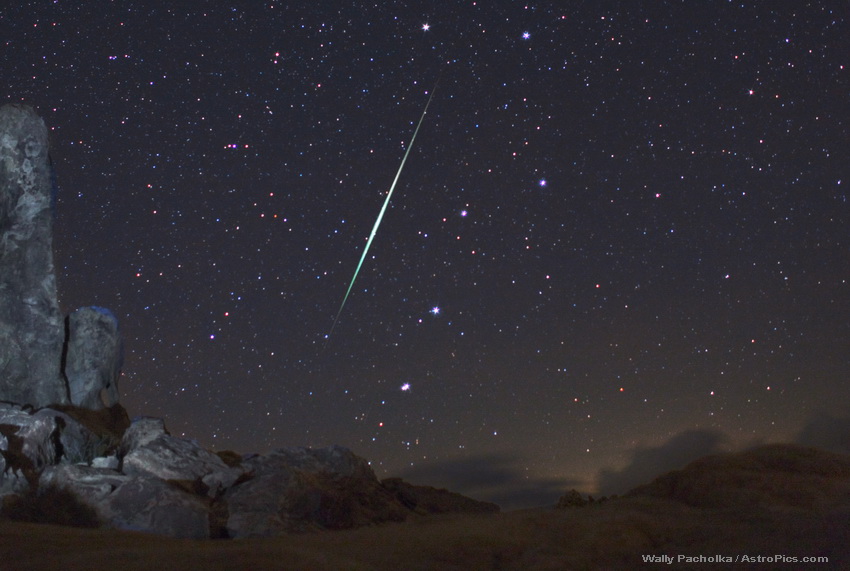
Created as planet Earth sweeps through dusty debris from mysterious, asteroid-like, 3200 Phaethon, the annual Geminid Meteor Shower should be the best meteor shower of the year. The Geminids are predicted to peak on the night of December 13/14, but you can start watching for Geminid meteors this weekend. The best viewing is after midnight in a dark, moonless sky, with the shower's radiant constellation Gemini well above the horizon - a situation that favors skygazers in the northern hemisphere. In this picture from the 2009 Geminid shower, a bright meteor with a greenish tinge flashes through the sky over the Mojave Desert near Barstow, California, USA. Recognizable in the background are bright stars in the northern asterism known as the Big Dipper, framing the meteor streak.
Creado cuando la Tierra atraviesa el polvo de escombros misterioso, similar a un asteroide, del 3200 Phaethon, la lluvia anual de meteoros Geminidas debería ser la mejor lluvia de meteoros del año. Se predice que las Geminidas alcancen su máximo en la noche del 13 al 14 de diciembre, pero ya puedes comenzar a observar meteoros Geminidas este fin de semana. La mejor observación es después de la medianoche en un cielo oscuro y sin luna, con la constelación radiante de las Geminidas bien por encima del horizonte, una situación que favorece a los observadores del hemisferio norte. En esta imagen de la lluvia de meteoros Geminidas de 2009, un meteorito brillante con un tono verdoso atraviesa el cielo sobre el desierto de Mojave cerca de Barstow, California, EE.UU. Se reconocen en el fondo las estrellas brillantes del asterismo norteño conocido como el Cazo Grande, enmarcando la estela del meteoro.