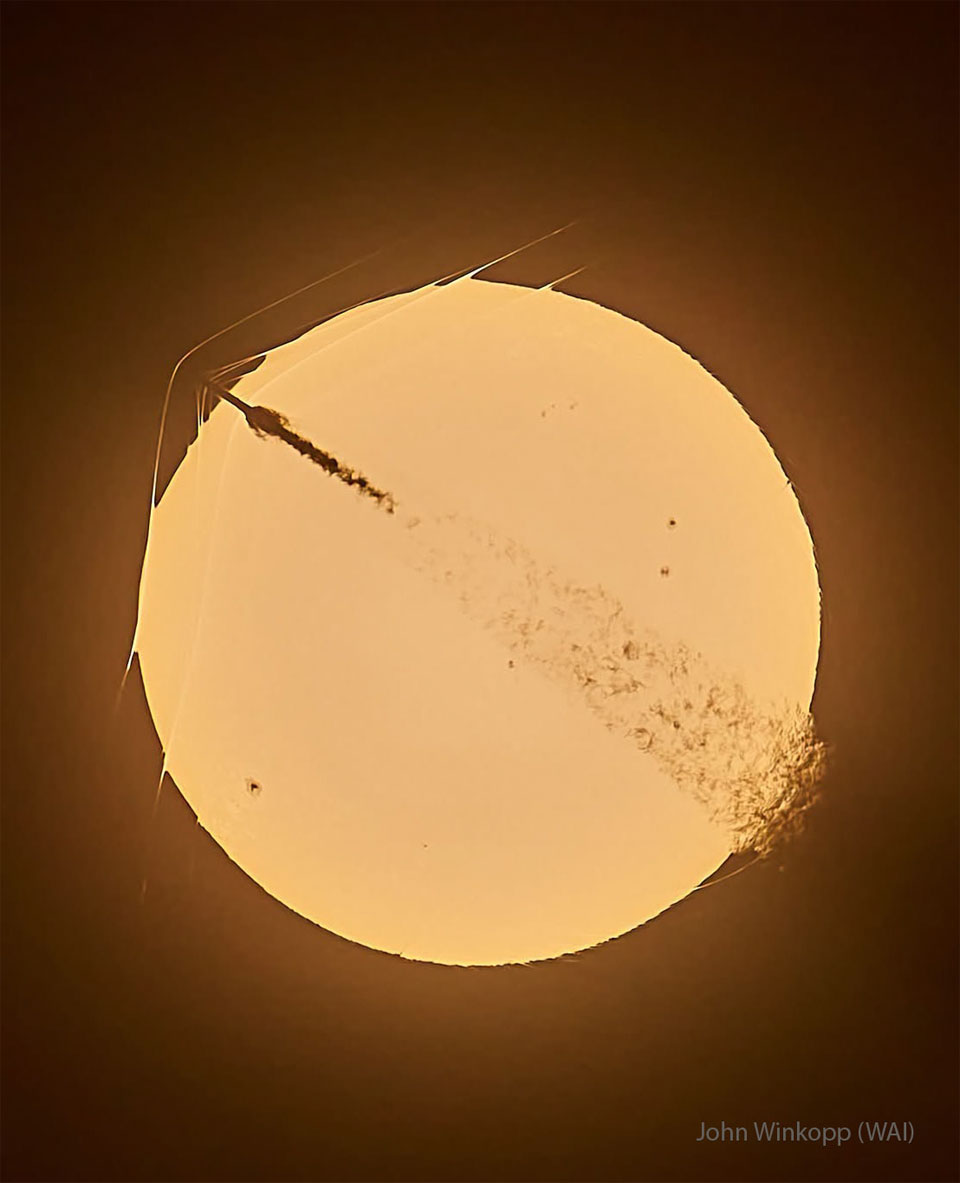
Click the arrow and watch an unusually long filament explode out from the Sun. The filament had been seen hovering over the Sun's surface for over a week before it erupted earlier this month. The image sequence was taken by the Earth-orbiting Solar Dynamics Observatory (SDO) in one color of ultraviolet light specifically emitted by helium, and another color of X-ray light specifically emitted by iron. The explosion created Coronal Mass Ejections which dispersed high energy plasma into the Solar System. This plasma cloud, though, missed the Earth and so did not cause auroras. The above eruption and an unusually expansive eruption that occurred in August are showing how widely separated areas of the Sun can sometimes act in unison. Explosions like this will likely become more common over the next few years as our Sun moves toward Solar Maximum activity. Best Astronomy Images: APOD Editor to speak in Philadelphia on Jan 5 and New York City on Jan 7
Haz clic en la flecha y observa un filamento inusualmente largo que estalla desde el Sol. El filamento había estado visible sobre la superficie solar durante más de una semana antes de estallar a principios de este mes. La secuencia de imágenes fue capturada por la nave espacial Solar Dynamics Observatory (SDO), que orbita la Tierra, en una longitud de onda específica de luz ultravioleta emitida por el helio, y en otra longitud de onda específica de luz de rayos X emitida por el hierro. La explosión generó Eyecciones de Masa Coronal (CME, por sus siglas en inglés), que dispersaron plasma de alta energía en el Sistema Solar. Sin embargo, esta nube de plasma no impactó la Tierra y, por lo tanto, no causó auroras. Esta erupción y otra erupción inusualmente extensa que tuvo lugar en agosto muestran cómo áreas ampliamente separadas del Sol pueden actuar a veces de manera coordinada. Explosiones como esta probablemente se volverán más comunes en los próximos años a medida que nuestro Sol se acerque al máximo solar.