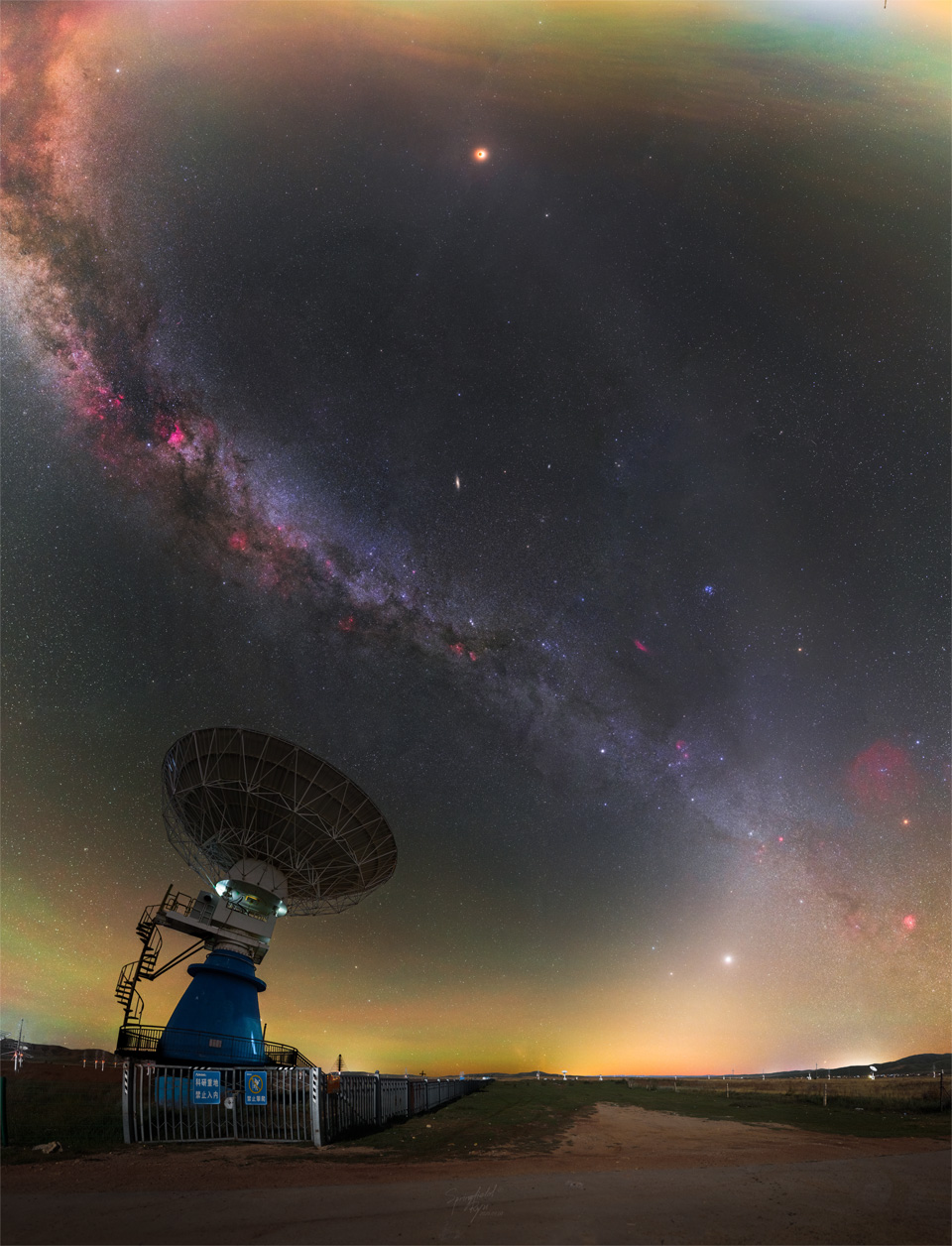
Why is the Earth moving in the above video? Most time lapse videos of the night sky show the stars and sky moving above a steady Earth. Here, however, the frames have been digitally rotated so that it is the stars that stay (approximately) steady, and the Earth that moves beneath them. The video dramatically shows the actual rotation of the Earth, called diurnal motion, in a clear and moving way, as if the camera were floating free in space. The telescopes featured in the video are the Very Large Telescopes (VLT) in Chile, a group of four of the largest optical telescopes deployed anywhere in the world. A discerning observer of the above time lapse movie may also note the use of laser guide stars, zodiacal light, the Large and Small Magellanic Clouds, and fast-moving, sunlight-reflecting, Earth-orbiting satellites. The original video, on which the above sequences are based, can be found here.
¿Por qué se mueve la Tierra en este vídeo? La mayoría de los vídeos en time lapse del cielo nocturno muestran las estrellas y el cielo moviéndose sobre una Tierra estática. Sin embargo, en este caso los fotogramas han sido rotados digitalmente de modo que son las estrellas las que permanecen (aproximadamente) quietas, mientras la Tierra se mueve bajo ellas. El vídeo muestra de forma clara y contundente la rotación real de la Tierra, denominada movimiento diurno, como si la cámara flotara libremente en el espacio. Los telescopios que aparecen en el vídeo son los Very Large Telescopes (VLT) situados en Chile, un conjunto de cuatro de los mayores telescopios ópticos desplegados en cualquier lugar del mundo. Un observador atento del time lapse podrá notar también el uso de estrellas guía láser, la luz zodiacal, las Nubes de Magallanes Mayor y Menor, y satélites en órbita terrestre que reflejan la luz solar y se desplazan rápidamente.