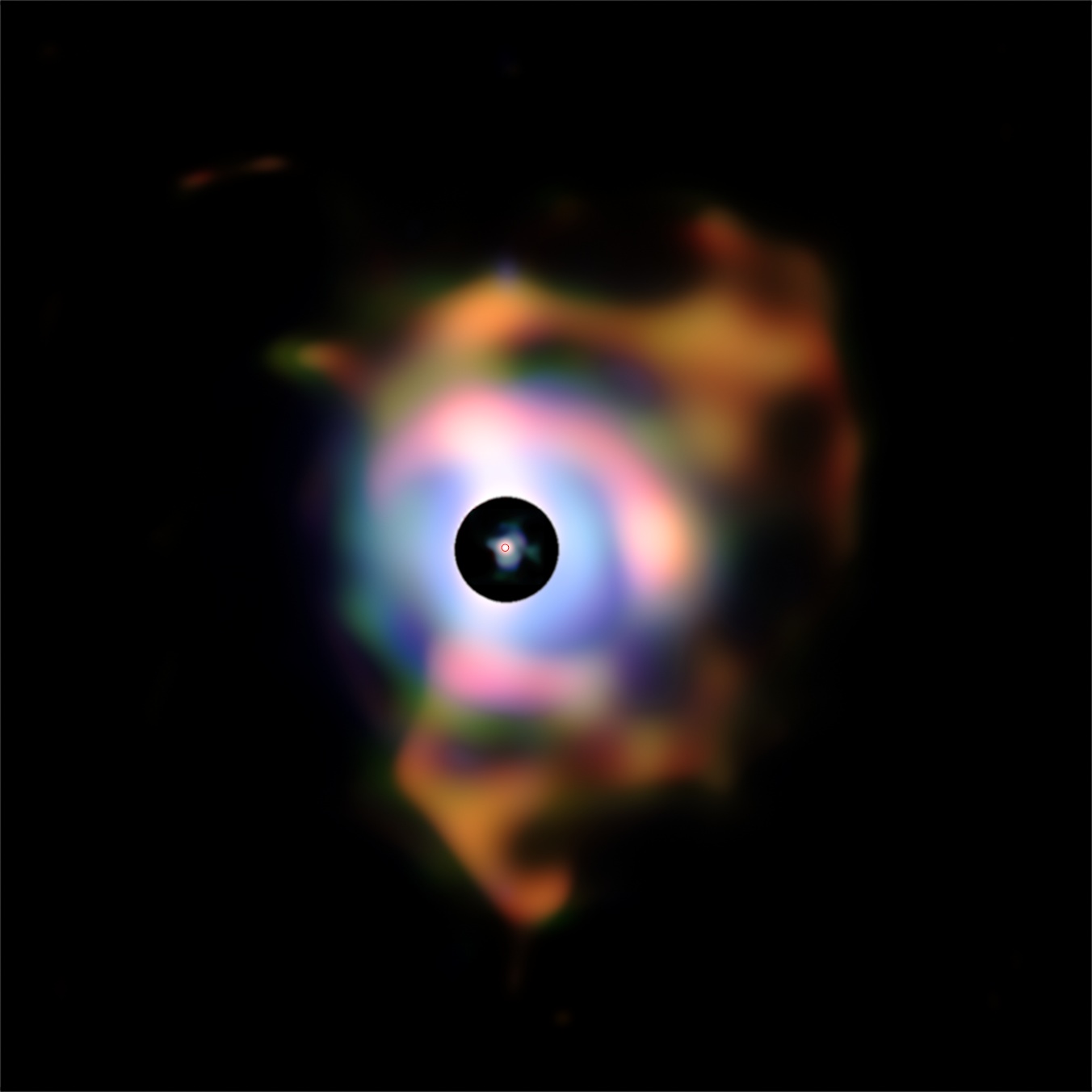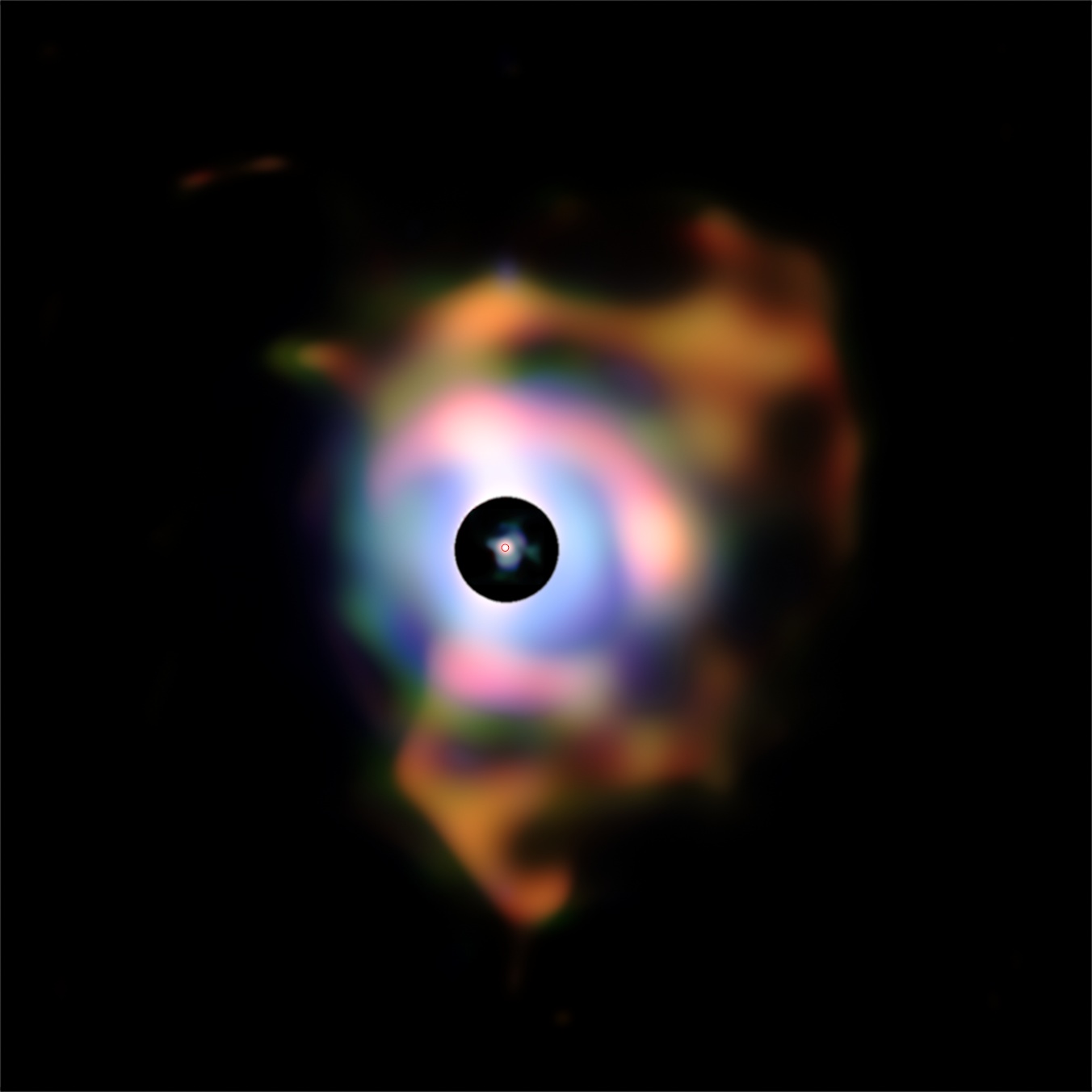
An expansive nebula of dust is seen to surround red supergiant star Betegeuse in this remarkable high resolution composite, an infrared VLT image from the European Southern Observatory. Betelgeuse itself is outlined by the small, central red circle. If found in our own solar system its diameter would almost encompass the orbit of Jupiter. But the larger envelope of circumstellar dust extends some 60 billion kilometers into space, equivalent to about 400 times the Earth-Sun distance. The dust is likely formed as the swollen atmosphere of the supergiant sheds material into space, a final phase in the evolution of a massive star. Mixing with the interstellar medium, the dust could ultimately form rocky terrestrial planets like Earth. The central bright portion of the outer image has been masked to reveal fainter extended structures. The field of view is 5.63 arcseconds across.
Una extensa nebulosa de polvo rodea a la estrella supergigante roja Betelgeuse en este notable compuesto de alta resolución, una imagen infrarroja del VLT del Observatorio Europeo Austral. La propia Betelgeuse está delimitada por el pequeño círculo rojo central. Si se encontrara en nuestro sistema solar, su diámetro abarcaría casi la órbita de Júpiter. Sin embargo, la mayor envoltura de polvo circunestelar se extiende unos 60 mil millones de kilómetros hacia el espacio, lo que equivale a aproximadamente 400 veces la distancia Tierra-Sol. Es probable que el polvo se forme cuando la hinchada atmósfera de la supergigante expulsa material al espacio, una fase final en la evolución de una estrella masiva. Al mezclarse con el medio interestelar, ese polvo podría llegar a formar planetas terrestres rocosos como la Tierra. La porción central y brillante de la imagen exterior ha sido enmascarada para revelar estructuras extendidas más tenues. El campo de visión abarca 5,63 segundos de arco.