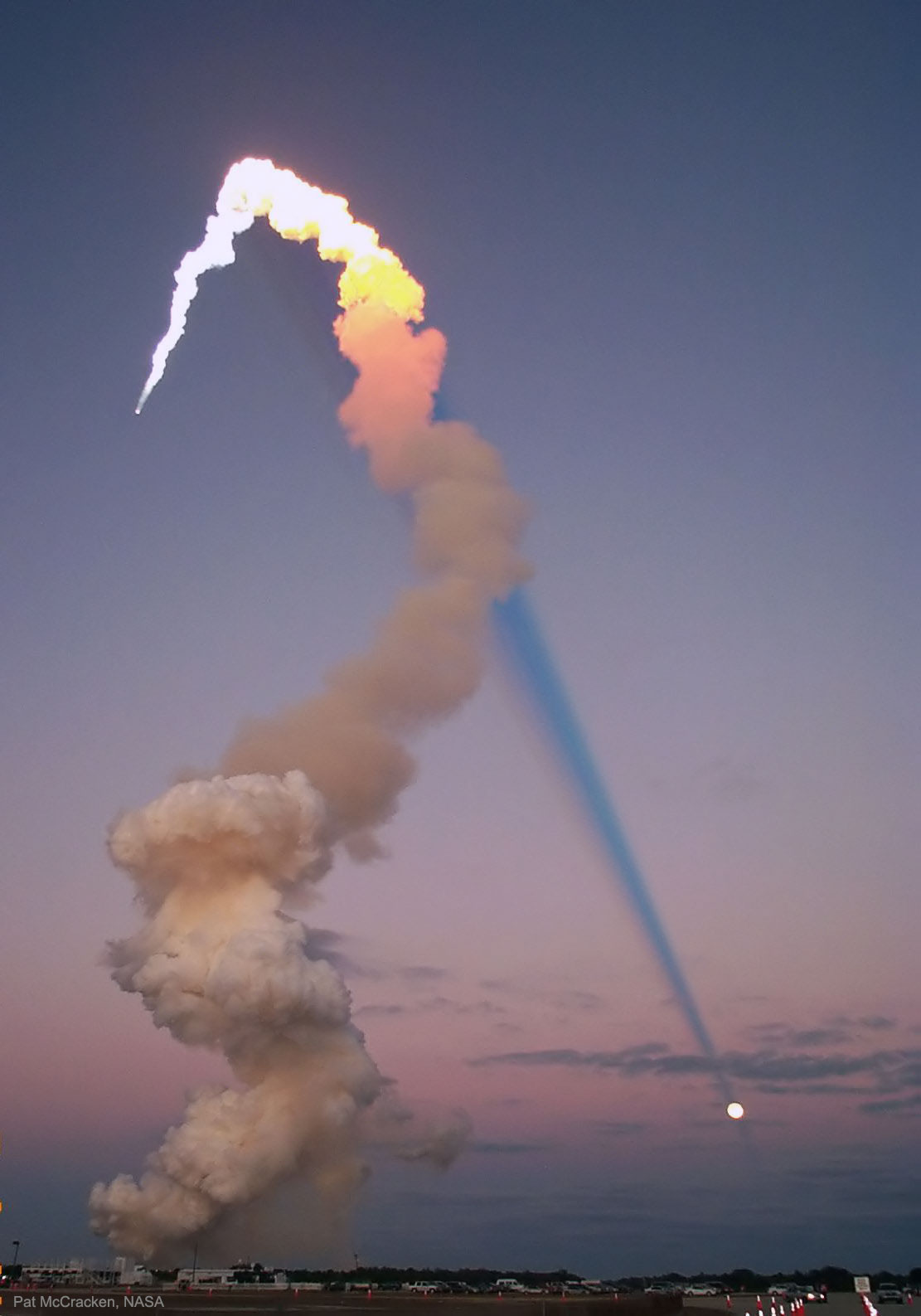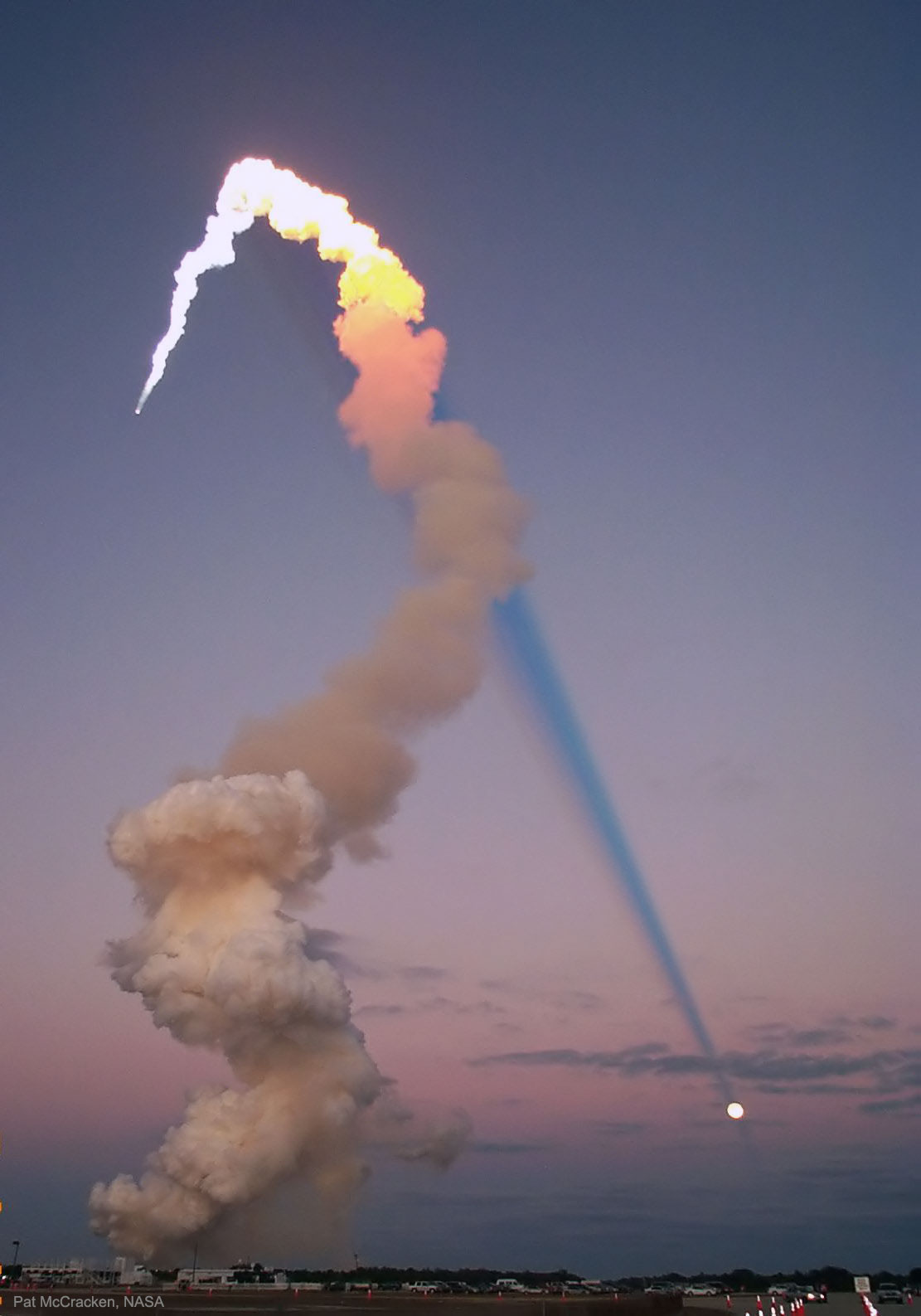
Why would the shadow of a space shuttle launch plume point toward the Moon? In early 2001 during a launch of Atlantis, the Sun, Earth, Moon, and rocket were all properly aligned for this photogenic coincidence. First, for the space shuttle's plume to cast a long shadow, the time of day must be either near sunrise or sunset. Only then will the shadow be its longest and extend all the way to the horizon. Finally, during a Full Moon, the Sun and Moon are on opposite sides of the sky. Just after sunset, for example, the Sun is slightly below the horizon, and, in the other direction, the Moon is slightly above the horizon. Therefore, as Atlantis blasted off, just after sunset, its shadow projected away from the Sun toward the opposite horizon, where the Full Moon just happened to be.
¿Por qué la sombra del penacho de lanzamiento de un transbordador espacial apuntaría hacia la Luna? A principios de 2001, durante un lanzamiento del Atlantis, el Sol, la Tierra, la Luna y el cohete estaban perfectamente alineados para esta fotogénica coincidencia. En primer lugar, para que el penacho del transbordador espacial proyecte una sombra larga, el momento del día debe ser cercano al amanecer o al atardecer. Solo entonces la sombra alcanza su mayor longitud y se extiende hasta el horizonte. Por último, durante la Luna llena, el Sol y la Luna se encuentran en lados opuestos del cielo. Justo después del atardecer, por ejemplo, el Sol está ligeramente por debajo del horizonte y, en la dirección opuesta, la Luna se encuentra ligeramente por encima. Por ello, cuando el Atlantis despegó justo después del atardecer, su sombra se proyectó en dirección contraria al Sol, hacia el horizonte opuesto, donde precisamente se encontraba la Luna llena.