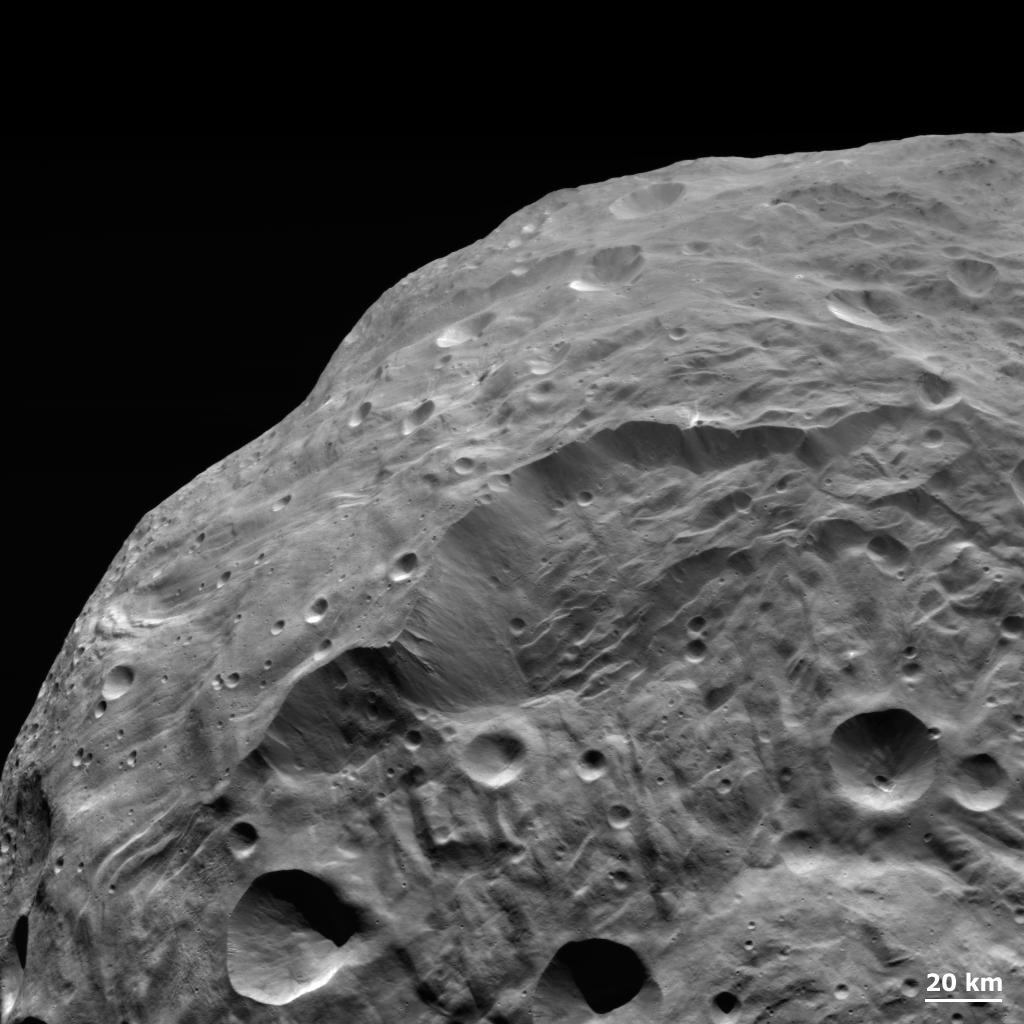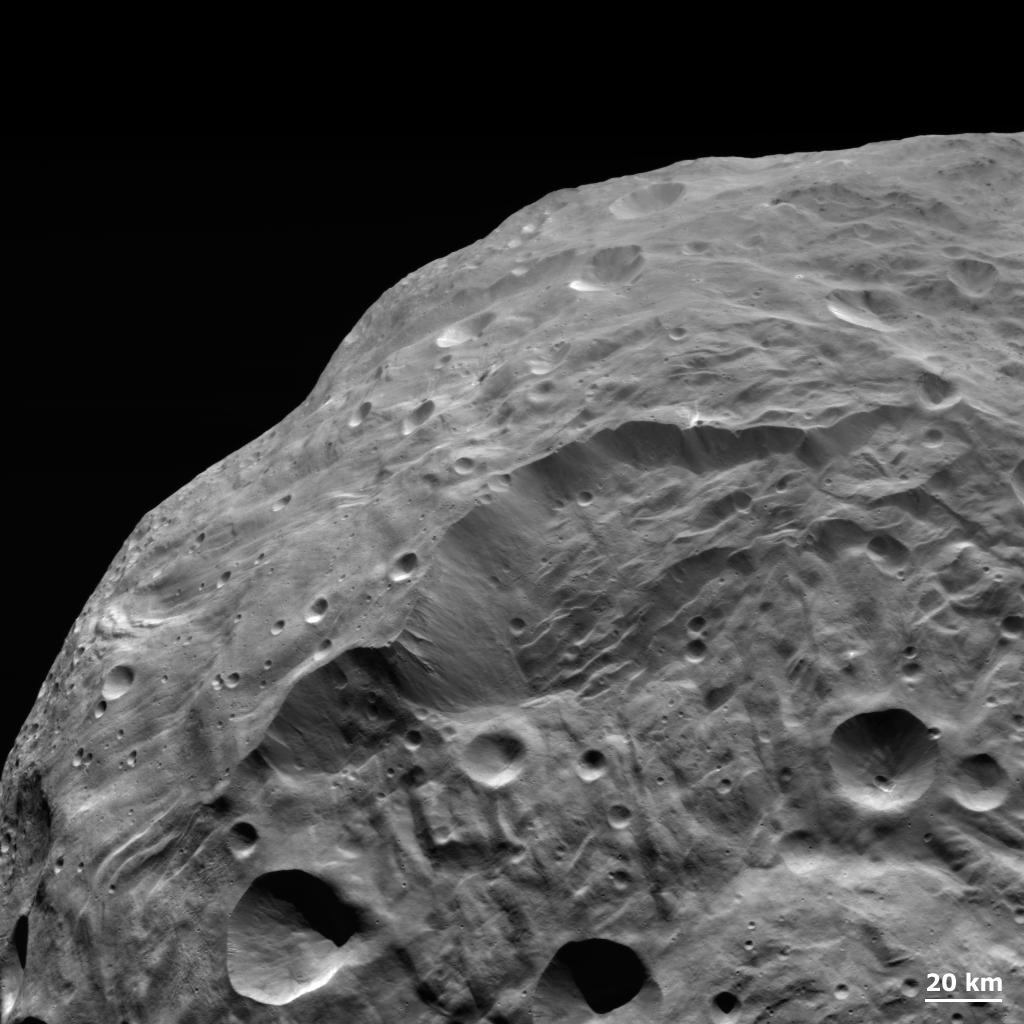
Asteroid Vesta is home to some of the most impressive cliffs in the Solar System. Pictured above near the image center is a very deep cliff running about 20 kilometers from top to bottom. The image was taken by the robotic Dawn spacecraft that began orbiting the 500-kilometer space rock earlier this year. The topography of the scarp and its surroundings indicates that huge landslides may have occurred down this slope. The scarp's origin remains unknown, but parts of the cliff face itself must be quite old as several craters have appeared in it since it was created. Dawn has now finished up its high altitude mapping survey and will spiral down to a lower altitude orbit to better explore the asteroid's gravitational field. During 2012, Dawn is scheduled to blast away from Vesta and begin a long journey to the only asteroid belt object known to be larger: Ceres.
El asteroide Vesta alberga algunos de los acantilados más impresionantes del Sistema Solar. En el centro de la imagen se puede apreciar un profundo acantilado que se extiende aproximadamente 20 kilómetros de arriba abajo. La imagen fue tomada por la sonda robótica Dawn, que comenzó a orbitar esta roca espacial de 500 kilómetros de diámetro a principios de este año. La topografía del escarpe y sus alrededores indica que podrían haber ocurrido enormes deslizamientos de tierra a lo largo de esta pendiente. El origen del escarpe sigue siendo desconocido, aunque algunas partes de la pared del acantilado deben ser bastante antiguas, ya que varios cráteres han aparecido en ella desde su formación. Dawn ha concluido su campaña de mapeo a gran altitud y descenderá en espiral hacia una órbita más baja para explorar con mayor detalle el campo gravitacional del asteroide. Durante 2012, está previsto que Dawn abandone Vesta e inicie un largo viaje hacia el único objeto del cinturón de asteroides conocido por ser de mayor tamaño: Ceres.