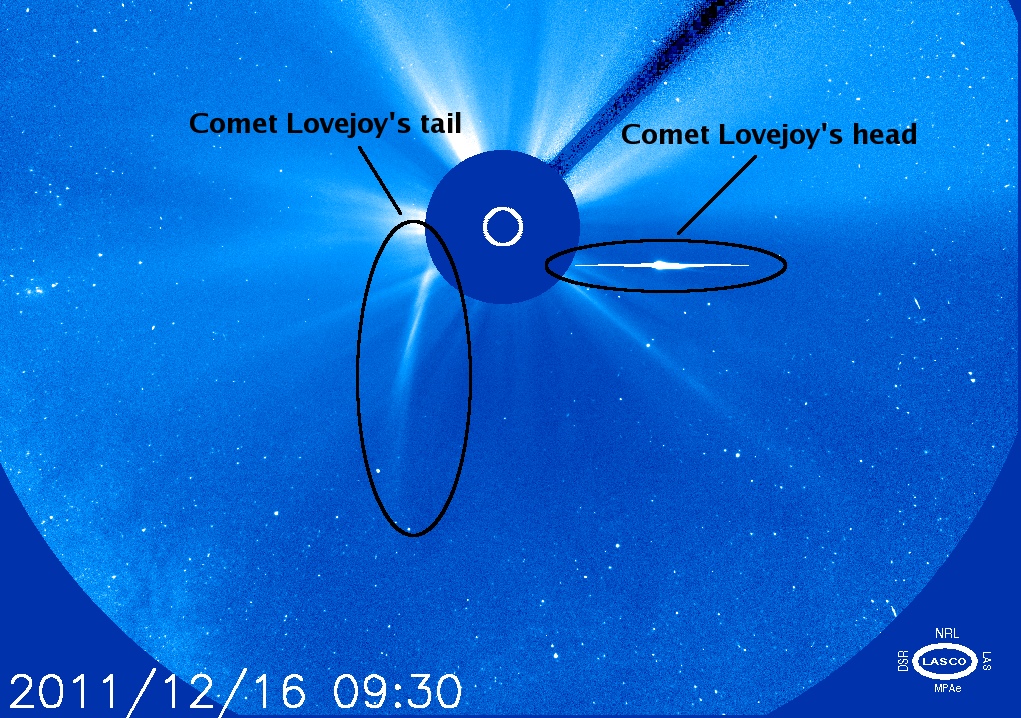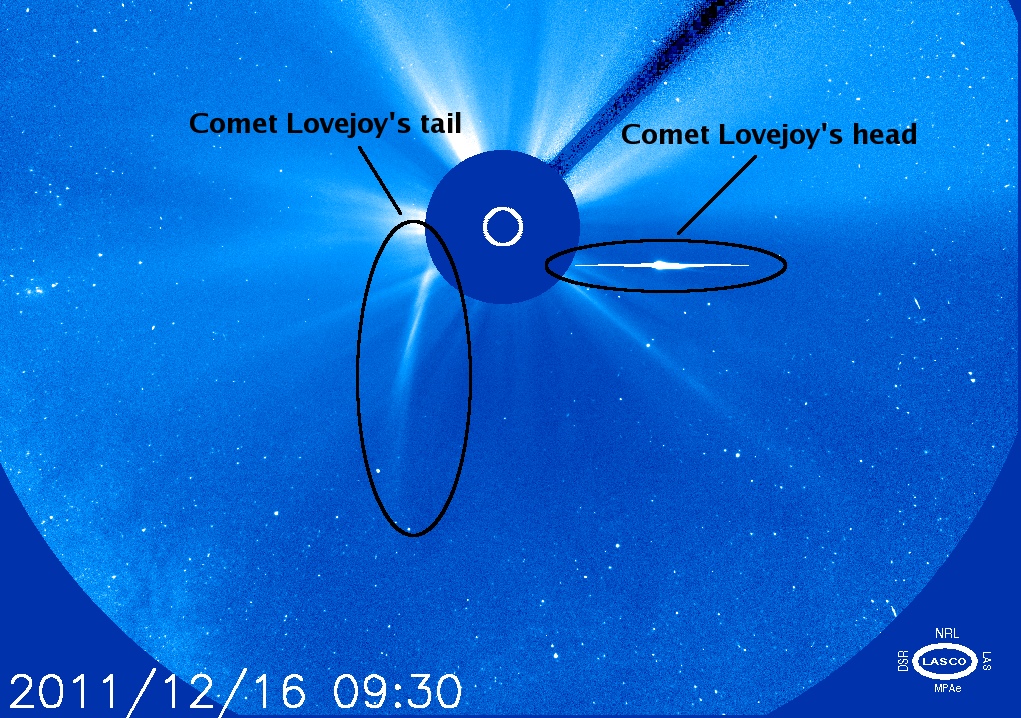
Like most other sungrazing comets, Comet Lovejoy (C/2011 W3) was not expected to survive its close encounter with the Sun. But it did. This image from a coronograph onboard the sun-staring SOHO spacecraft identifies the still inbound remnants of the tail, with the brilliant head or coma emerging from the solar glare on December 16. The Sun's position, behind an occulting disk to block the overwhelming glare, is indicated by the white circle. Separated from its tail, Comet Lovejoy's coma is so bright it saturates the camera's pixels creating the horizontal streaks. Based on their orbits, sungrazer comets are thought to belong to the Kreutz family of comets, created by successive break ups from a single large parent comet that passed very near the Sun in the twelfth century. Most have been discovered with SOHO's cameras, but unlike many sungrazers, this one was first spotted by Australian astronomer Terry Lovejoy from an earth-based observatory. Comet Lovejoy is estimated to have come within 120,000 kilometers of the Sun's surface and likely had a large cometary nucleus to have survived its intense perihelion passage. Remarkable videos of the encounter from the Solar Dynamics Observatory can be found here.
Como la mayoría de los cometas rasantes solares, no se esperaba que el Cometa Lovejoy (C/2011 W3) sobreviviera a su estrecho encuentro con el Sol. Sin embargo, lo hizo. Esta imagen, obtenida por un coronógrafo a bordo de la nave espacial SOHO —dedicada a la observación solar—, muestra los restos aún en trayectoria de entrada de la cola, con la brillante cabeza o coma emergiendo del resplandor solar el 16 de diciembre. La posición del Sol, oculta tras un disco ocultador para bloquear su abrumador brillo, está indicada por el círculo blanco. Separada de su cola, la coma del Cometa Lovejoy es tan brillante que satura los píxeles de la cámara, generando las líneas horizontales visibles en la imagen. Según sus órbitas, se cree que los cometas rasantes solares pertenecen a la familia Kreutz, originada por sucesivas fragmentaciones de un único cometa progenitor de gran tamaño que pasó muy cerca del Sol en el siglo XII. La mayoría han sido descubiertos por las cámaras del SOHO, pero a diferencia de muchos cometas rasantes, este fue avistado por primera vez por el astrónomo australiano Terry Lovejoy desde un observatorio terrestre. Se estima que el Cometa Lovejoy se aproximó a unos 120.000 kilómetros de la superficie solar y es probable que contara con un núcleo cometario de gran tamaño para haber sobrevivido a su intenso paso por el perihelio. Notables vídeos del encuentro, obtenidos por el Observatorio de Dinámica Solar (SDO), están disponibles en línea.