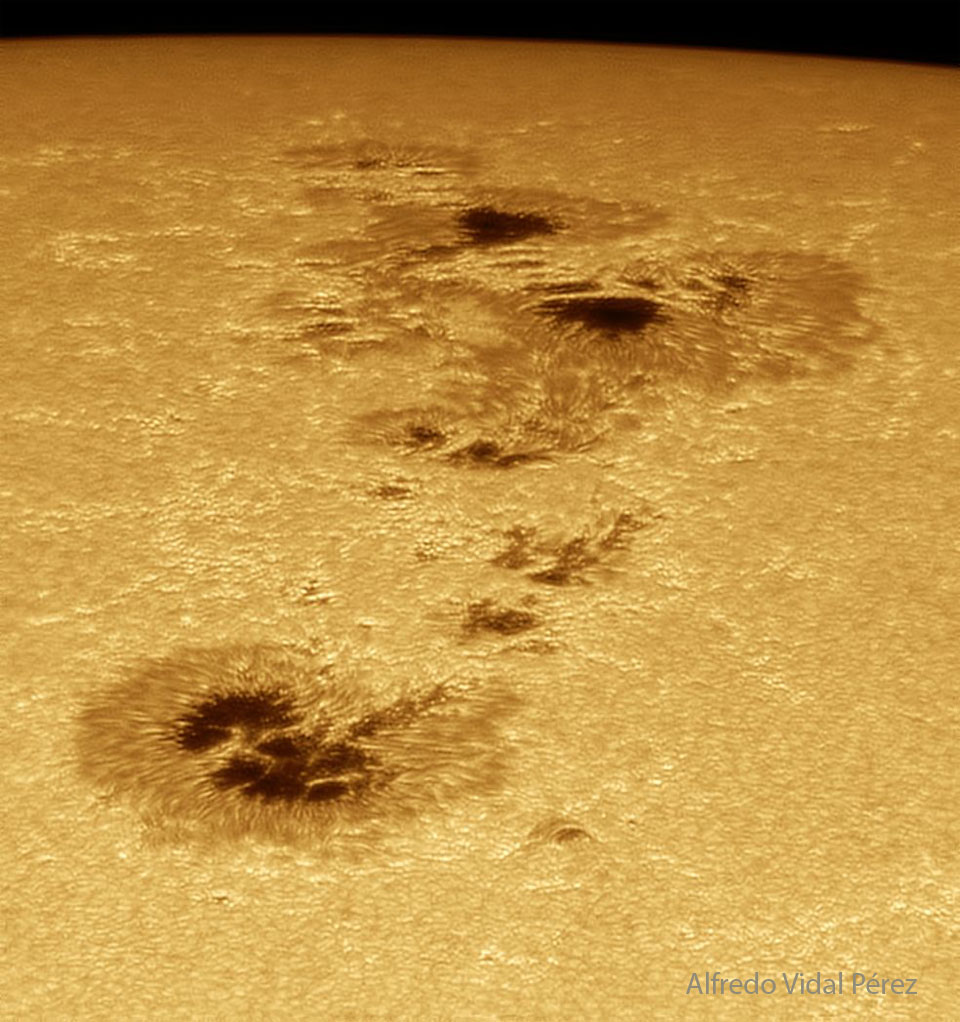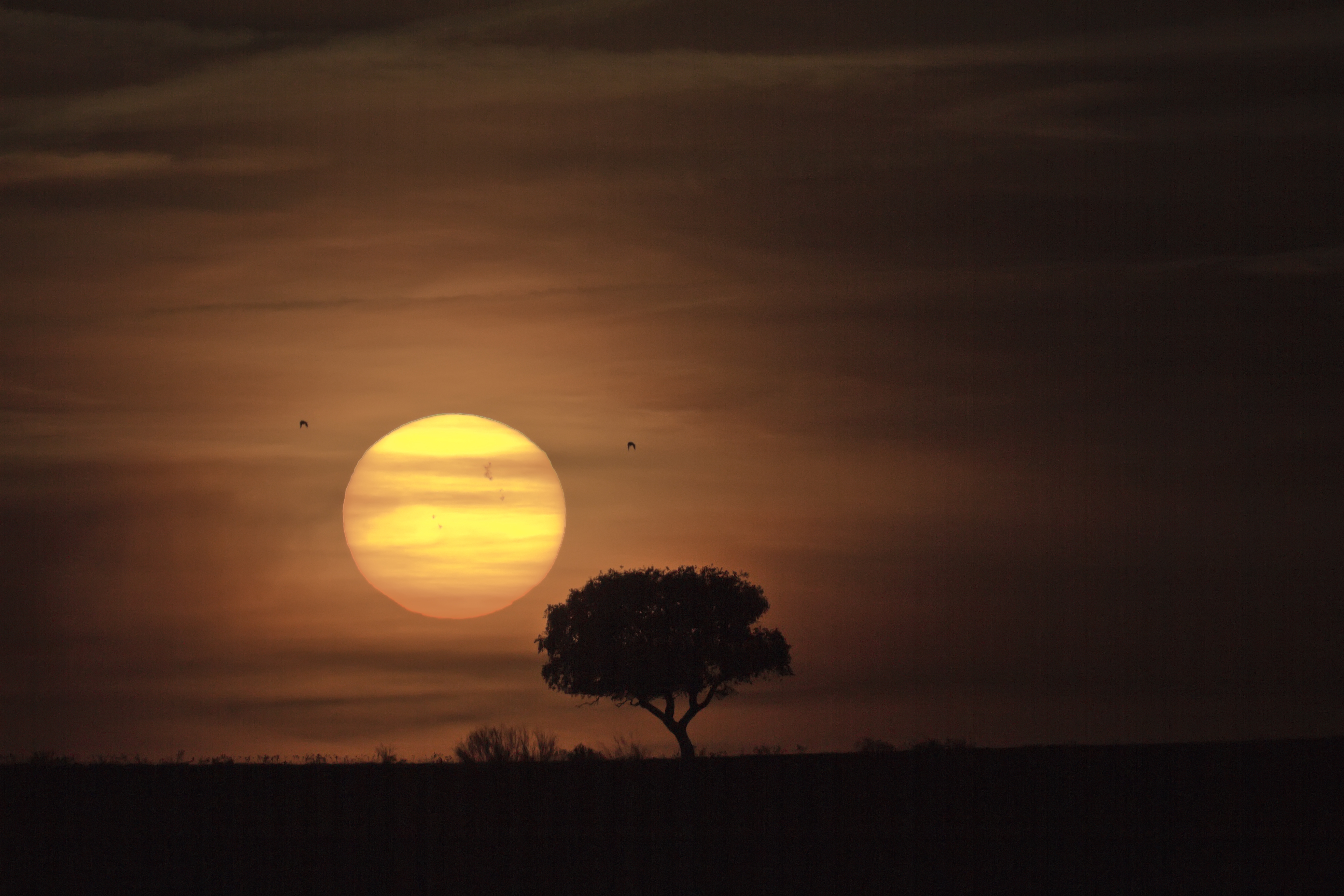
What's that on the Sun? Over the past two weeks, one of the most energetic sunspot regions of recent years crossed the face of the Sun. Active Region 1429, visible above as the group of dark spots on the Sun's upper right, blasted out several solar flares and coronal mass ejections since coming around the edge of the Sun almost a month ago. Fast moving particles from these solar explosions have impacted the Earth and been responsible for many colorful auroras seen over the past two weeks. The picturesque foreground features trees and birds near Merida, Spain, where the above image was taken about a week ago. Although AR 1429 has continued to rotate to the right and gone around the limb of the Sun -- as seen from the Earth -- monitoring of the region will be continued by one of the STEREO satellites, however, which is orbiting the Sun well ahead of the Earth.
Crédito: NASA, STEREO ¿Qué es eso en el Sol? Durante las últimas dos semanas, una de las regiones más activas con manchas solares de los últimos años cruzó la cara del Sol. La Región Activa 1429, visible en la imagen superior como el grupo de manchas oscuras en la parte superior derecha del Sol, ha emitido varios destellos solares y eyecciones de masa coronal desde que apareció al borde del Sol casi un mes atrás. Las partículas de alta velocidad provenientes de estas explosiones solares han impactado la Tierra y han sido responsables de muchas auroras coloridas vistas durante las últimas dos semanas. Las características del primer plano, de apariencia pintoresca, incluyen árboles y aves cerca de Mérida, España, donde se tomó la imagen superior hace aproximadamente una semana. Aunque la RA 1429 ha continuado rotando hacia la derecha y ha desaparecido por el borde del Sol —como se ve desde la Tierra—, la región será monitoreada por uno de los satélites STEREO, que orbita el Sol bastante por delante de la Tierra.