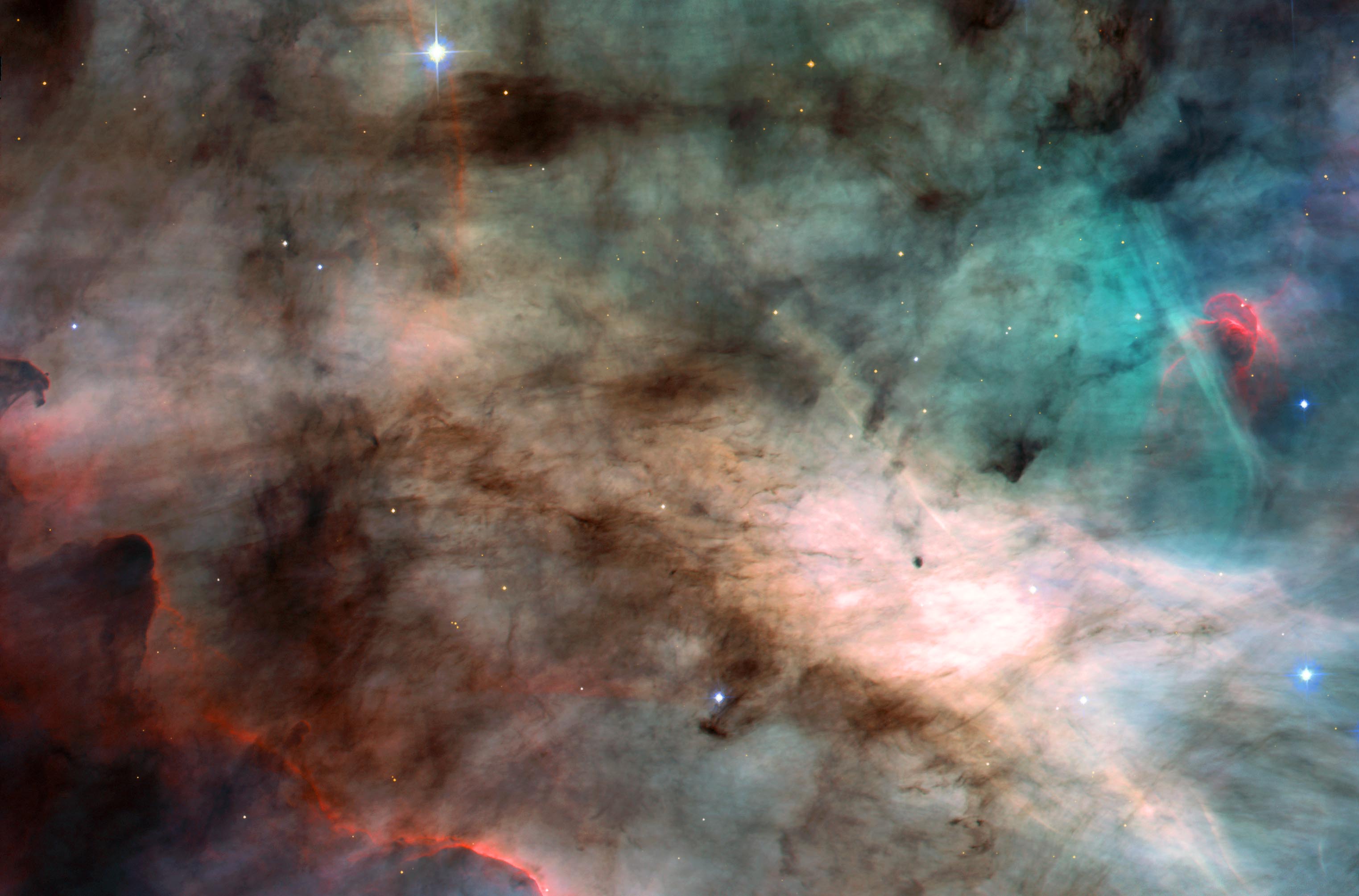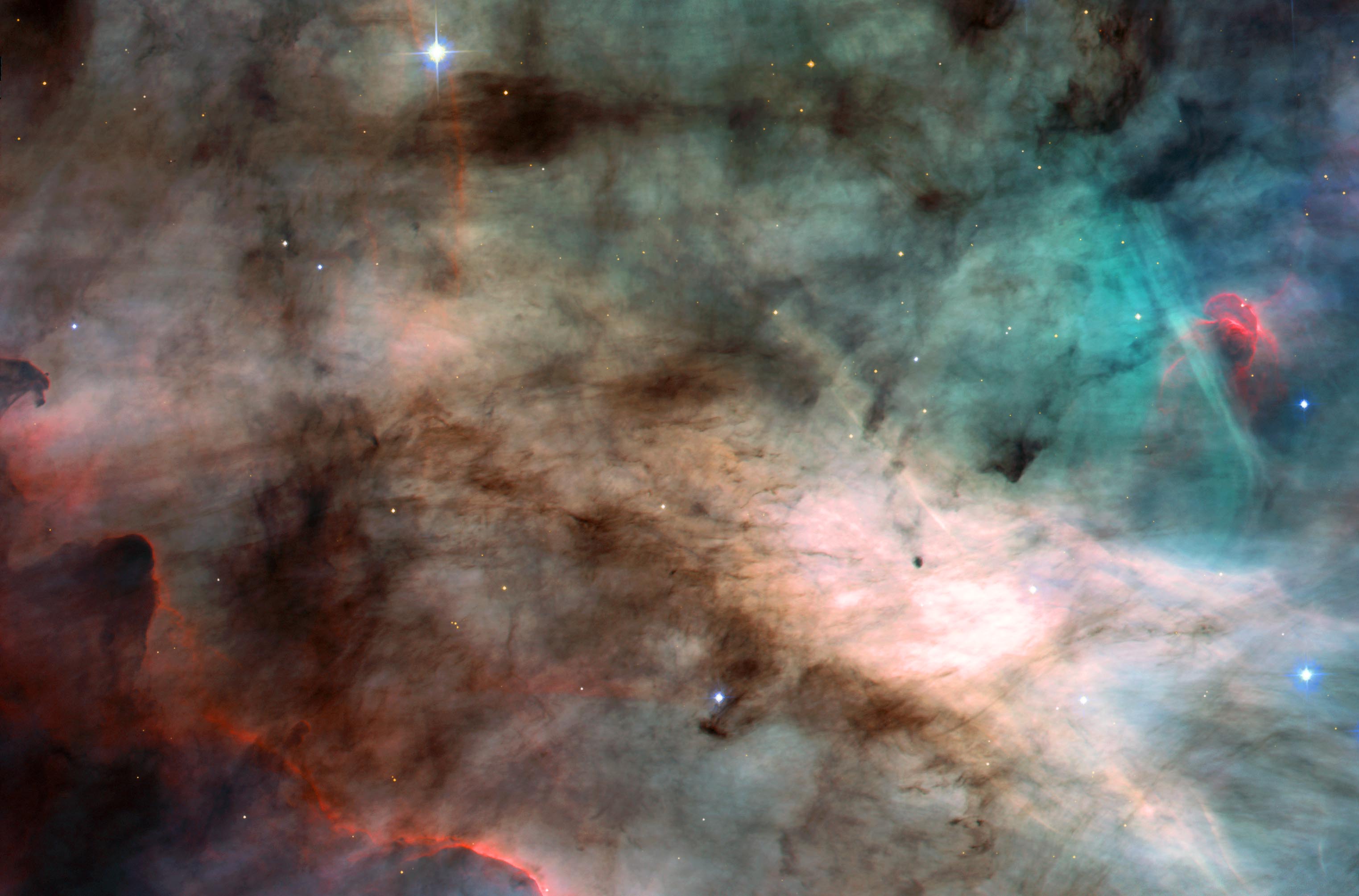
In the depths of the dark clouds of dust and molecular gas known as the Omega Nebula, stars continue to form. The above image from the Hubble Space Telescope's Advanced Camera for Surveys shows exquisite detail in the famous star-forming region. The dark dust filaments that lace the center of Omega Nebula were created in the atmospheres of cool giant stars and in the debris from supernova explosions. The red and blue hues arise from glowing gas heated by the radiation of massive nearby stars. The points of light are the young stars themselves, some brighter than 100 Suns. Dark globules mark even younger systems, clouds of gas and dust just now condensing to form stars and planets. The Omega Nebula lies about 5000 light years away toward the constellation of Sagittarius. The region shown spans about 3000 times the diameter of our Solar System. Gallery: Supermoon 2012
En las profundidades de las nubes oscuras de polvo y gas molecular conocidas como la Nebulosa Omega, las estrellas continúan formándose. La imagen superior obtenida por el Hubble Space Telescope con su Cámara Avanzada para Sondeos muestra detalles exquisitos en esta famosa región de formación estelar. Los filamentos oscuros de polvo que recorren el centro de la Nebulosa Omega se formaron en las atmósferas de estrellas gigantes frías y en los escombros de explosiones de supernovas. Los matices rojos y azules provienen de gas que brilla calentado por la radiación de estrellas masivas cercanas. Los puntos luminosos son las propias estrellas jóvenes, algunas más brillantes que 100 soles. Los globulos oscuros marcan sistemas aún más jóvenes, nubes de gas y polvo que ahora se condensan para formar estrellas y planetas. La Nebulosa Omega se encuentra a unos 5000 años luz en dirección a la constelación de Sagitario. La región mostrada tiene un tamaño aproximado 3000 veces el diámetro de nuestro sistema solar.