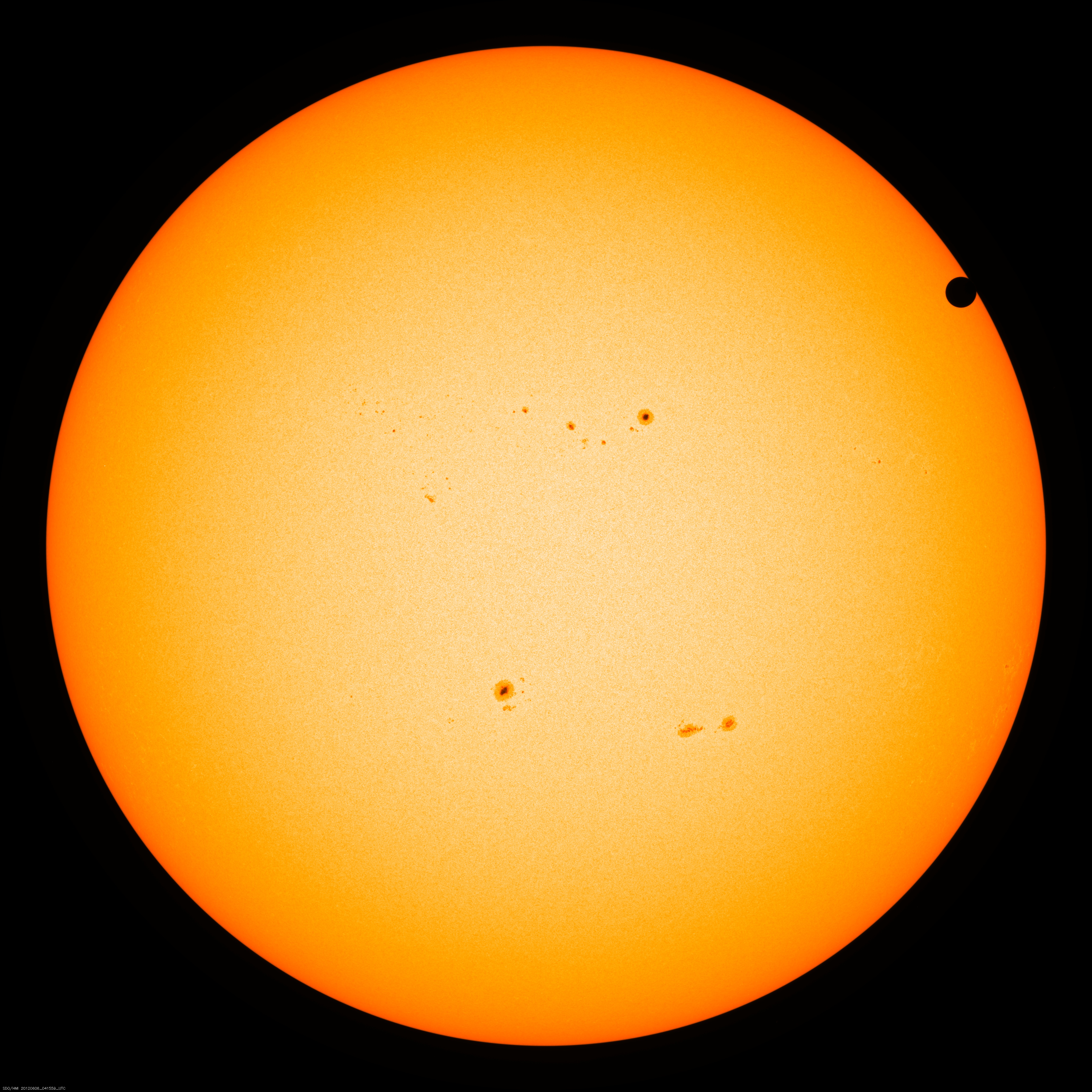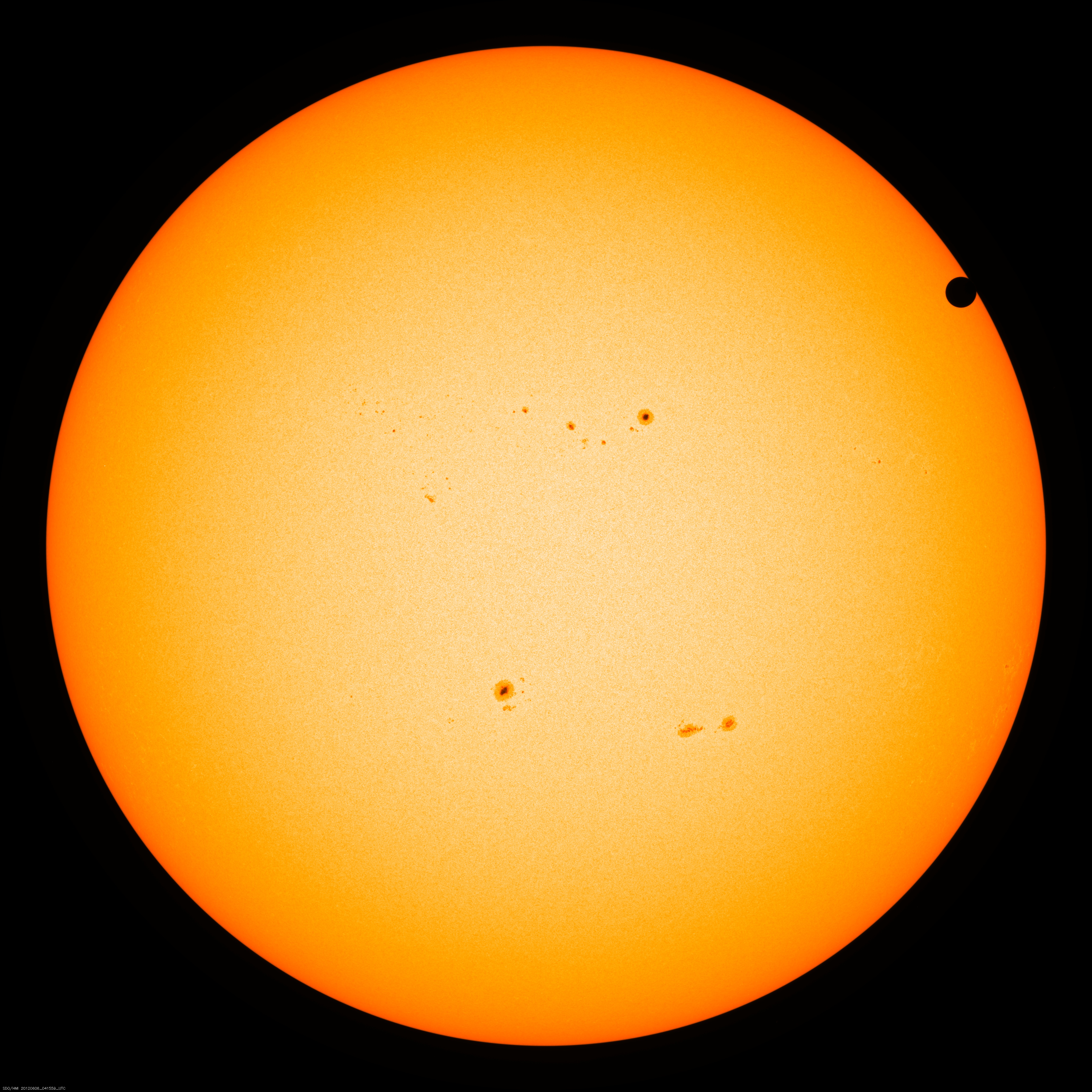
Today Venus moves in front of the Sun. One way to follow this rare event is to actively reload the above live image of the Sun during the right time interval and look for an unusual circular dark dot. The smaller sprawling dark areas are sunspots. The circular dot is the planet Venus. The dark dot will only appear during a few very specific hours, from about 22:10 on 2012 June 5 through 4:50 2012 June 6, Universal Time. This transit is the rarest type of solar eclipse known -- much more rare than an eclipse of the Sun by the Moon or even by the planet Mercury. In fact, the next transit of Venus across the Sun will be in 2117. Anyone with a clear view of the Sun can go outside and carefully view the transit for themselves by projecting sunlight through a hole in a card onto a wall. Because this Venus transit is so unusual and visible from so much of the Earth, it is expected to be one of the more photographed celestial events in history. The above live image on the Sun is being taken by the Earth-orbiting Solar Dynamics Observatory and can be updated about every 15 minutes. Editor's note: Since the transit has ended, the live image was replaced by one taken just before Venus crossed out of Sun. Gallery: Browse the latest Venus transit images
Hoy Venus se mueve frente al Sol. Una forma de seguir este evento raro es recargar activamente la imagen en directo del Sol mostrada arriba durante el intervalo de tiempo correcto y buscar un punto oscuro circular inusual. Las áreas oscuras más grandes son manchas solares. El punto circular es el planeta Venus. El punto oscuro solo aparecerá durante unas pocas horas muy específicas, desde aproximadamente las 22:10 del 5 de junio de 2012 hasta las 4:50 del 6 de junio de 2012, hora universal. Este tránsito es el tipo más raro de eclipse solar conocido, mucho más raro que un eclipse del Sol por la Luna o incluso por el planeta Mercurio. De hecho, el próximo tránsito de Venus a través del Sol será en 2117. Cualquiera que tenga una vista clara del Sol puede salir al exterior y observar cuidadosamente el tránsito por sí mismo proyectando la luz solar a través de un agujero en una tarjeta sobre una pared. Debido a que este tránsito de Venus es tan inusual y visible desde tanta parte de la Tierra, se espera que sea uno de los eventos celestes más fotografiados en la historia. La imagen en directo del Sol mostrada arriba es capturada por la nave espacial Solar Dynamics Observatory en órbita terrestre y se actualiza aproximadamente cada 15 minutos. Nota del editor: Dado que el tránsito ha terminado, la imagen en directo ha sido reemplazada por una tomada justo antes de que Venus saliera del Sol.