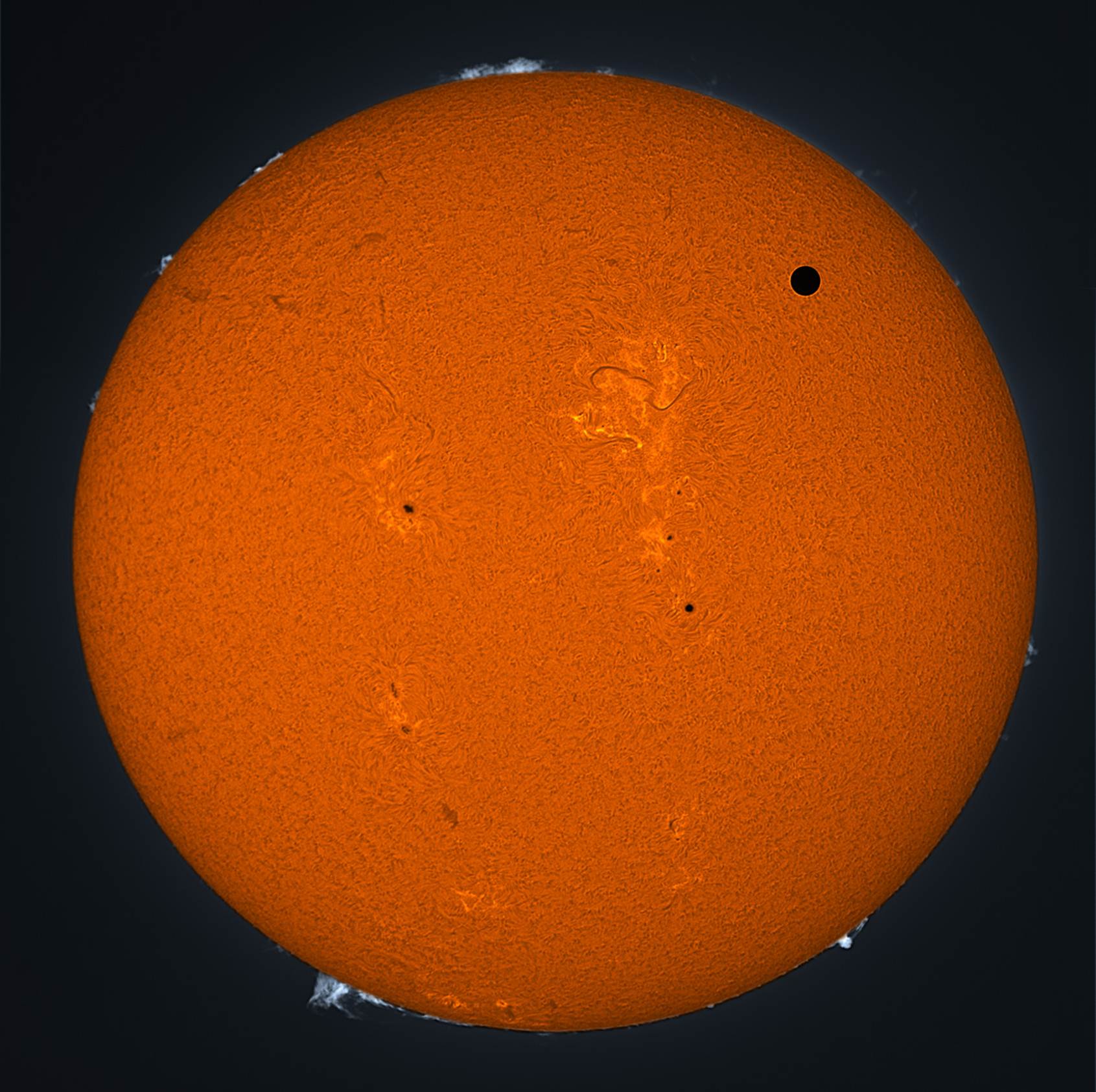
Occurring in pairs separated by over a hundred years, there have now been only eight transits of Venus since the invention of the telescope in 1608. The next will be in December of 2117. But many modern telescopes and cameras were trained on this week's Venus transit, capturing the planet in rare silhouette against the Sun. In this sharp telescopic view from Georgia, USA, a narrowband H-alpha filter was used to show the round planetary disk against a mottled solar surface with dark filaments, sunspots, and prominences. The transit itself lasted for 6 hours and 40 minutes. Historically, astronomers used timings of the transit from different locations to triangulate the distance to Venus, while modern astronomers actively search for planets that transit distant suns.
Ocurren en pares separados por más de cien años, y desde la invención del telescopio en 1608, solo han ocurrido ocho tránsitos de Venus. El siguiente será en diciembre de 2117. Pero muchos telescopios y cámaras modernos estuvieron enfocados en el tránsito de Venus esta semana, capturando al planeta en rara silueta contra el Sol. En esta nítida imagen telescopiada desde Georgia, Estados Unidos, se utilizó un filtro estrecho de H-alfa para mostrar el disco planetario redondo contra una superficie solar moteada con filamentos oscuros, manchas solares y prominencias. El tránsito mismo duró 6 horas y 40 minutos. Históricamente, los astrónomos usaron los tiempos del tránsito desde diferentes ubicaciones para triangular la distancia a Venus, mientras que los astrónomos modernos buscan activamente planetas que trasciendan soles distantes.