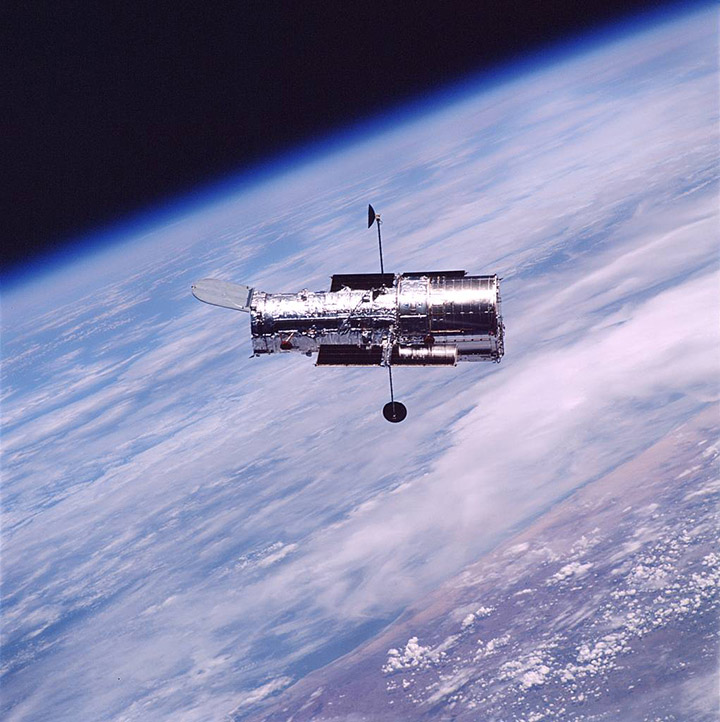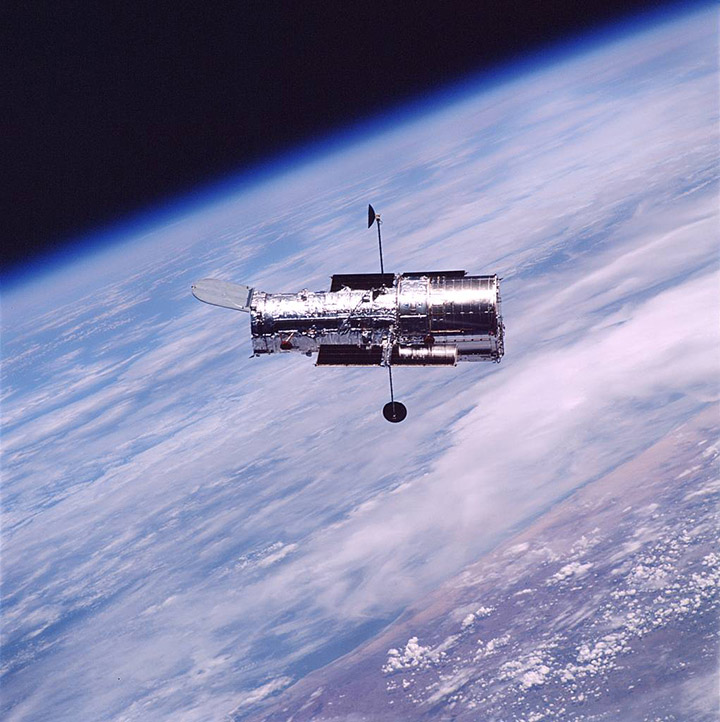
What if you were given a new Hubble telescope for free? How about two? The astronomical community is abuzz with just this opportunity as the US National Reconnaissance Office has unexpectedly transferred ownership of two space-qualified Hubble-quality telescopes to NASA. The usefulness of these telescopes in addressing existing science priorities has begun, but preliminary indications hold that even one of these telescope could be extremely useful in searching for extrasolar planets as well as distant galaxies and supernovas that could better explore the nature of dark energy. Although they start out as free, making even one telescope operational and fitting it with useful cameras would be quite expensive, so NASA is being decidedly careful about how to fit these new telescopes into its existing budget. Pictured above, the original Hubble Space Telescope floats high above the Earth during a servicing mission in 2002. Prefer Spanish?: Follow APOD's new Facebook feed "Universo"
¿Y si se le diera un nuevo telescopio Hubble gratis? ¿O dos? La comunidad astronómica está muy interesada en esta oportunidad, ya que la Oficina Nacional de Reconocimiento de EE. UU. ha transferido inesperadamente la propiedad de dos telescopios espaciales calificados de calidad Hubble a NASA. La utilidad de estos telescopios para abordar prioridades científicas existentes ha comenzado, pero las indicaciones preliminares sugieren que incluso uno de estos telescopios podría ser extremadamente útil para buscar planetas extrasolares, así como galaxias y supernovas distantes que podrían explorar mejor la naturaleza de la energía oscura. Aunque comienzan siendo gratuitos, hacer operativo incluso un telescopio y equiparlo con cámaras útiles sería bastante costoso, por lo que NASA está siendo decididamente cuidadosa sobre cómo integrar estos nuevos telescopios en su presupuesto actual. En la imagen de arriba, el telescopio espacial original Hubble flota a gran altura sobre la Tierra durante una misión de mantenimiento en 2002.