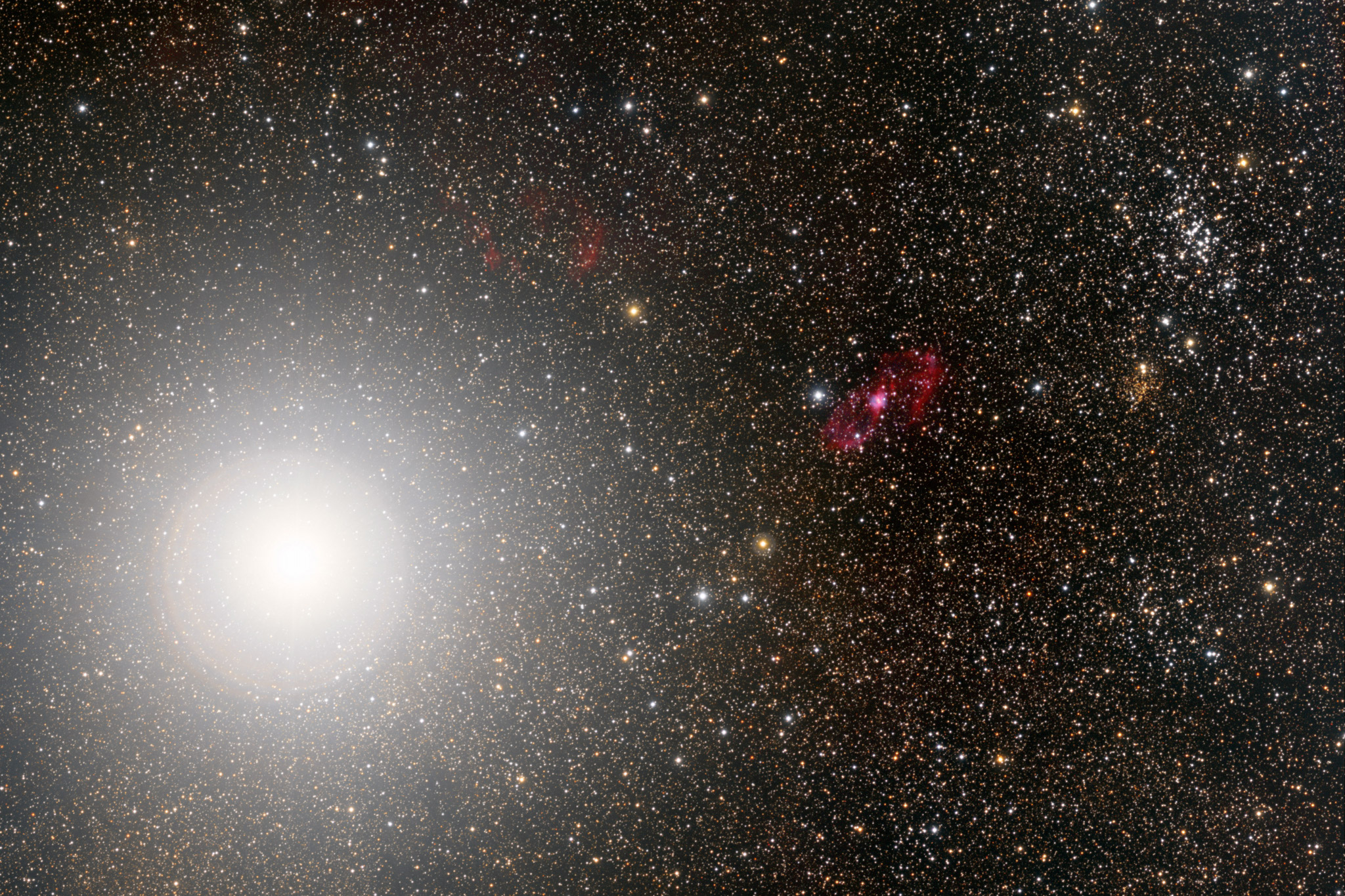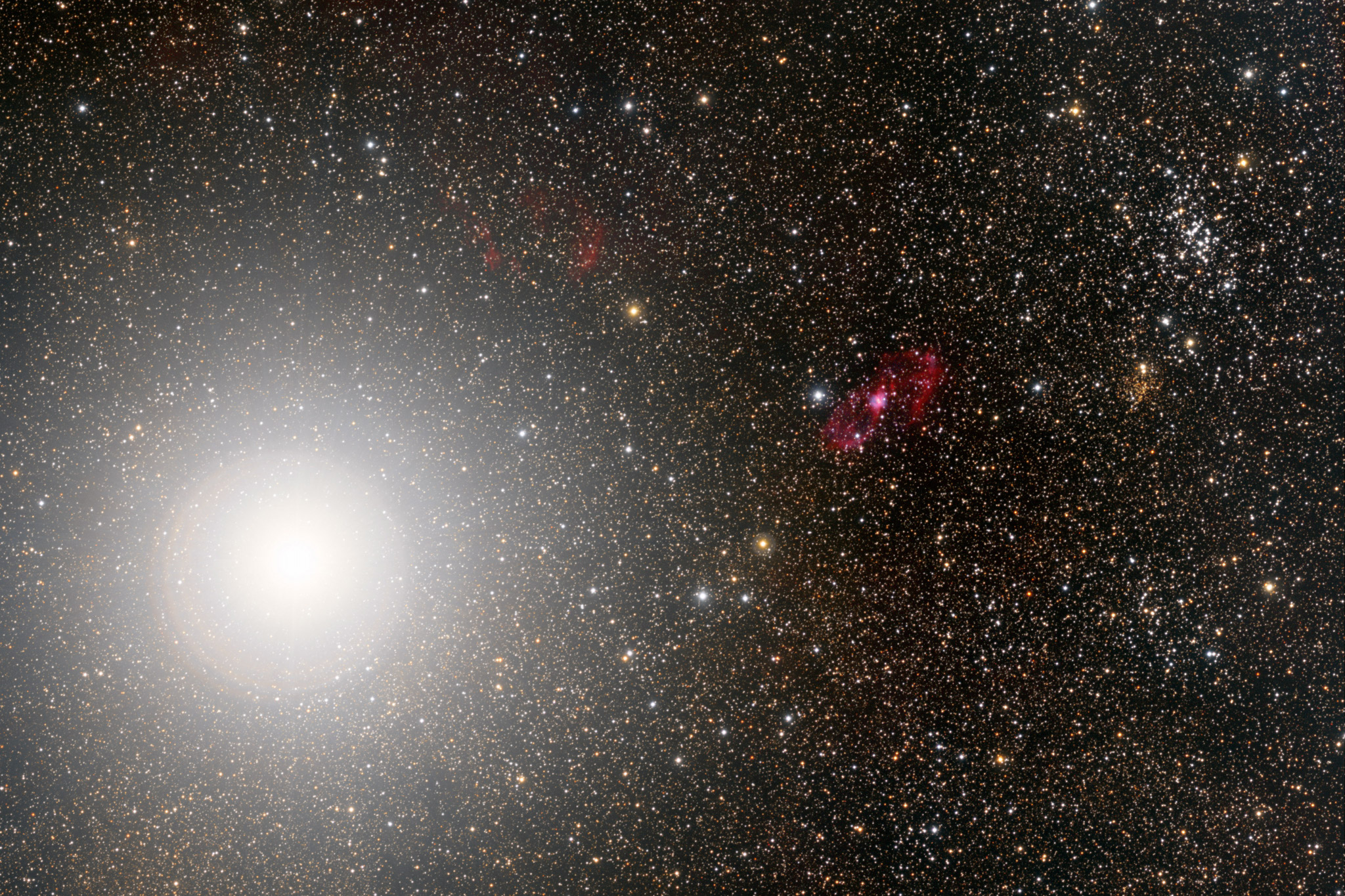
The glare of Alpha Centauri, one of the brightest stars in planet Earth's night sky, floods the left side of this southern skyscape. A mere 4.3 light-years distant, Alpha Centauri actually consists of two component stars similar in size to the Sun, locked in a mutual orbit. Much smaller and cooler, a third member of the same star system, Proxima Centauri, lies outside this field of view. Still, the telescopic scene does reveal often overlooked denizens of the Milky Way's crowded galactic plane that lie beyond the glare of Alpha Centauri, including a planetary nebula cataloged as Hen 2-111, an estimated 7,800 light-years away. The gaseous shroud of a dying star, the nebula's brighter core and fainter halo of reddish ionized gas span over twenty light-years, seen just right of picture center. Farther right are two notable open clusters of stars, the compact Pismis 19 also nearly 8,000 light-years away whose light is reddened by intervening dust, and the looser, closer NGC 5617. Just visible in the glare of Alpha Centauri is the dim glow of a shell-like supernova remnant, above and right of the closest star system's bright core.
La luz de Alpha Centauri, una de las estrellas más brillantes en el cielo nocturno de la Tierra, inunda el lado izquierdo de esta escena del cielo austral. A tan solo 4,3 años luz de distancia, Alpha Centauri consta en realidad de dos estrellas componentes similares en tamaño al Sol, que orbitan mutuamente. Más pequeña y fría, un tercer miembro del mismo sistema estelar, Proxima Centauri, se encuentra fuera de este campo de visión. Sin embargo, la escena captada con telescopio revela habitantes a menudo ignorados de la densa línea galáctica de la Vía Láctea que se extienden más allá de la luz de Alpha Centauri, incluyendo una nebulosa planetaria catalogada como Hen 2-111, estimada a unos 7.800 años luz de distancia. La envoltura gaseosa de una estrella moribunda, el núcleo más brillante y el halo más tenue de gas ionizado de color rojizo abarcan más de veinte años luz, visibles justo a la derecha del centro de la imagen. Más a la derecha se encuentran dos notables cúmulos abiertos de estrellas, el compacto Pismis 19, también a casi 8.000 años luz de distancia, cuya luz está enrojecida por el polvo intermedio, y el más cercano y disperso NGC 5617. Justo visible en la luz de Alpha Centauri, se encuentra el tenue brillo de un remanente de supernova en forma de capa, ubicado arriba y a la derecha del núcleo brillante del sistema estelar más cercano.