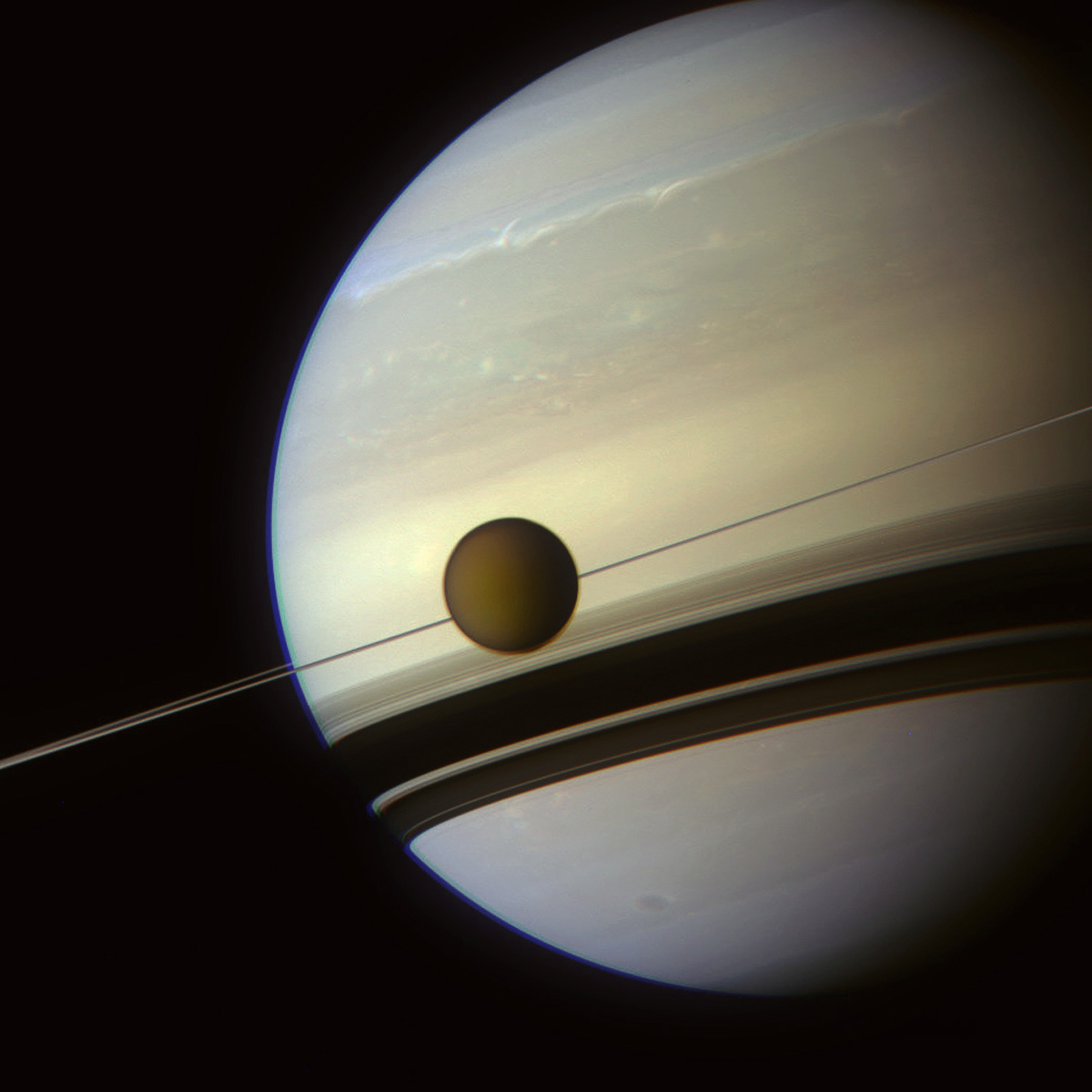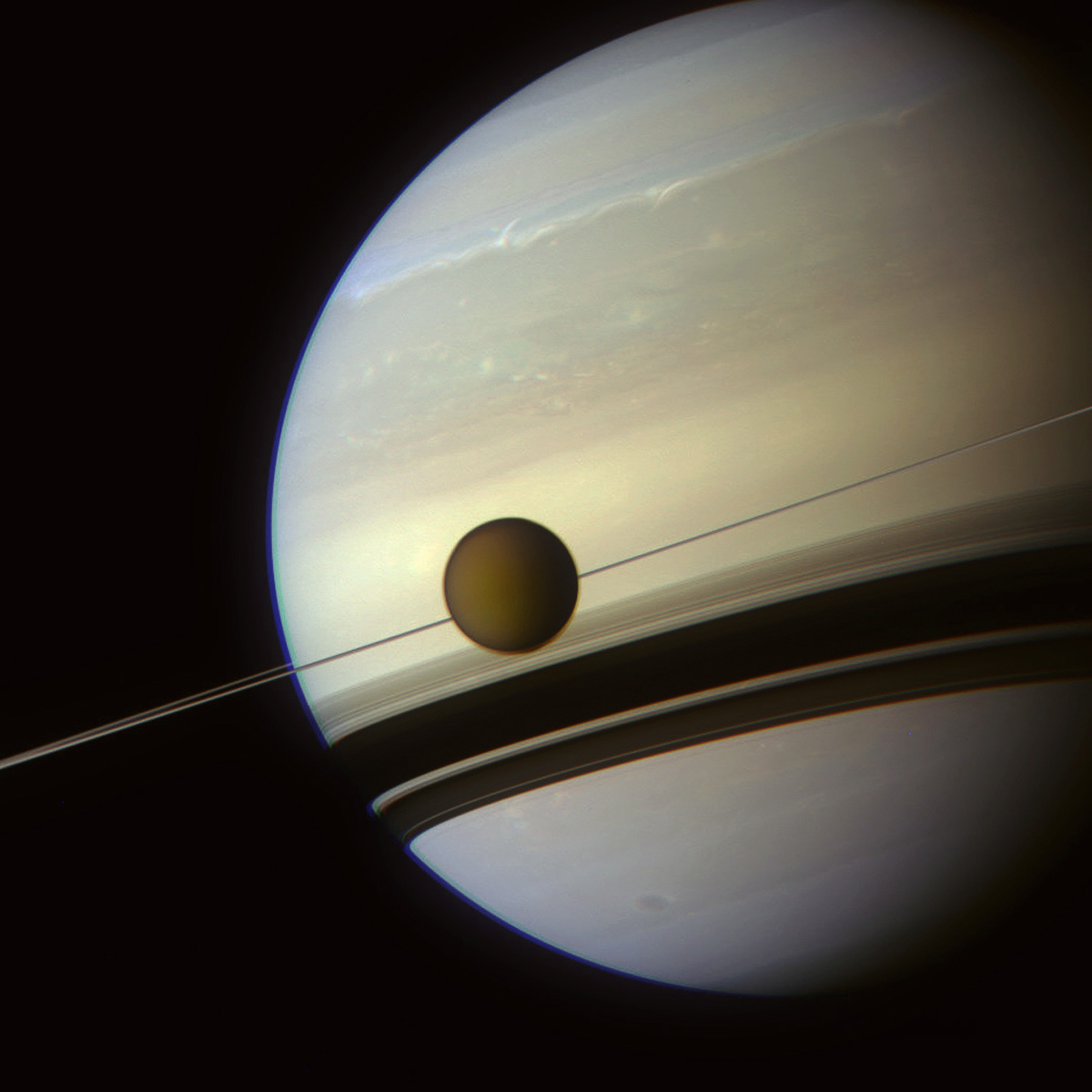
Humanity's robot orbiting Saturn has recorded yet another amazing view. That robot, of course, is the spacecraft Cassini, while the new amazing view includes a bright moon, thin rings, oddly broken clouds, and warped shadows. Titan, Saturn's largest moon, appears above as a featureless tan as it is continually shrouded in thick clouds. The rings of Saturn are seen as a thin line because they are so flat and imaged nearly edge on. Details of Saturn's rings are therefore best visible in the dark ring shadows seen across the giant planet's cloud tops. Since the ring particles orbit in the same plane as Titan, they appear to skewer the foreground moon. In the upper hemisphere of Saturn, the clouds show many details, including dips in long bright bands indicating disturbances in a high altitude jet stream. Recent precise measurements of how much Titan flexes as it orbits Saturn hint that vast oceans of water might exist deep underground. APOD in Spanish: On the web and through Facebook
Crédito: NASA, ESA, JPL, Space Science Institute La nave robot de la humanidad que orbita Saturno ha registrado otra vista asombrosa. Esa nave, por supuesto, es la nave espacial Cassini, mientras que la nueva vista asombrosa incluye una luna brillante, anillos delgados, nubes extrañamente rotas y sombras distorsionadas. Titán, la luna más grande de Saturno, aparece arriba como una mancha marrón sin características, ya que está constantemente cubierta por nubes espesas. Los anillos de Saturno se ven como una línea delgada porque son muy planos y se han fotografiado casi de perfil. Por lo tanto, los detalles de los anillos de Saturno son más visibles en las sombras oscuros de los anillos que se proyectan sobre las nubes de la cima del planeta gigante. Dado que las partículas de los anillos orbitan en el mismo plano que Titán, parecen atravesar la luna del primer plano. En el hemisferio superior de Saturno, las nubes muestran muchos detalles, incluyendo depresiones en bandas brillantes largas que indican disturbios en una corriente de chorro de alta altitud. Recientes mediciones precisas de cuánto se flexiona Titán mientras orbita Saturno sugieren que podrían existir vastos océanos de agua bajo tierra.