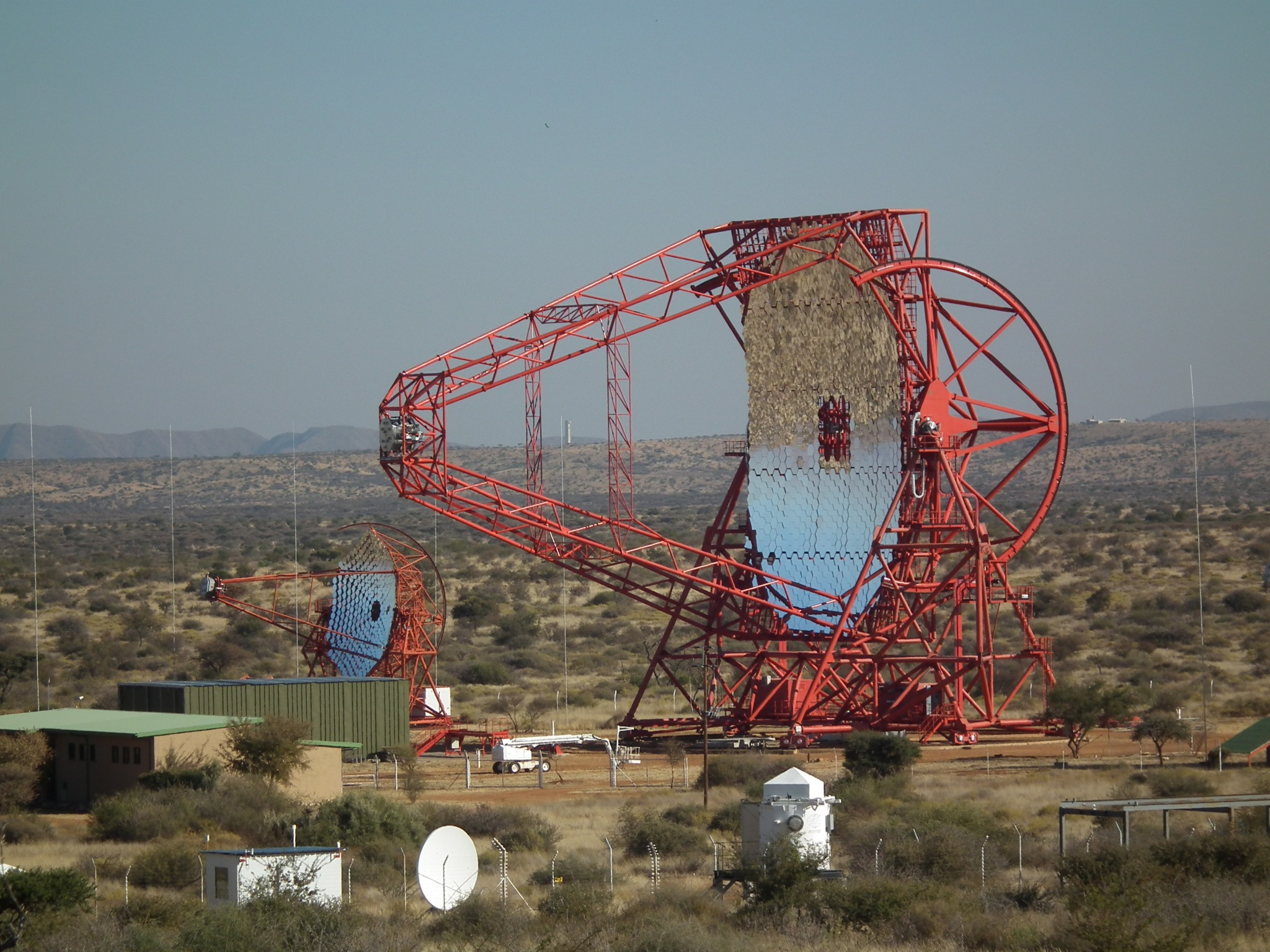
The largest of its kind, the High Energy Stereoscopic System (H.E.S.S.) II telescope stands in the foreground of this photo. Tilted horizontally it reflects the inverted landscape of the Namibian desert in a segmented mirror 24 meters wide and 32 meters tall, equal in area to two tennis courts. Now beginning an exploration of the Universe at extreme energies, H.E.S.S. II saw first light on July 26. Most ground-based telescopes with lenses and mirrors are hindered by the Earth's nurturing, protective atmosphere that blurs images and scatters and absorbs light. But the H.E.S.S. II telescope is a cherenkov telescope, designed to detect gamma rays - photons with over 100 billion times the energy of visible light - and actually requires the atmosphere to operate. As the gamma rays impact the upper atmosphere they produce air showers of high-energy particles. A large camera at the mirror's focus records in detail the brief flashes of optical light, called cherenkov light, created by the air shower particles. The H.E.S.S. II telescope operates in concert with the array of four other 12 meter cherenkov telescopes to provide multiple stereoscopic views of the air showers, relating them to the energies and directions of the incoming cosmic gamma rays.
El telescopio H.E.S.S. II (Sistema Estereoscópico de Alta Energía) es el más grande de su tipo y aparece en primer plano en esta fotografía. Inclinado horizontalmente, refleja el paisaje invertido del desierto namibio en un espejo segmentado de 24 metros de ancho y 32 metros de alto, equivalente en área a dos canchas de tenis. Ahora comenzando una exploración del universo a energías extremas, el H.E.S.S. II captó su primera luz el 26 de julio. La mayoría de los telescopios terrestres con lentes y espejos están limitados por la atmósfera terrestre, protectora y amortiguadora, que desenfoca las imágenes y dispersa y absorbe la luz. Pero el telescopio H.E.S.S. II es un telescopio de Cherenkov, diseñado para detectar rayos gamma - fotones con más de 100 mil millones de veces la energía de la luz visible - y en realidad requiere la atmósfera para operar. Cuando los rayos gamma impactan la atmósfera superior, producen lluvias de partículas de alta energía. Una gran cámara en el foco del espejo registra con detalle los breves destellos de luz óptica, llamados luz Cherenkov, creados por las partículas de la lluvia atmosférica. El telescopio H.E.S.S. II opera en conjunto con un conjunto de otros cuatro telescopios Cherenkov de 12 metros para proporcionar múltiples vistas estereoscópicas de las lluvias atmosféricas, relacionándolas con las energías y direcciones de los rayos gamma cósmicos entrantes.