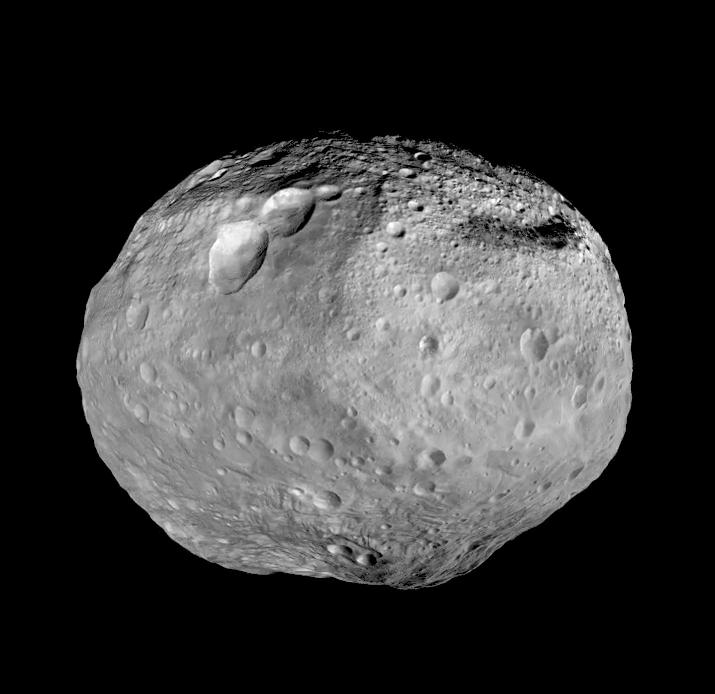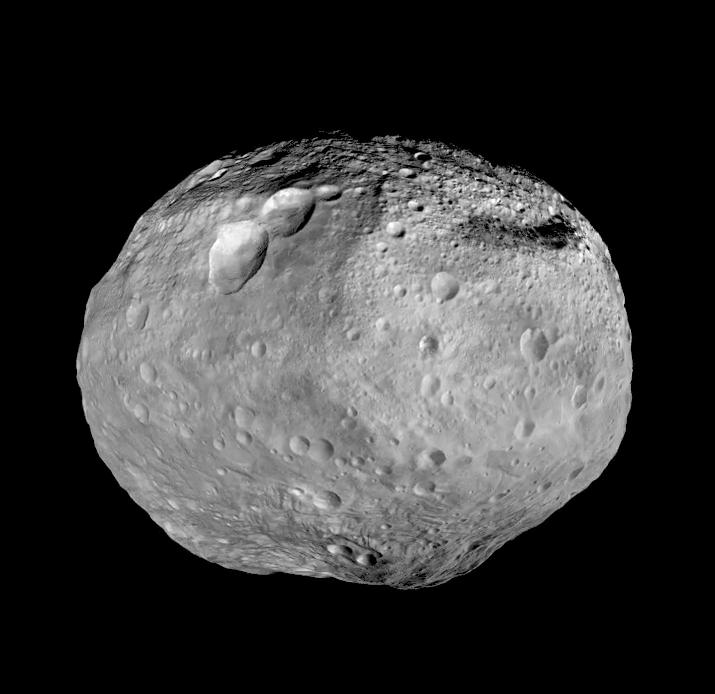
Next stop: Ceres. Last week the robotic Dawn spacecraft ended its year-long mission to asteroid Vesta, becoming the first spacecraft ever to visit this far off world located between Mars and Jupiter, in the Solar System's main asteroid belt. Many of the best images taken by Dawn at Vesta have been compiled into the above encompassing view. Vesta shows evidence of being a leftover from the early years of our Solar System, a building block for rocky planets like Earth. Vesta's ancient surface shows heavy cratering and long troughs likely created by huge impacts. The minor planet's low gravity allows for surface features like huge cliffs and a large mountain that reaches twice the height of Earth's Mount Everest, visible at the image bottom. Vesta, however, spanning about 500 kilometers across, is only the second most massive object in the asteroid belt. And so, two weeks ago, Dawn fired its gentle ion rockets and has begun chasing the most massive: Ceres. If everything goes as planned, Dawn will reach Ceres in 2015. Ceres looks quite different to the distant telescope -- but what will Dawn find? Help evaluate APOD: How old are you?
Próxima parada: Ceres. La semana pasada, la nave espacial robótica Dawn terminó su misión de un año en el asteroide Vesta, convirtiéndose en la primera nave espacial en visitar este mundo distante ubicado entre Marte y Júpiter, en el cinturón principal de asteroides del Sistema Solar. Muchas de las mejores imágenes tomadas por Dawn en Vesta han sido compiladas en la vista abarcadora mostrada arriba. Vesta muestra evidencia de ser un cuerpo restante de los primeros años de nuestro Sistema Solar, un bloque de construcción para planetas rocosos como la Tierra. La antigua superficie de Vesta muestra una fuerte craterización y largas hendiduras probablemente creadas por impactos masivos. La baja gravedad del asteroide permite características superficiales como gigantescas paredes rocosas y una montaña grande que alcanza el doble de la altura del Monte Everest terrestre, visible en la parte inferior de la imagen. Sin embargo, Vesta, que tiene aproximadamente 500 kilómetros de diámetro, es solo el segundo objeto más masivo del cinturón de asteroides. Y así, hace dos semanas, Dawn encendió sus suaves cohetes iónicos y comenzó a perseguir al más masivo: Ceres. Si todo transcurre según lo planeado, Dawn llegará a Ceres en 2015. Ceres se ve bastante diferente desde los telescopios distantes, pero ¿qué encontrará Dawn?