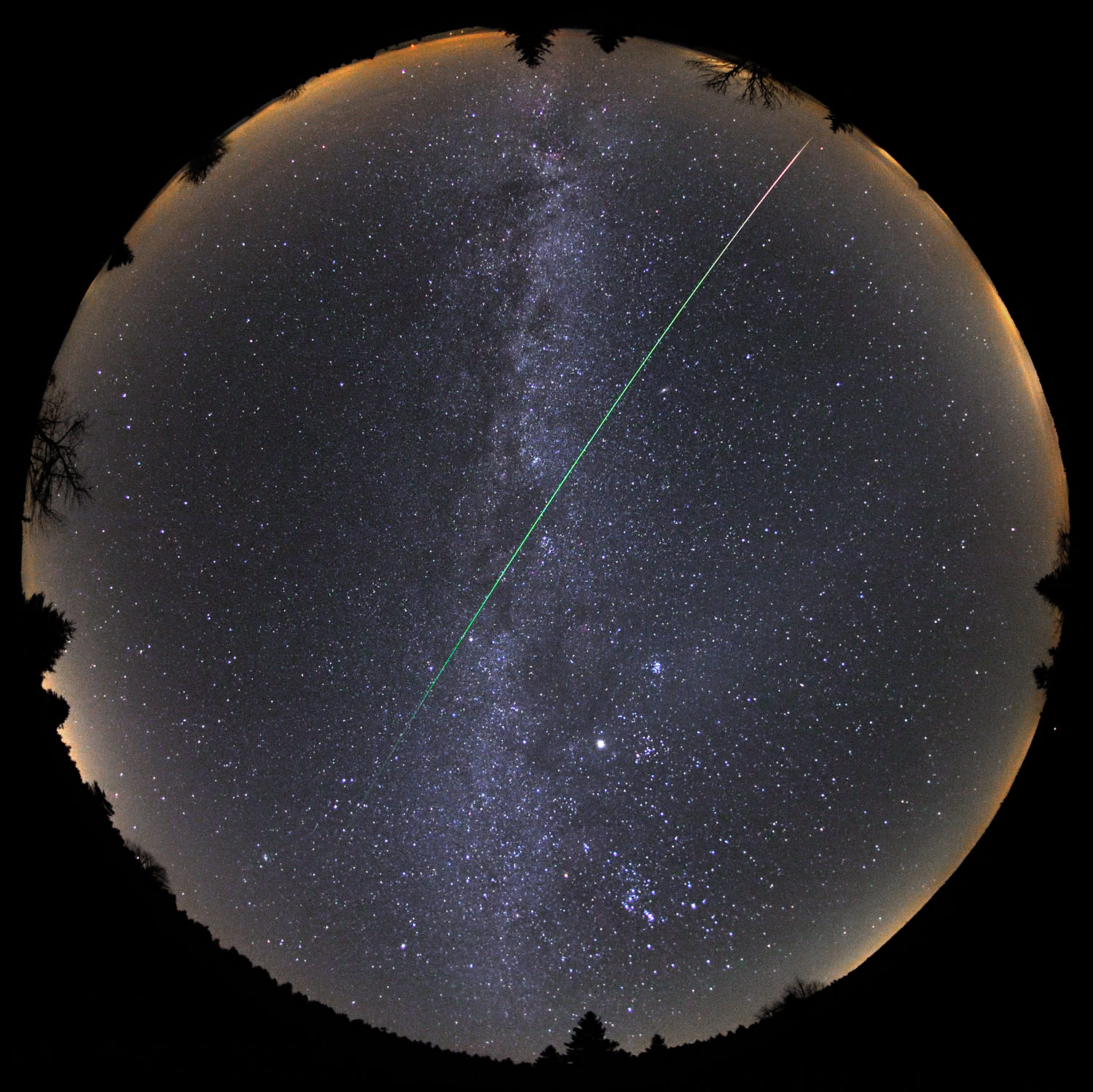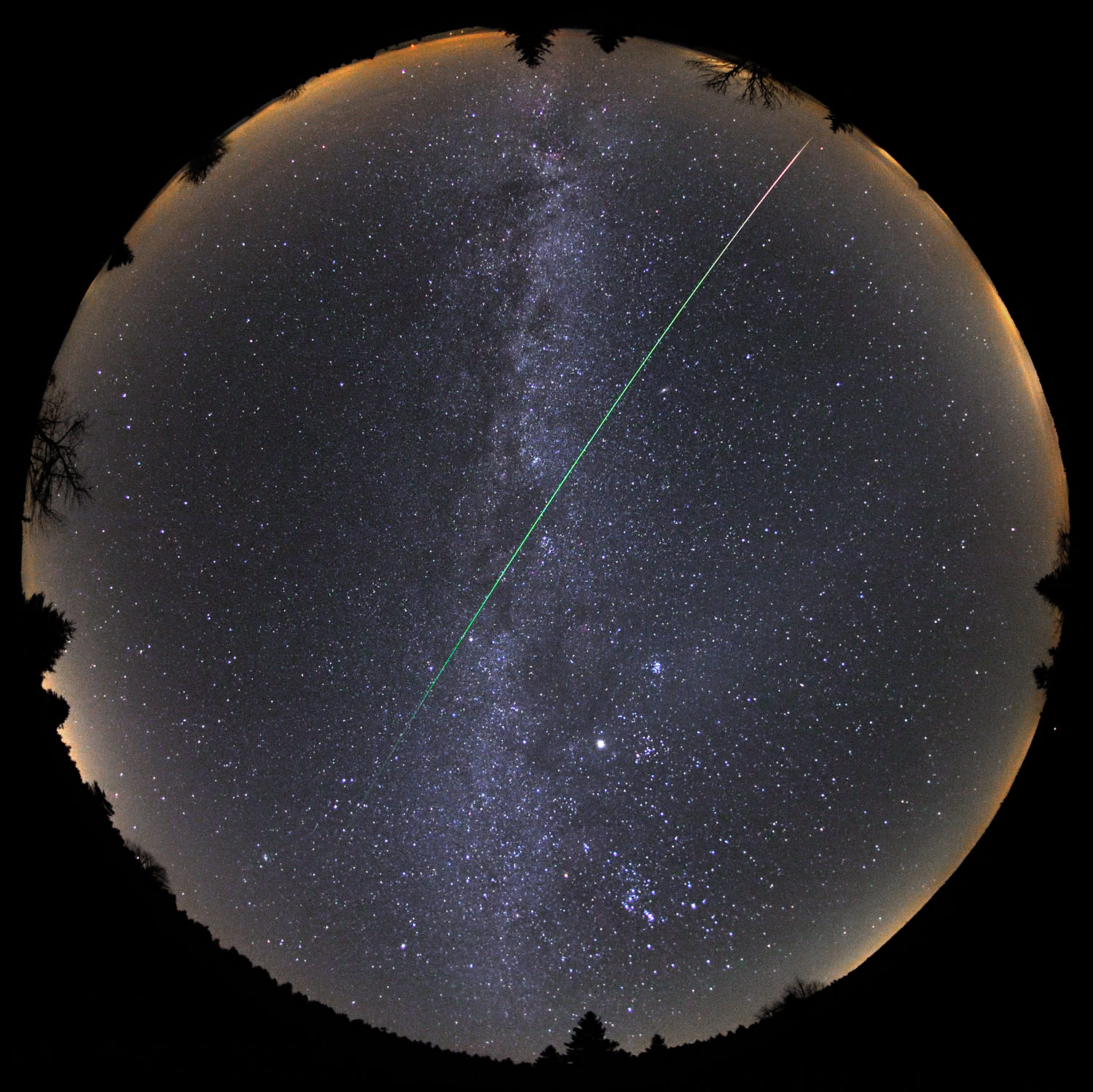
A cosmic grain of sand left the long and colorful trail across this all-sky view. Its grazing impact with planet Earth's atmosphere began at 71 kilometers per second. With the Milky Way stretching from horizon to horizon, the scene was captured on the night of November 17 from the astronomically popular high plateau at Champ du Feu in Alsace, France. Of course, the earthgrazer meteor belongs to this month's Leonid meteor shower, produced as our fair planet annually sweeps through dust from the tail of periodic Comet Tempel-Tuttle. The shower's radiant point in the constellation Leo is very close to the eastern horizon, near the start of the trail at the lower left. Bright planet Jupiter is also easy to spot, immersed in a faint band of Zodiacal light just below and right of center. The image is part of a dramatic time-lapse video (vimeo here) that began only 7 minutes before the long leonid crossed the sky.
Una partícula cósmica de arena dejó una larga y colorida estela a través de esta vista de todo el cielo. Su impacto rasante con la atmósfera de la Tierra comenzó a 71 kilómetros por segundo. Con la Vía Láctea extendiéndose del horizonte al horizonte, la escena fue capturada la noche del 17 de noviembre desde la popular altiplanicie astronómica del Champ du Feu en Alsacia, Francia. Por supuesto, el meteoro terrestre pertenece a la lluvia de meteoros Leonídea de este mes, producida cuando nuestro planeta atraviesa anualmente el polvo de la cola del cometa periódico Tempel-Tuttle. El punto radiante de la lluvia en la constelación de Leo está muy cerca del horizonte oriental, cerca del inicio de la estela en la parte inferior izquierda. El brillante planeta Júpiter también es fácil de localizar, sumergido en una banda tenue de luz zodiacal justo debajo y a la derecha del centro. La imagen forma parte de un dramático video de tiempo real (vídeo aquí) que comenzó solo 7 minutos antes de que la larga leonídea cruzara el cielo.