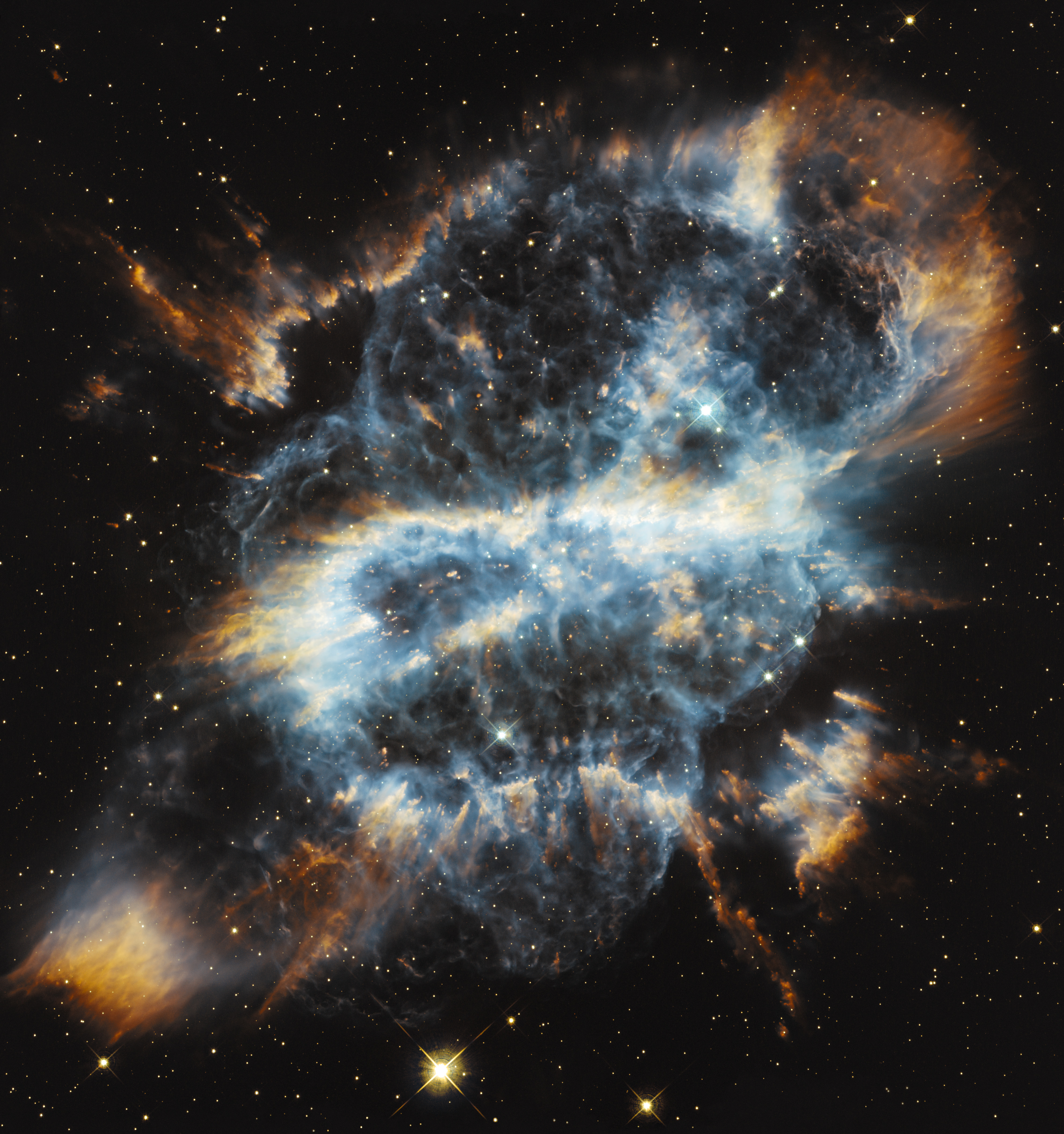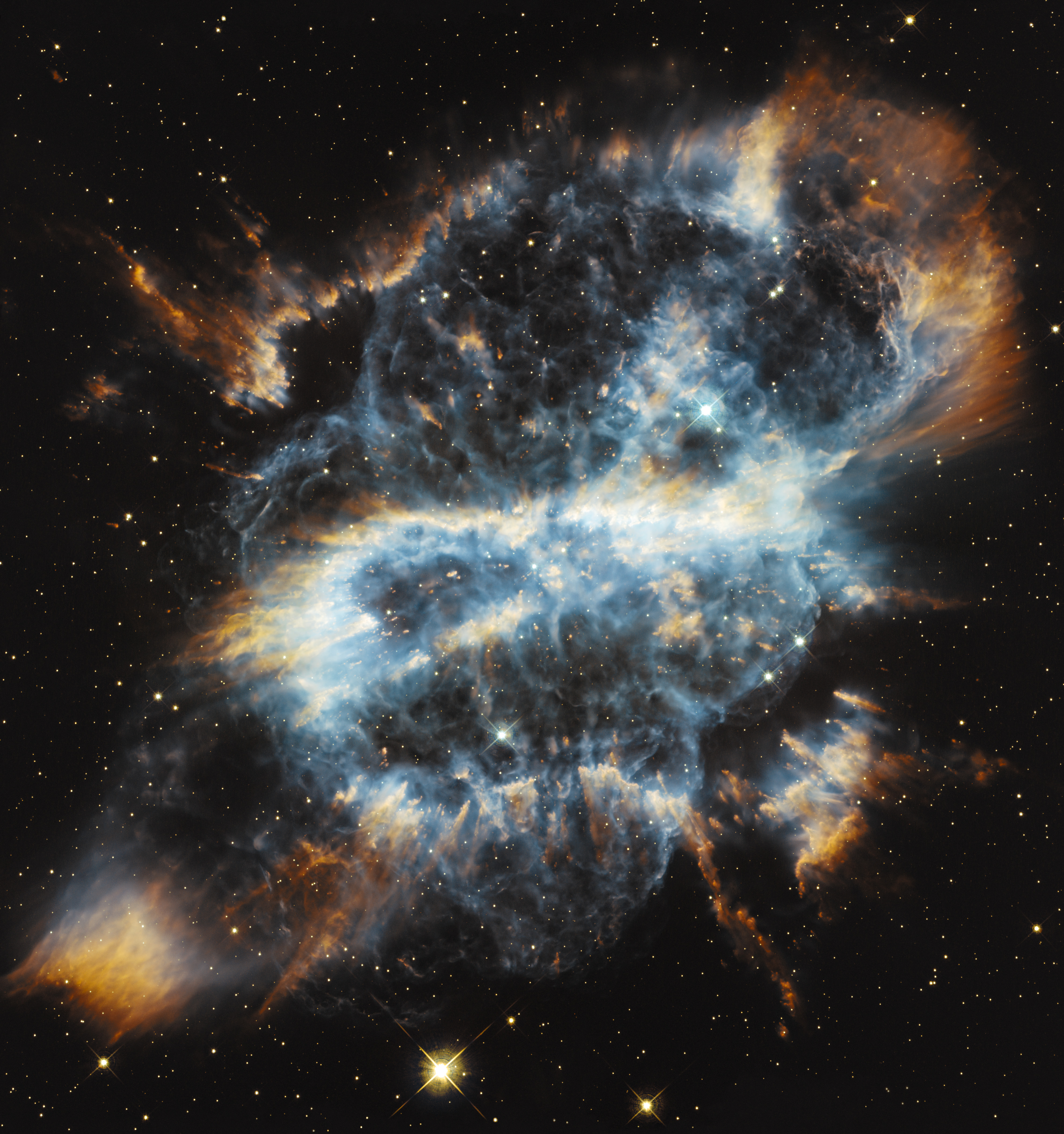
Why is this nebula so complex? When a star like our Sun is dying, it will cast off its outer layers, usually into a simple overall shape. Sometimes this shape is a sphere, sometimes a double lobe, and sometimes a ring or a helix. In the case of planetary nebula NGC 5189, however, no such simple structure has emerged. To help find out why, the Earth-orbiting Hubble Space Telescope recently observed NGC 5189 in great detail. Previous findings indicated the existence of multiple epochs of material outflow, including a recent one that created a bright but distorted torus running horizontally across image center. Results appear consistent with a hypothesis that the dying star is part of a binary star system with a precessing symmetry axis. Given this new data, though, research is sure to continue. NGC 5189 spans about three light years and lies about 3,000 light years away toward the southern constellation of the Fly (Musca). APOD Editors to Speak: RJN in Philadelphia on Jan. 3 & JTB in New York City on Jan. 4
Crédito: NASA, Hubble Space Telescope ¿Por qué esta nebulosa es tan compleja? Cuando una estrella como nuestro Sol está muriéndose, expulsa sus capas externas, normalmente formando una estructura general relativamente simple. A veces esta forma es una esfera, otras veces un doble lóbulo, y otras un anillo o una hélice. En el caso de la nebulosa planetaria NGC 5189, sin embargo, no ha surgido ninguna estructura sencilla. Para ayudar a descubrir por qué, el Telescopio Espacial Hubble, que orbita la Tierra, observó recientemente NGC 5189 con gran detalle. Hallazgos anteriores indicaron la existencia de múltiples épocas de salida de material, incluyendo una reciente que creó un toro brillante pero distorsionado que se extiende horizontalmente a través del centro de la imagen. Los resultados parecen compatibles con la hipótesis de que la estrella moribunda forma parte de un sistema binario con un eje de simetría que precesa. Dado este nuevo conjunto de datos, es seguro que la investigación continuará. NGC 5189 tiene un tamaño de aproximadamente tres años luz y se encuentra a unos 3000 años luz de distancia en dirección a la constelación austral de la Mosca (Musca).