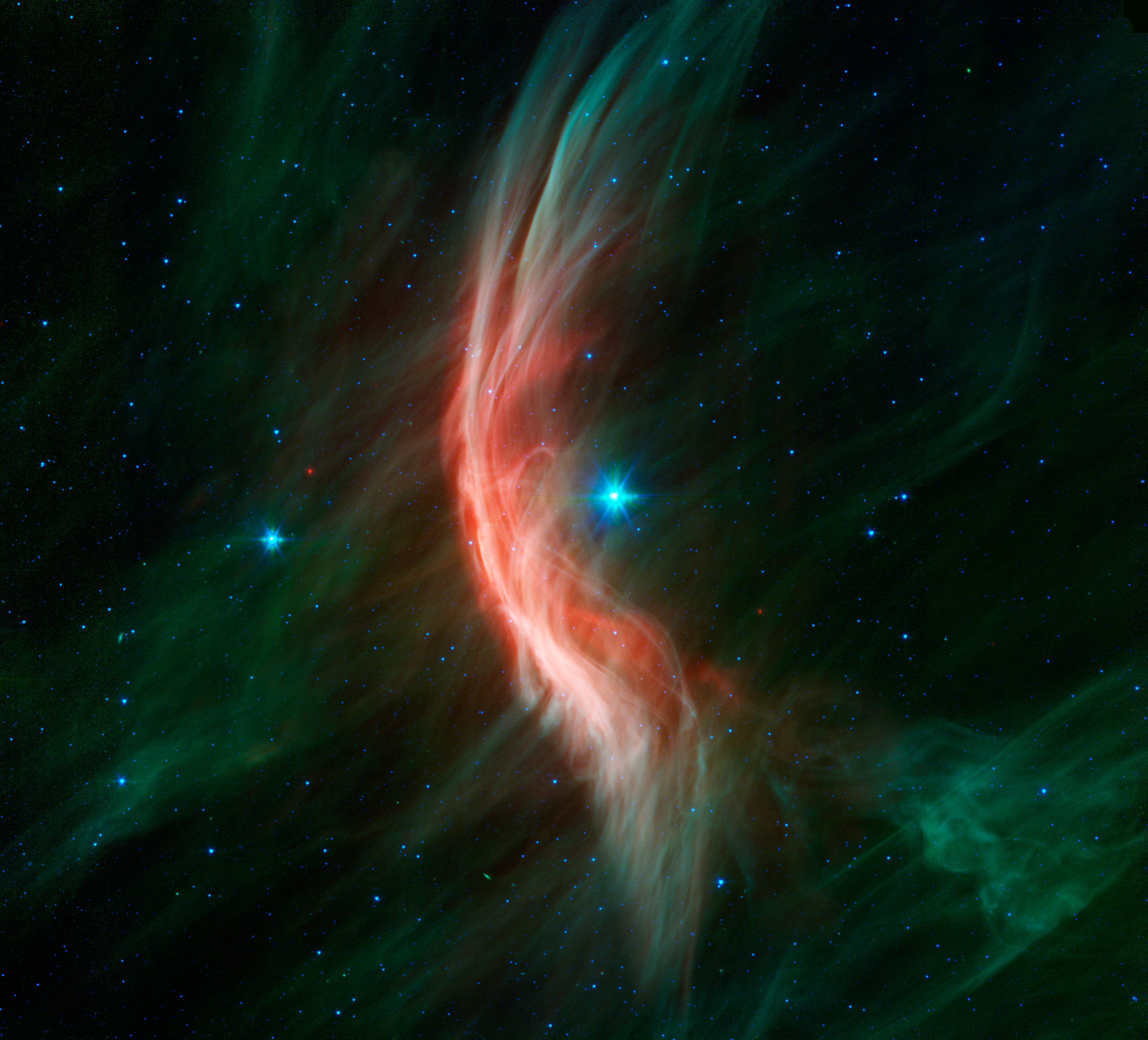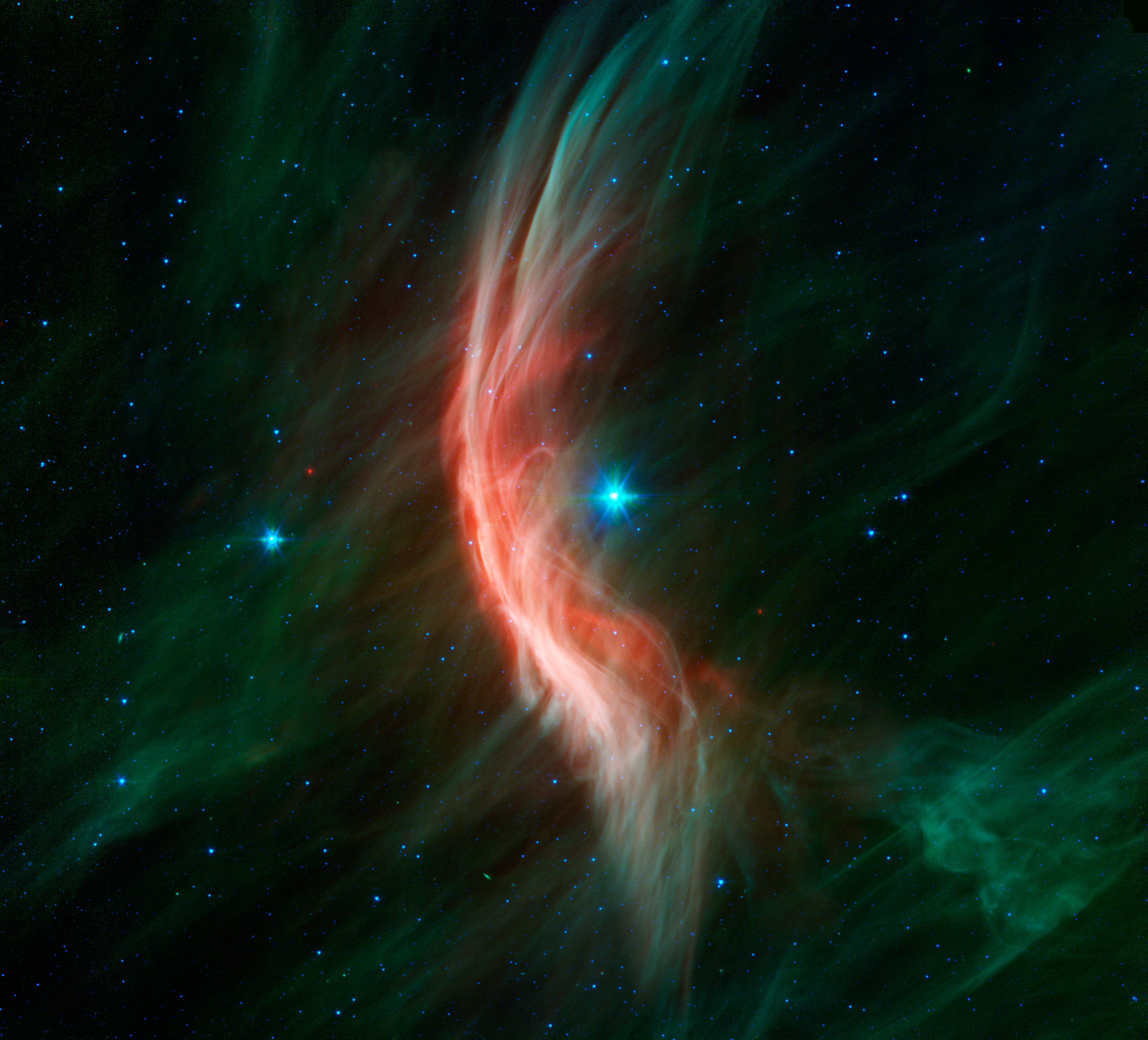
Like a ship plowing through cosmic seas, runaway star Zeta Ophiuchi produces the arcing interstellar bow wave or bow shock seen in this stunning infrared portrait. In the false-color view, bluish Zeta Oph, a star about 20 times more massive than the Sun, lies near the center of the frame, moving toward the left at 24 kilometers per second. Its strong stellar wind precedes it, compressing and heating the dusty interstellar material and shaping the curved shock front. Around it are clouds of relatively undisturbed material. What set this star in motion? Zeta Oph was likely once a member of a binary star system, its companion star was more massive and hence shorter lived. When the companion exploded as a supernova catastrophically losing mass, Zeta Oph was flung out of the system. About 460 light-years away, Zeta Oph is 65,000 times more luminous than the Sun and would be one of the brighter stars in the sky if it weren't surrounded by obscuring dust. The image spans about 1.5 degrees or 12 light-years at the estimated distance of Zeta Ophiuchi. Best of APOD 2012: Download a free 2013 APOD Calendar Follow APOD on: Facebook (Daily) (Sky) (Spanish) or Google Plus (Daily) (River)
Como un barco que se abriera paso a través de mares cósmicos, la estrella fugitiva Zeta Ophiuchi produce la onda de choque interstelar o onda de choque frontal que se observa en este impactante retrato en el infrarrojo. En esta imagen con colores falsos, la estrella Zeta Oph, de color azul, que es aproximadamente 20 veces más masiva que el Sol, se encuentra cerca del centro del marco, moviéndose hacia la izquierda a una velocidad de 24 kilómetros por segundo. Su fuerte viento estelar la precede, comprimiendo y calentando el material interestelar polvoriento y formando la frente de choque curvada. Alrededor de ella se encuentran nubes de material relativamente inalterado. ¿Qué puso en movimiento a esta estrella? Zeta Oph probablemente fue en un principio un miembro de un sistema binario, cuya estrella compañera era más masiva y, por lo tanto, de vida más corta. Cuando la estrella compañera explotó como una supernova, perdiendo repentinamente masa, Zeta Oph fue lanzada fuera del sistema. A unos 460 años luz de distancia, Zeta Oph es 65 000 veces más luminosa que el Sol y sería una de las estrellas más brillantes en el cielo si no estuviera rodeada por polvo que la oscurece. La imagen abarca aproximadamente 1,5 grados, o unos 12 años luz, a la distancia estimada de Zeta Ophiuchi.