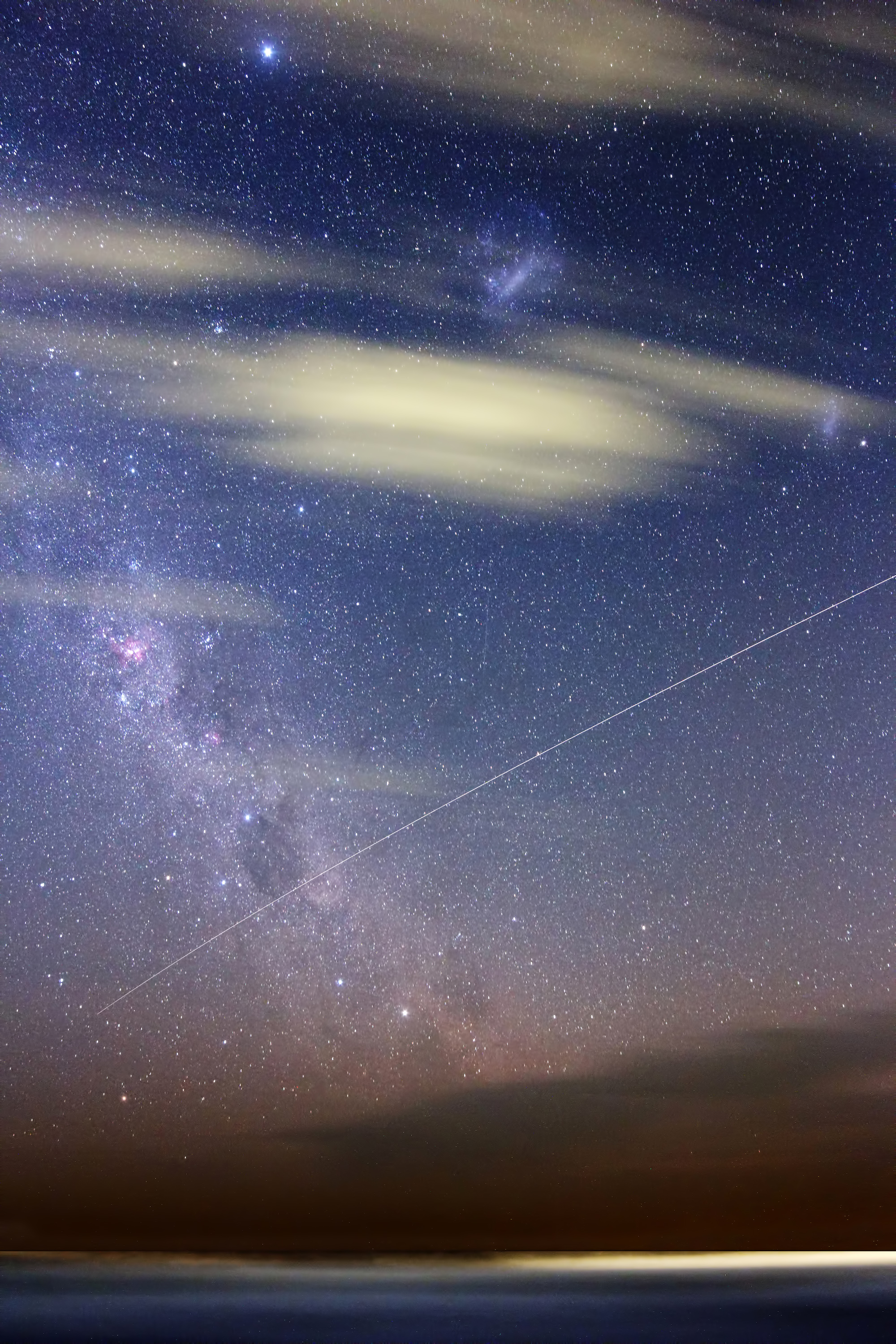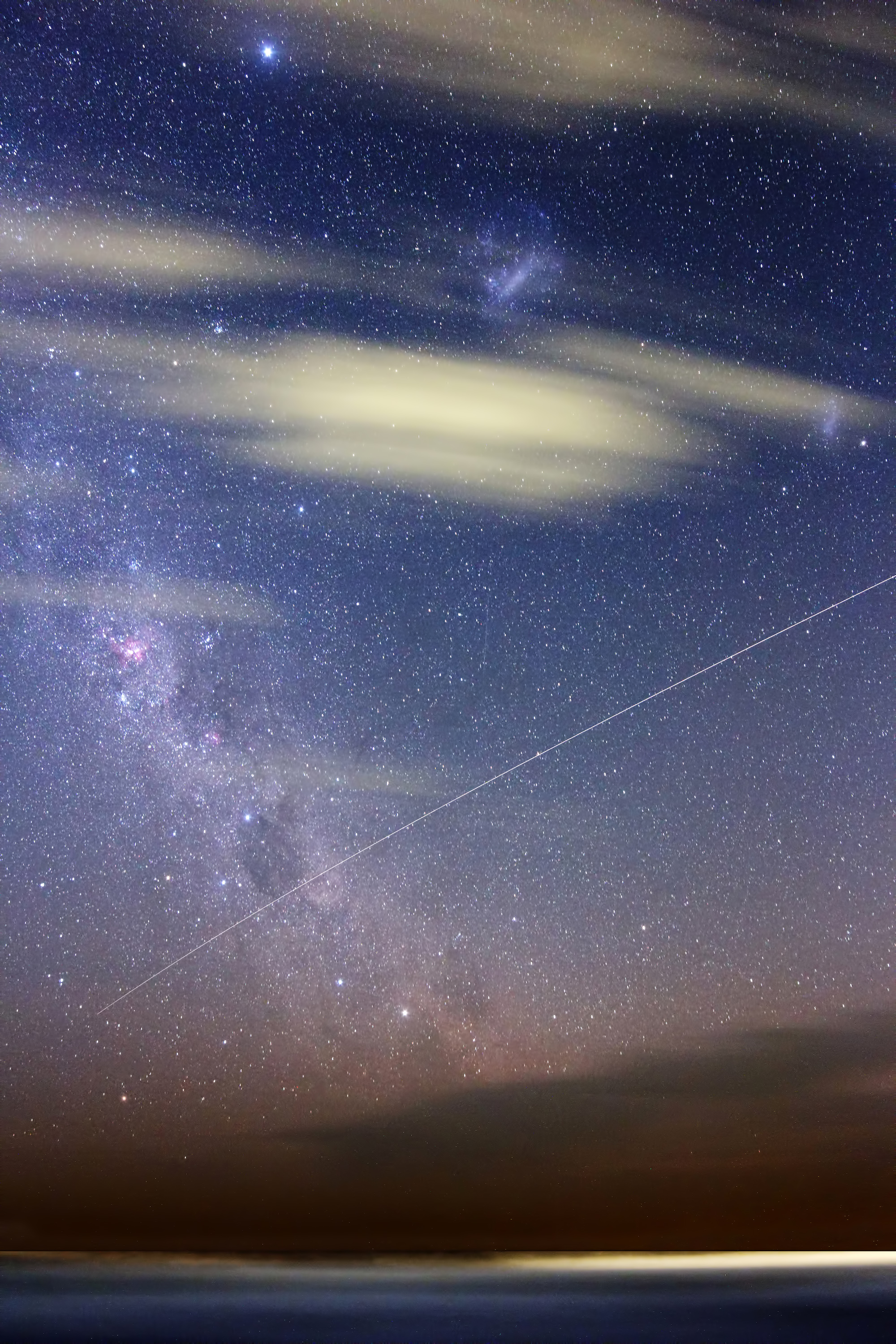
Clouds on a summer night frame this sea and skyscape, recorded earlier this month near Buenos Aires, Argentina. But planet Earth's clouds are not the only clouds on the scene. Starry clouds and nebulae along the southern hemisphere's summer Milky Way arc above the horizon, including the dark Coal Sack near the Southern Cross and the tantalizing pinkish glow of the Carina Nebula. Both the Large (top center) and Small Magellanic Clouds are also in view, small galaxies in their own right and satellites of the Milky Way up to 200,000 light-years distant. Alpha star of the Carina constellation and second brightest star in Earth's night, Canopus shines above about 300 light-years away. Still glinting in sunlight at an altitude of 400 kilometers, the orbiting International Space Station traces a long streak through the single, 5 minute, star-tracking exposure.
Nubes de una noche de verano delimitan este paisaje marino y celeste, capturado hace poco tiempo cerca de Buenos Aires, Argentina. Pero las nubes de la Tierra no son las únicas en escena. Las nubes estelares y nebulosas a lo largo del arco de la Vía Láctea en el hemisferio sur se elevan sobre el horizonte, incluyendo la oscura Nube de la Carbón cerca de la Cruz del Sur y el tentador brillo rosado de la Nebulosa de Carina. Tanto la Gran Nube de Magallanes (en el centro superior) como la Pequeña Nube de Magallanes también están presentes, galaxias pequeñas por derecho propio y satélites de la Vía Láctea a una distancia de hasta 200 000 años luz. La estrella alfa de la constelación de Carina y la segunda estrella más brillante del cielo nocturno terrestre, Canopus, brilla por encima a unos 300 años luz de distancia. Aún reflejando la luz del Sol a una altitud de 400 kilómetros, la Estación Espacial Internacional en órbita traza una larga línea a través de la exposición única de 5 minutos con seguimiento estelar.