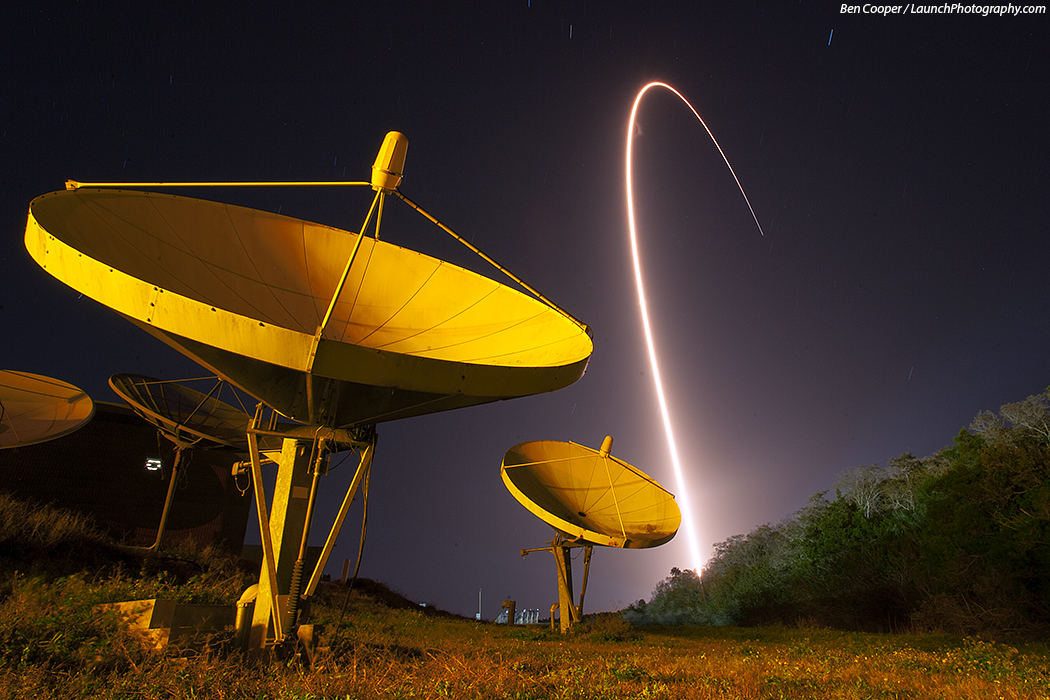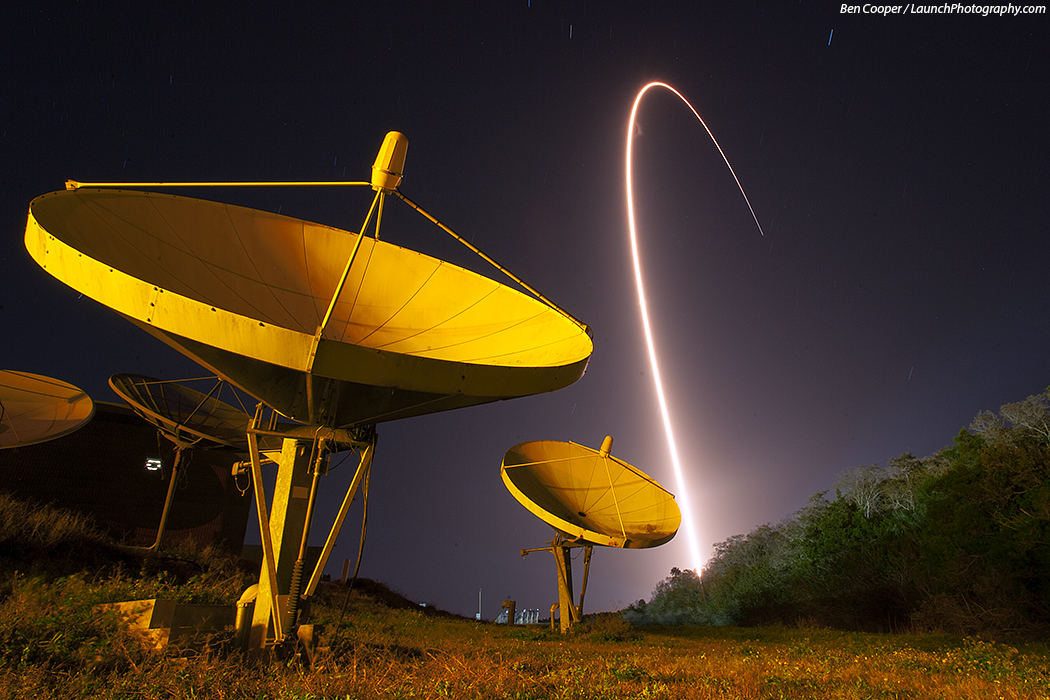
Beyond a fertile field of satellite communication antennas at Kennedy Space Center, an Atlas V rocket streaks into orbit in this long exposure photograph. In the thoughtfully composed image recorded on the evening of January 30, the antennas in the foreground bring to mind the rocket's payload, a Tracking and Data Relay Satellite (TDRS; sounds like TEE-dress). This TDRS-K is the first in a next-generation series adding to the constellation of NASA's communication satellites. Operating from geosynchronous orbit 22,300 miles (36,000 kilometers) above planet Earth, the network of TDRS satellites relays communications, data, and commands between spacecraft and ground stations. Formerly the TDRS network provided communications for space shuttle missions. In fact, many TDRS satellites were ferried as far as low Earth orbit on space shuttles. The TDRS network continues to support major spacecraft like the International Space Station, the Hubble Space Telescope, and the Fermi Gamma-ray Space Telescope.
Más allá de un campo fértil de antenas de comunicación satelital en el Centro Espacial Kennedy, un cohete Atlas V se dirige hacia la órbita en esta fotografía de larga exposición. En la imagen cuidadosamente compuesta, tomada durante la noche del 30 de enero, las antenas en primer plano evocan la carga útil del cohete, un satélite de seguimiento y retransmisión de datos (TDRS; se pronuncia TEE-dress). Este TDRS-K es el primero de una nueva generación que se suma a la constelación de satélites de comunicación de la NASA. Operando desde una órbita geoestacionaria a 22.300 millas (36.000 kilómetros) sobre la Tierra, la red de satélites TDRS transmite comunicaciones, datos y órdenes entre naves espaciales y estaciones terrestres. Antes, la red TDRS proporcionaba comunicación para misiones del transbordador espacial. De hecho, muchos satélites TDRS fueron transportados hasta la órbita baja terrestre en transbordadores espaciales. La red TDRS continúa apoyando importantes naves espaciales como la Estación Espacial Internacional, el Telescopio Espacial Hubble y el Telescopio Espacial Fermi de rayos gamma.