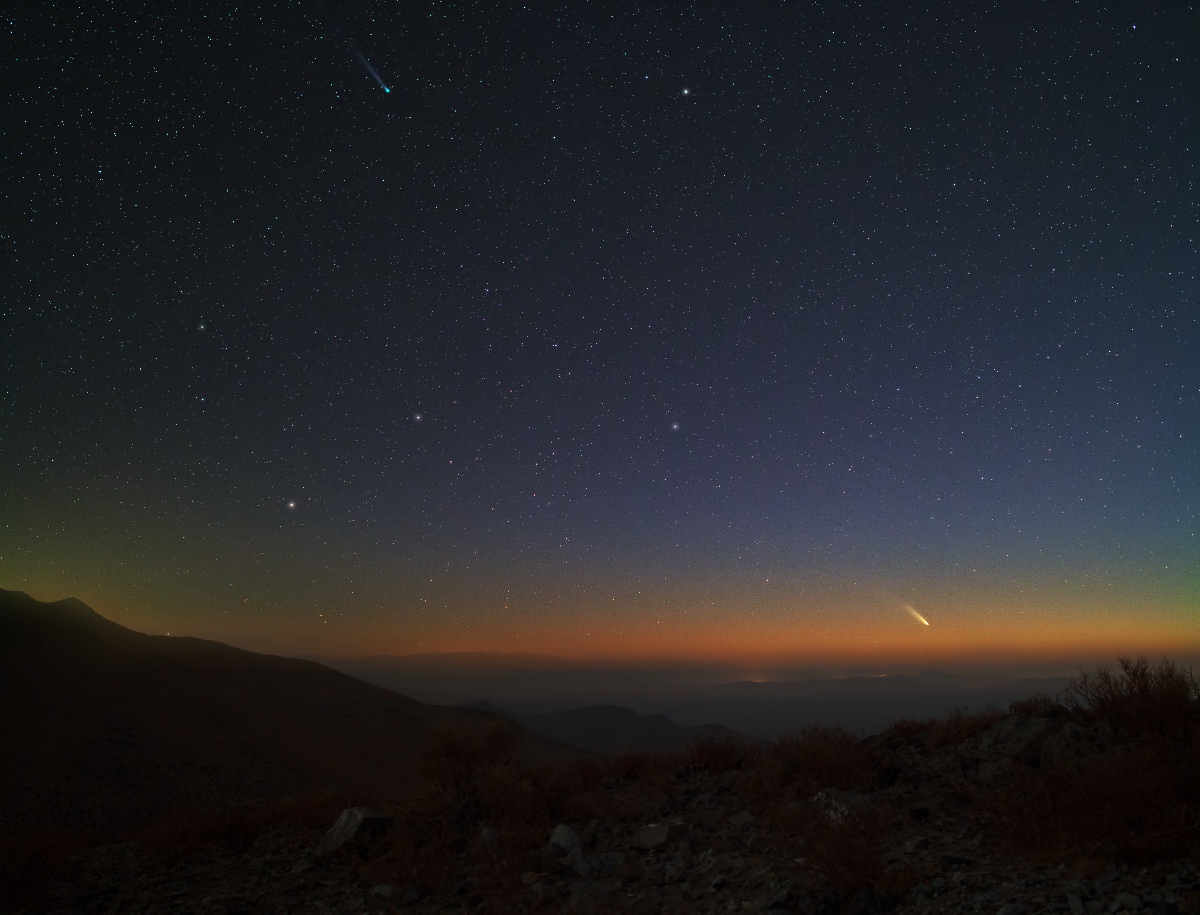
Two impressive comets will both reach their peak brightness during the next two weeks. Taking advantage of a rare imaging opportunity, both of these comets were captured in the sky together last week over the Atacama desert in South America. Comet C/2012 F6 (Lemmon), visible on the upper left of the above image, is sporting a long tail dominated by glowing green ions. Comet C/2011 L4 (PanSTARRS), visible near the horizon on the lower right, is showing a bright tail dominated by dust reflecting sunlight. The tails of both comets point approximately toward the recently set Sun. Comet Lemmon will be just barely visible to the unaided eye before sunset in southern skies for the next week, and then best viewed with binoculars as it fades and moves slowly north. Comet PanSTARRS, however, will remain visible in southern skies for only a few more days, after which it will remain bright enough to be locatable with the unaided eye as it moves into northern skies. To find the giant melting snowball PanSTARRS, sky enthusiasts should look toward the western horizon just after sunset. Deep sky observers are also monitoring the brightening of Comet C/2012 S1 (ISON), which may become one of the brightest objects in the entire night sky toward the end of 2013. Expanding Gallery: Bright Comets of 2013
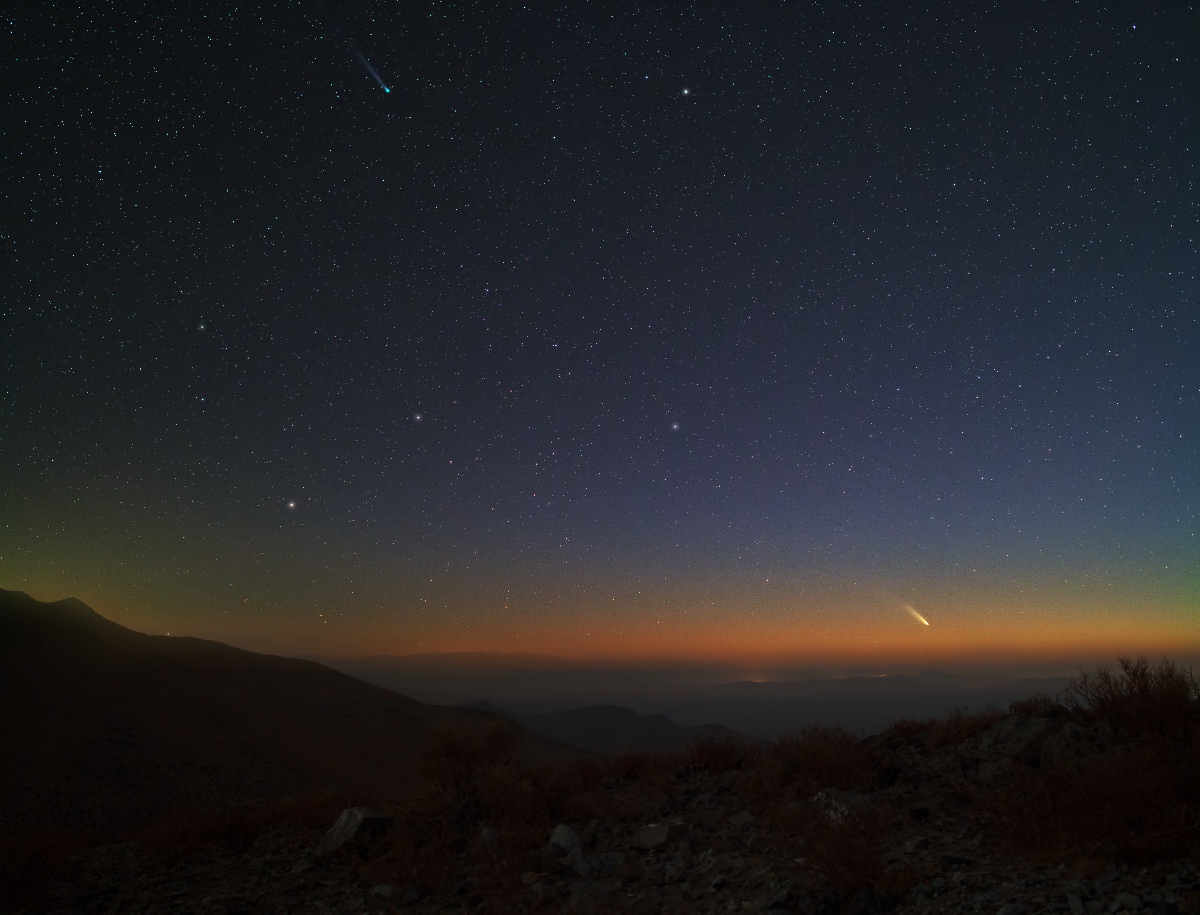
Dos cometas impresionantes alcanzarán su máxima luminosidad durante las próximas dos semanas. Aprovechando una oportunidad de imagen rara, ambos cometas fueron capturados juntos en el cielo la semana pasada sobre el desierto de Atacama en América del Sur. El cometa C/2012 F6 (Lemmon), visible en la parte superior izquierda de la imagen anterior, tiene una larga cola dominada por iones brillantes de color verde. El cometa C/2011 L4 (PanSTARRS), visible cerca del horizonte en la parte inferior derecha, muestra una cola brillante dominada por polvo que refleja la luz solar. Las colas de ambos cometas apuntan aproximadamente hacia el Sol que recientemente se puso. El cometa Lemmon será apenas visible a simple vista antes del atardecer en los cielos del sur durante la próxima semana, y luego será mejor observado con binoculares a medida que se debilite y se mueva lentamente hacia el norte. Sin embargo, el cometa PanSTARRS permanecerá visible en los cielos del sur solo unos días más, después de lo cual permanecerá lo suficientemente brillante como para ser localizado a simple vista a medida que se mueve hacia los cielos del norte. Para localizar el gran cometa de nieve fundida PanSTARRS, los entusiastas del cielo deberían mirar hacia el horizonte occidental poco después del atardecer. Los observadores del cielo profundo también están monitoreando el aumento de brillo del cometa C/2012 S1 (ISON), que podría convertirse en uno de los objetos más brillantes del cielo nocturno hacia finales de 2013.