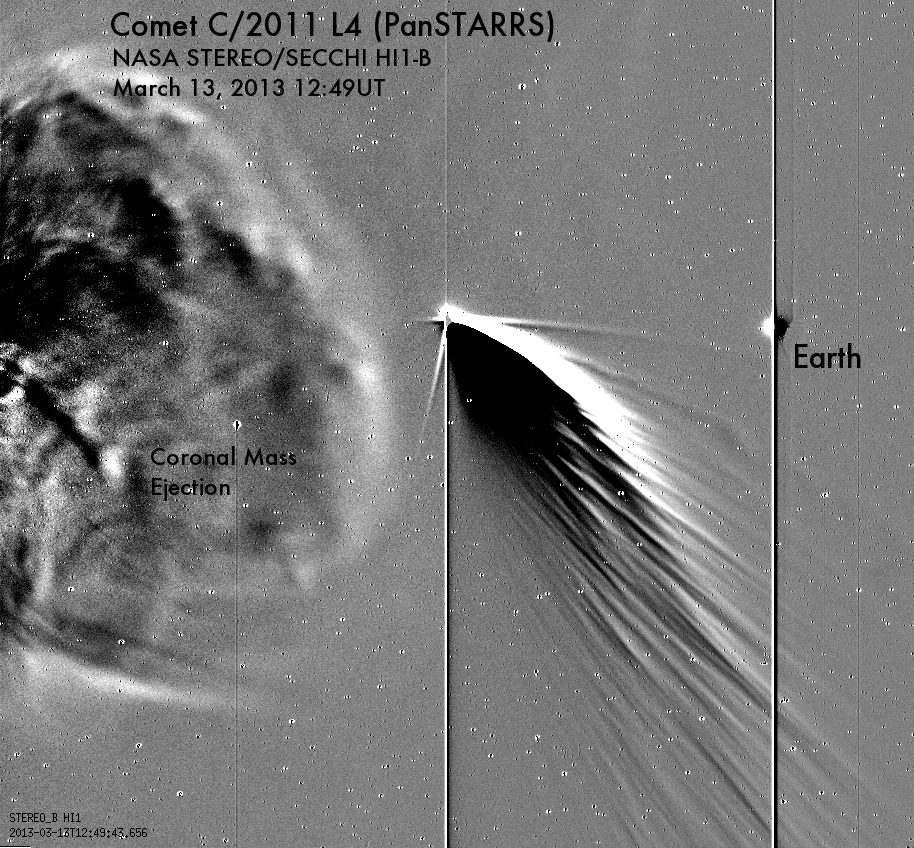
After appearing in a popular photo opportunity with a young crescent Moon near sunset, naked-eye Comet PanSTARRS continues to rise in northern hemisphere skies. But this remarkable interplanetary perspective from March 13, finds the comet posing with our fair planet itself - as seen from the STEREO Behind spacecraft. Following in Earth's orbit, the spacecraft is nearly opposite the Sun and looks back toward the comet and Earth, with the Sun just off the left side of the frame. At the left an enormous coronal mass ejection (CME) is erupting from a solar active region. Of course, CME, comet, and planet Earth are all at different distances from the spacecraft. (The comet is closest.) The processed digital image is the difference between two consecutive frames from the spacecraft's SECCHI Heliospheric Imager, causing the strong shadowing effect for objects that move between frames. Objects that are too bright create the sharp vertical lines. The processing reveals complicated feather-like structures in Comet PanSTARRS's extensive dust tail. Growing Gallery: Comet PanSTARRS at Sunset
Después de aparecer en una popular oportunidad fotográfica junto a una joven luna creciente cerca del atardecer, el cometa PanSTARRS continúa elevándose en los cielos del hemisferio norte. Pero esta notable perspectiva interplanetaria del 13 de marzo, muestra al cometa junto a nuestro planeta mismo, tal como se ve desde la nave espacial STEREO Behind. Siguiendo la órbita de la Tierra, la nave espacial está casi opuesta al Sol y mira hacia atrás hacia el cometa y la Tierra, con el Sol apenas a la izquierda del marco. A la izquierda, una enorme eyección de masa coronal (CME) está erupcionando desde una región activa solar. Por supuesto, el CME, el cometa y la Tierra se encuentran a diferentes distancias de la nave espacial. (El cometa está más cerca). La imagen digital procesada es la diferencia entre dos marcos consecutivos de la cámara Heliosférica de la nave espacial SECCHI, causando el fuerte efecto de sombreado para los objetos que se mueven entre los marcos. Los objetos que son demasiado brillantes generan las líneas verticales nítidas. El procesamiento revela estructuras complejas en forma de pluma en la extensa cola de polvo del cometa PanSTARRS.