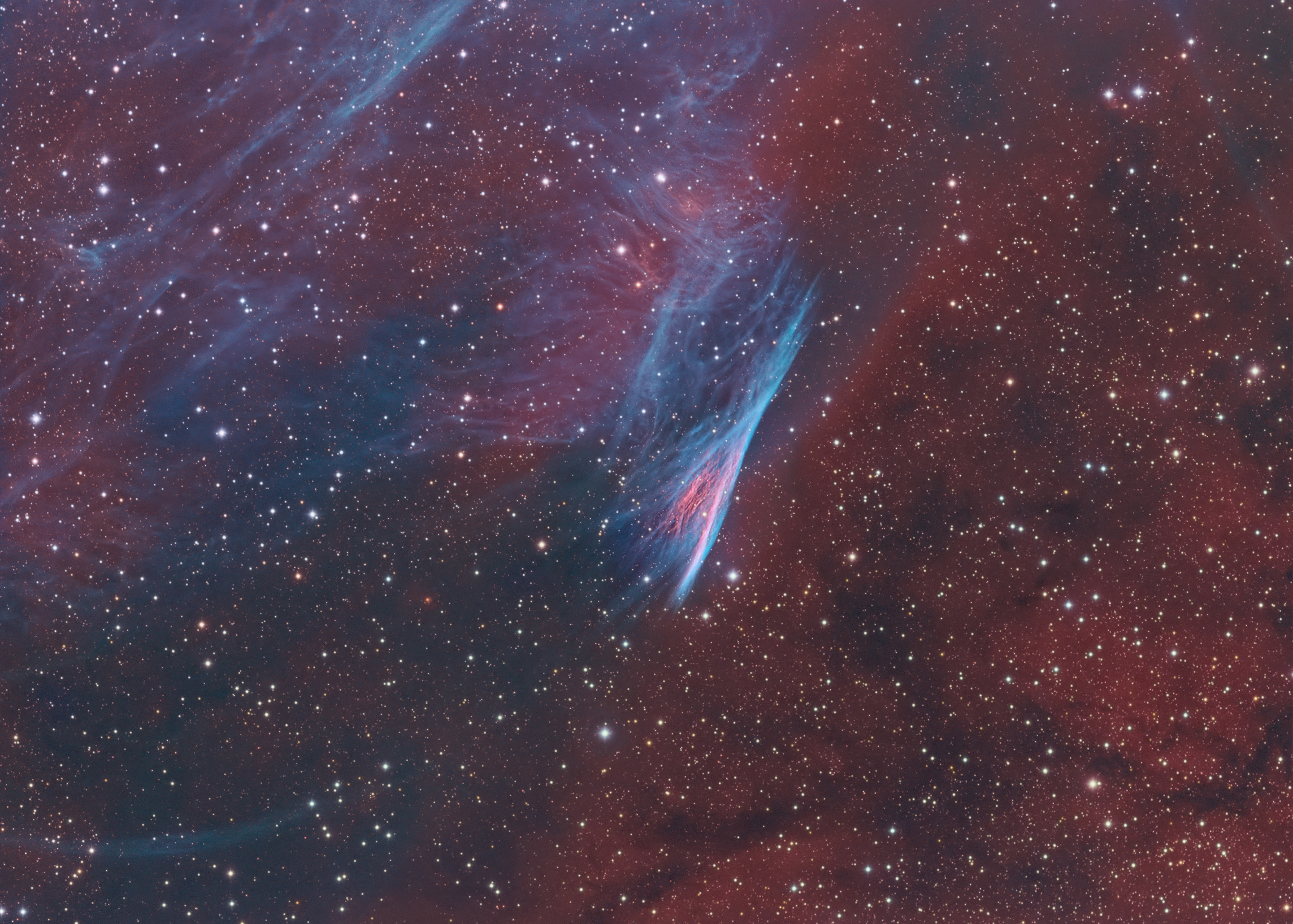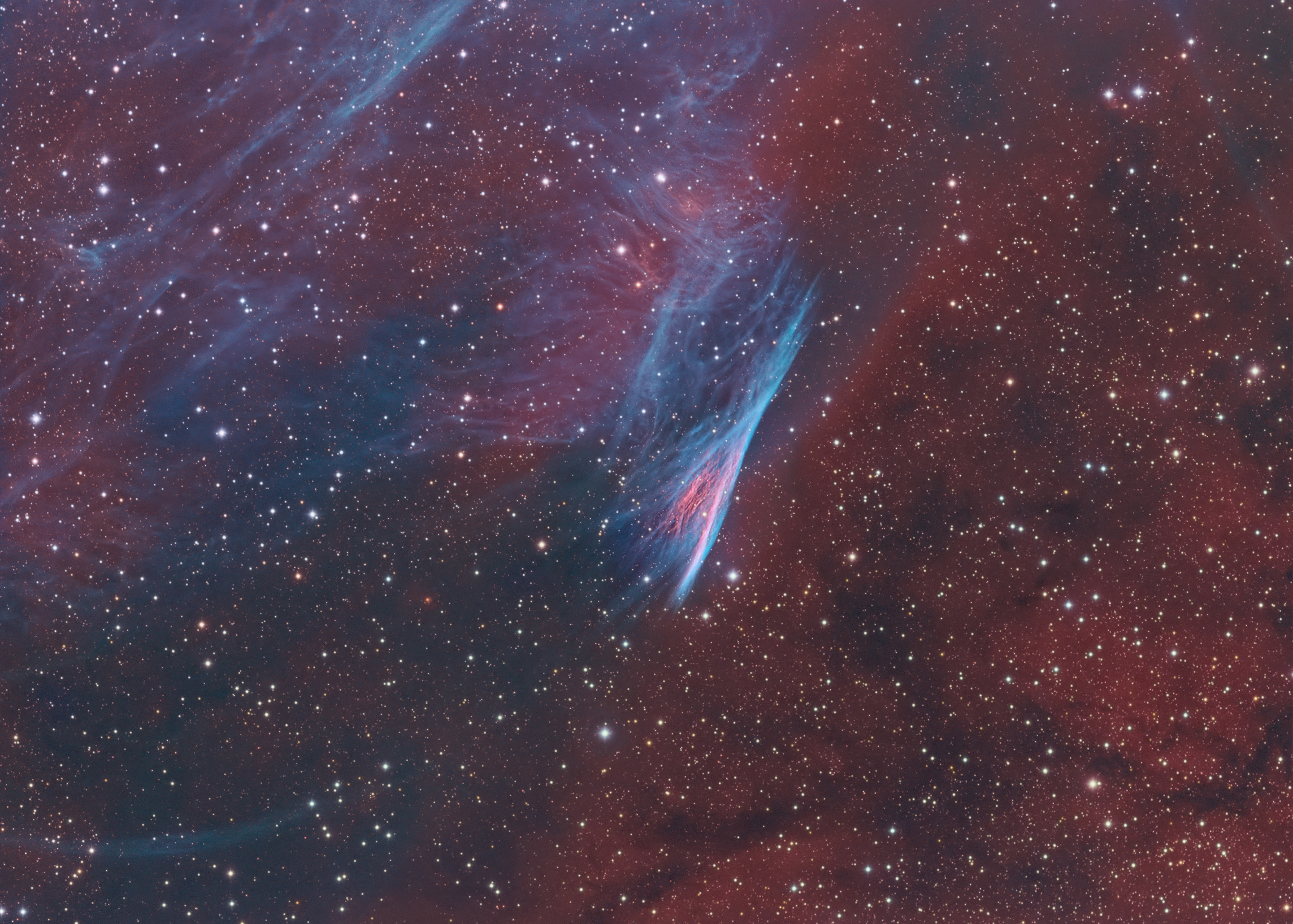
Moving left to right near the center of this beautifully detailed color composite, the thin, bright, braided filaments are actually long ripples in a sheet of glowing gas seen almost edge on. The interstellar shock wave plows through space at over 500,000 kilometers per hour. Cataloged as NGC 2736, its elongated appearance suggests its popular name, the Pencil Nebula. The Pencil Nebula is about 5 light-years long and 800 light-years away, but represents only a small part of the Vela supernova remnant. The Vela remnant itself is around 100 light-years in diameter, the expanding debris cloud of a star that was seen to explode about 11,000 years ago. Initially, the shock wave was moving at millions of kilometers per hour but has slowed considerably, sweeping up surrounding interstellar material. In the narrowband, wide field image, red and blue-green colors track the characteristic glow of ionized hydrogen and oxygen atoms.
Moviéndose de izquierda a derecha cerca del centro de esta detallada imagen en color compuesto, las delgadas y brillantes fibras trenzadas son en realidad largas ondulaciones en una lámina de gas brillante vista casi de perfil. La onda de choque interestelar avanza a través del espacio a más de 500,000 kilómetros por hora. Catalogada como NGC 2736, su apariencia alargada sugiere su nombre popular, la Nebulosa Lápiz. La Nebulosa Lápiz tiene aproximadamente 5 años luz de longitud y se encuentra a unos 800 años luz de distancia, pero representa solo una pequeña parte del remanente de supernova Vela. El remanente Vela en sí mismo tiene aproximadamente 100 años luz de diámetro, nube de desechos en expansión de una estrella que fue observada explotar hace aproximadamente 11,000 años. Inicialmente, la onda de choque se movía a millones de kilómetros por hora, pero ha disminuido considerablemente, recogiendo material interestelar circundante. En la imagen de banda estrecha y campo amplio, los colores rojo y azul-verde siguen la característica luminosidad de los átomos de hidrógeno y oxígeno ionizados.