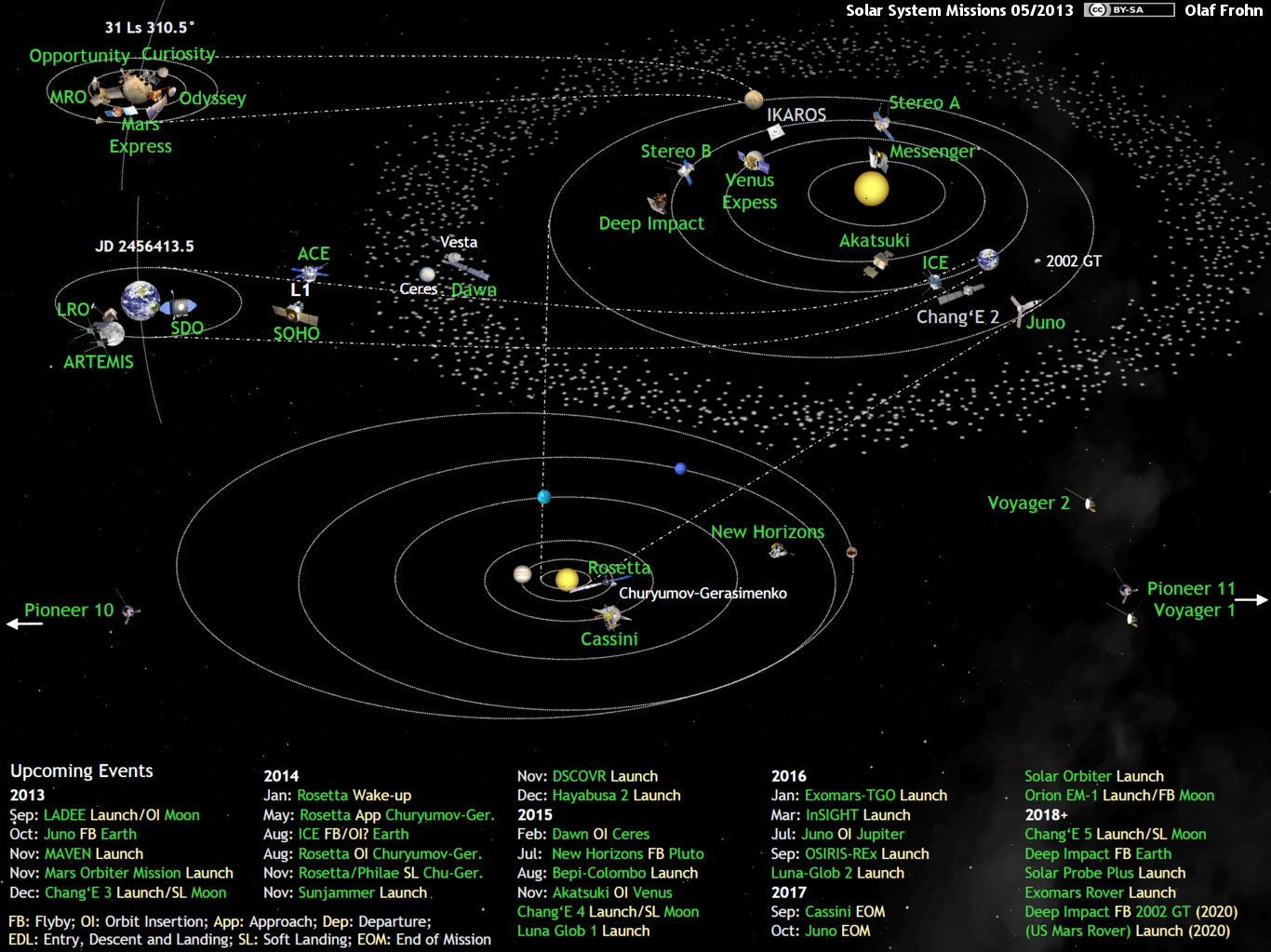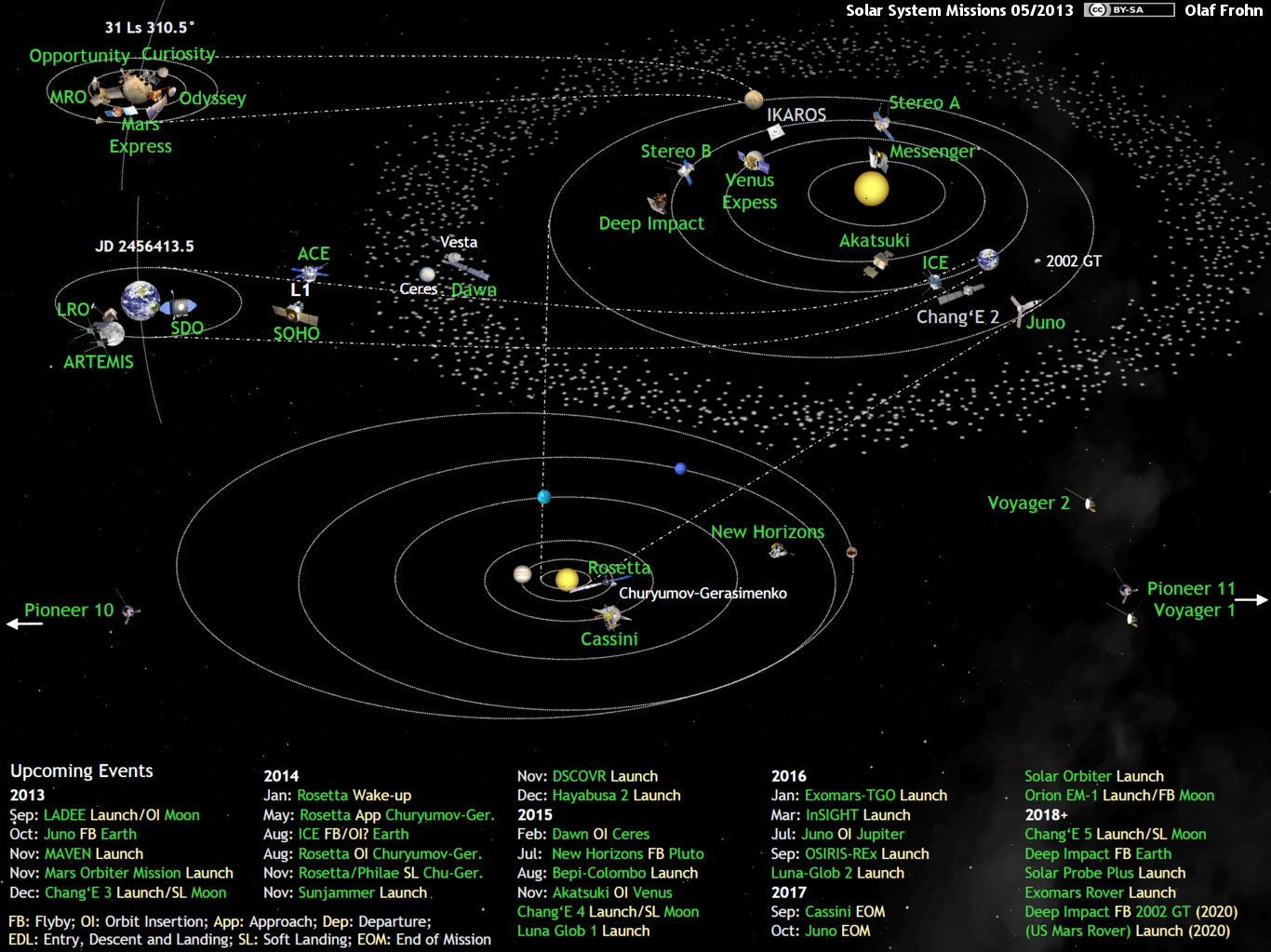
What spacecraft is humanity currently using to explore our Solar System? Presently, every inner planet has at least one robotic explorer, while several others are monitoring our Sun, some are mapping Earth's Moon, a few are chasing asteroids and comets, one is orbiting Saturn, and several are even heading out into deep space. The above illustration gives more details, with the inner Solar System depicted on the upper right and the outer Solar System on the lower left. Given the present armada, our current epoch might become known as the time when humanity first probed its own star system. Sometimes widely separated spacecraft act together as an InterPlanetary Network to determine the direction of distant explosions by noting when each probe detects high energy photons. Future spacecraft milestones, as indicated along the bottom of the graphic, include Dawn reaching Ceres, the largest object in the asteroid belt, and New Horizons reaching Pluto, both in 2015. Follow APOD in: Arabic, Bahasa Indonesian, Catalan, Chinese, Chinese, Czech, Dutch, Farsi, Farsi, Galego, German, French, Hebrew, Japanese, Polish, Portuguese, Romanian, Russian, Slovenian, Spanish, Spanish, or Turkish,
¿Qué nave espacial está utilizando actualmente la humanidad para explorar nuestro Sistema Solar? En la actualidad, cada planeta interior tiene al menos un explorador robótico, mientras que varios otros están monitoreando nuestro Sol, algunos están cartografiando la Luna de la Tierra, algunos están persiguiendo asteroides y cometas, uno está orbitando Saturno, y varios incluso están dirigiéndose hacia el espacio profundo. La ilustración anterior proporciona más detalles, mostrando el Sistema Solar interior en la parte superior derecha y el Sistema Solar exterior en la parte inferior izquierda. Dada la flota actual, nuestra época actual podría conocerse como el período en el que la humanidad por primera vez exploró su propio sistema estelar. A veces, naves espaciales ampliamente separadas actúan juntas como una Red Interplanetaria para determinar la dirección de explosiones distantes al observar cuándo cada sonda detecta fotones de alta energía. Las próximas hitos de naves espaciales, como se indica en la parte inferior del gráfico, incluyen a Dawn llegando a Ceres, el objeto más grande en el cinturón de asteroides, y a New Horizons llegando a Plutón, ambos en 2015.