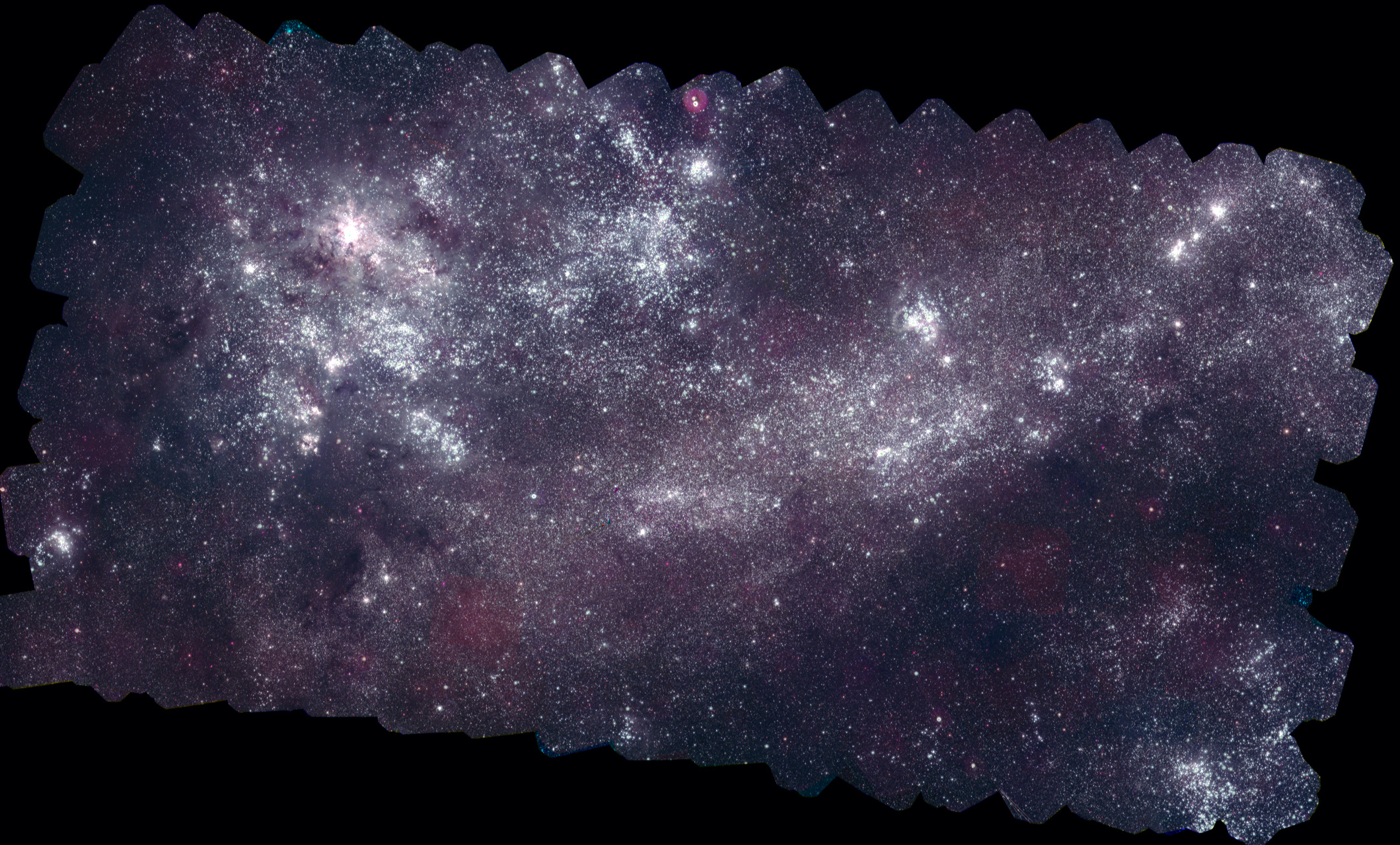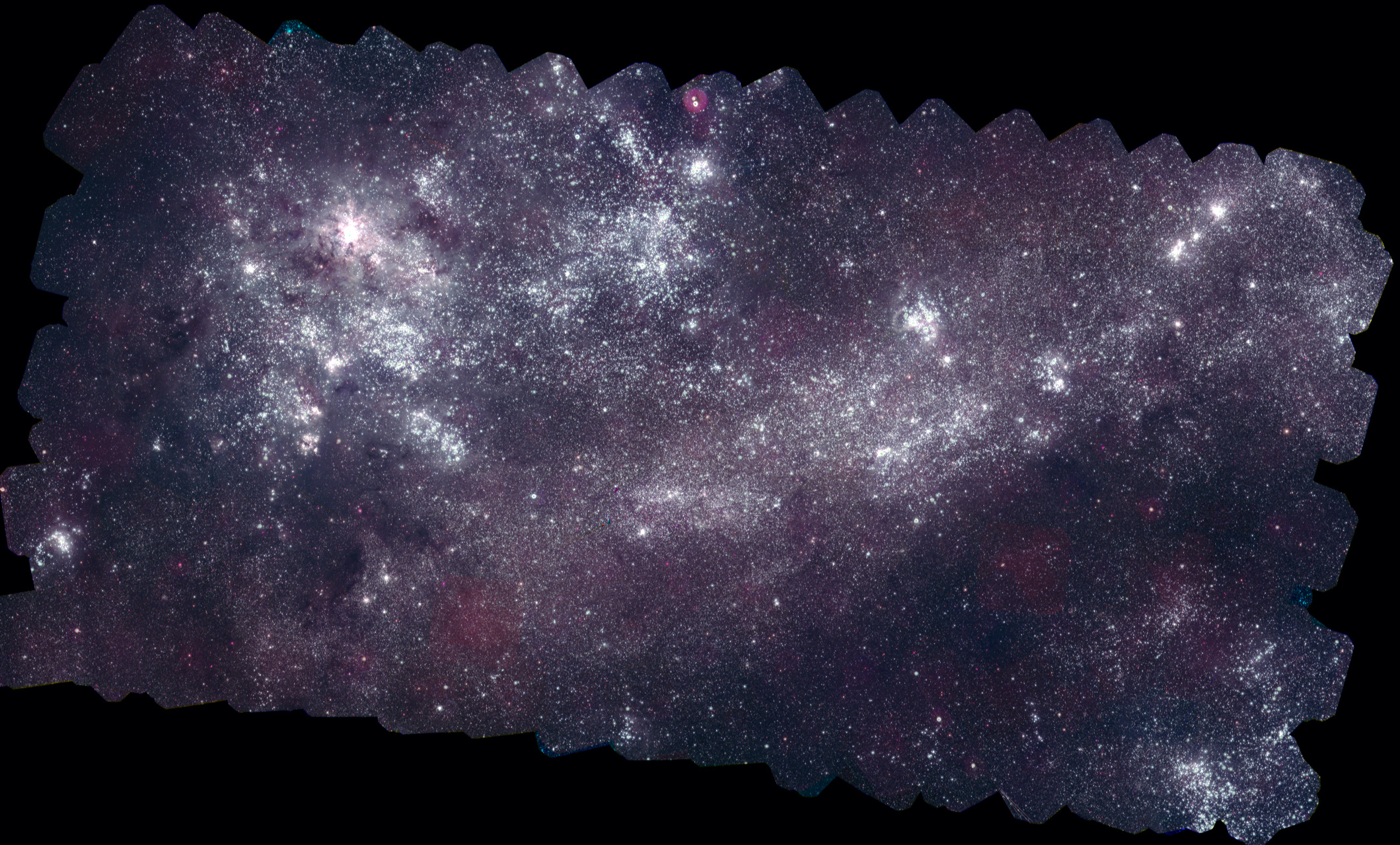
Where are the hottest stars in the nearest galaxies? To help find out, NASA commissioned its Earth-orbiting Swift satellite to compile a multi-image mosaic of the neighboring Large Magellanic Cloud (LMC) galaxy in ultraviolet light. The above image shows where recently formed stars occur in the LMC, as the most massive of these young stars shine brightly in blue and ultraviolet. In contrast, visible in an image roll-over, a more familiar view of the LMC in visible light better highlights older stars. On the upper left is one of the largest star forming regions known in the entire Local Group of galaxies: the Tarantula Nebula. The Large Magellanic Cloud and its smaller companion the Small Magellanic Cloud are easily visible with the unaided eye to sky enthusiasts with a view of the southern sky. Detailed inspection of the above image is allowing a better galaxy-comprehensive picture for how star formation occurs.
¿Dónde se encuentran las estrellas más calientes en las galaxias más cercanas? Para ayudar a descubrirlo, la NASA encargó a su satélite Swift, que orbita la Tierra, la elaboración de un mosaico multimagen de la galaxia vecina de la Nube Magallánica Grande (LMC) en luz ultravioleta. La imagen anterior muestra dónde se forman recientemente las estrellas en la LMC, ya que las estrellas más masivas de estas jóvenes brillan intensamente en el azul y en la luz ultravioleta. Por el contrario, en una imagen de desplazamiento, una vista más familiar de la LMC en luz visible destaca mejor las estrellas más antiguas. En la parte superior izquierda se encuentra una de las regiones de formación estelar más grandes conocidas en toda la Grupo Local de galaxias: la Nebulosa Tarántula. La Nube Magallánica Grande y su compañero más pequeño, la Nube Magallánica Pequeña, son fácilmente visibles a simple vista para los entusiastas del cielo que tengan una vista del cielo austral. La inspección detallada de la imagen anterior está permitiendo obtener una mejor imagen integral de cómo ocurre la formación estelar en la galaxia.