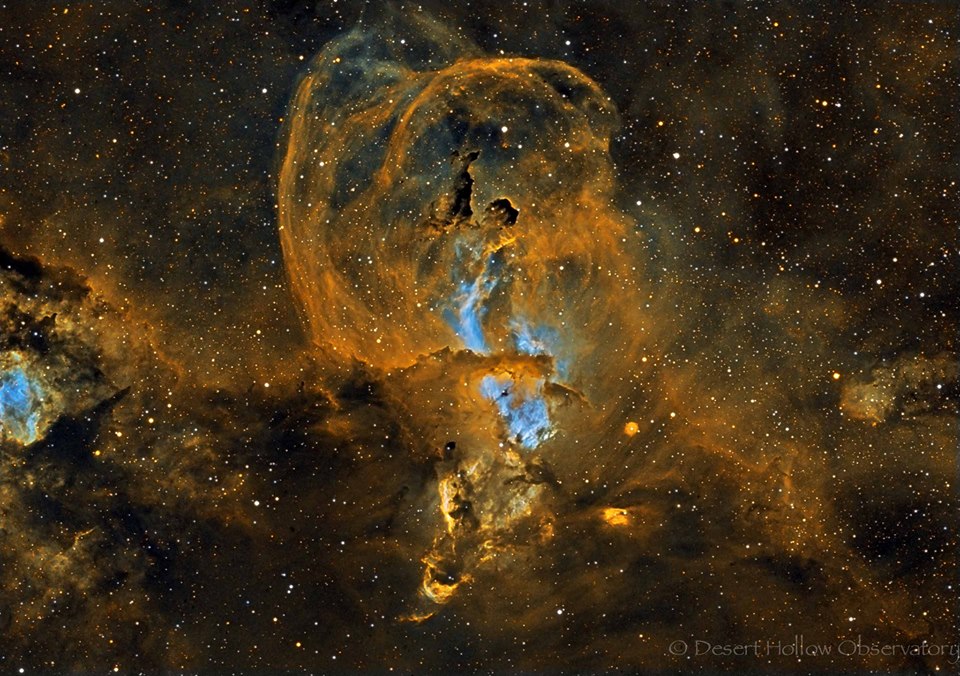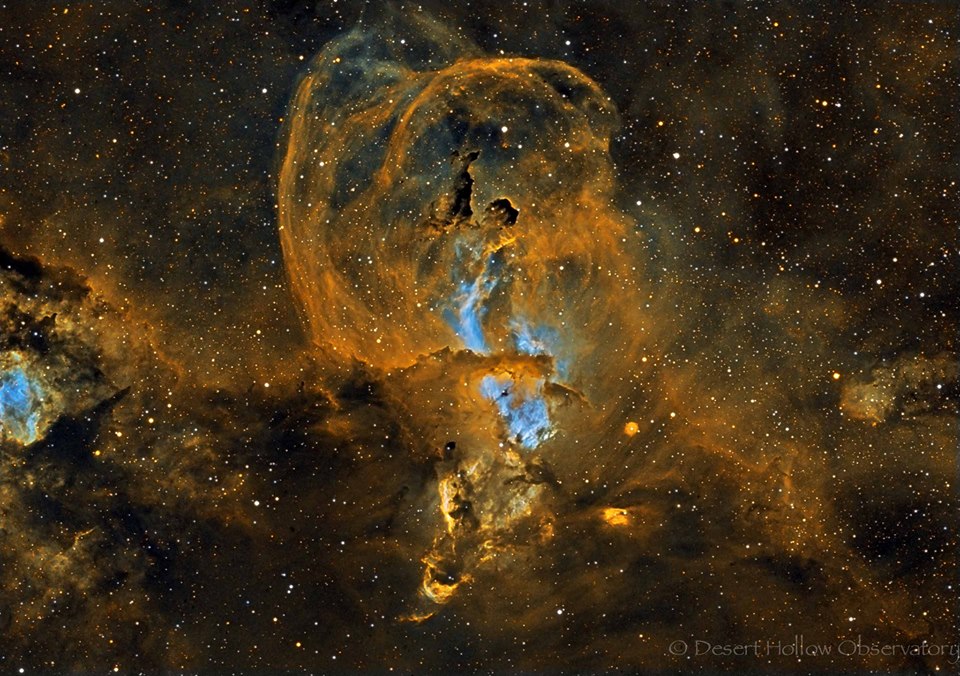
What's happening in the NGC 3582 nebula? Bright stars and interesting molecules are forming. The complex nebula resides in the star forming region called RCW 57. Visible in this image are dense knots of dark interstellar dust, bright stars that have formed in the past few million years, fields of glowing hydrogen gas ionized by these stars, and great loops of gas expelled by dying stars. A detailed study of NGC 3582, also known as NGC 3584 and NGC 3576, uncovered at least 33 massive stars in the end stages of formation, and the clear presence of the complex carbon molecules known as polycyclic aromatic hydrocarbons (PAHs). PAHs are thought to be created in the cooling gas of star forming regions, and their development in the Sun's formation nebula five billion years ago may have been an important step in the development of life on Earth. The above image was taken at the Desert Hollow Observatory north of Phoenix, Arizona, USA. Follow APOD on: Facebook (Daily) (Sky) (Spanish) or Google Plus (Daily) (River)
¿Qué está ocurriendo en la nebulosa NGC 3582? Están formándose estrellas brillantes y moléculas interesantes. La compleja nebulosa se encuentra en la región de formación estelar llamada RCW 57. En esta imagen se pueden ver nudos densos de polvo interestelar oscuro, estrellas brillantes que se formaron en los últimos millones de años, campos de gas hidrógeno que brillan debido a la ionización causada por estas estrellas, y grandes bucles de gas expulsados por estrellas en su etapa final. Un estudio detallado de NGC 3582, también conocida como NGC 3584 y NGC 3576, reveló al menos 33 estrellas masivas en la etapa final de su formación, y la presencia clara de las complejas moléculas de carbono conocidas como hidrocarburos aromáticos policíclicos (PAHs). Se cree que los PAHs se forman en el gas en enfriamiento de las regiones de formación estelar, y su desarrollo en la nebulosa de formación del Sol hace cinco mil millones de años pudo haber sido un paso importante en el desarrollo de la vida en la Tierra. La imagen anterior fue tomada en el Observatorio Desert Hollow, al norte de Phoenix, Arizona, EE. UU.