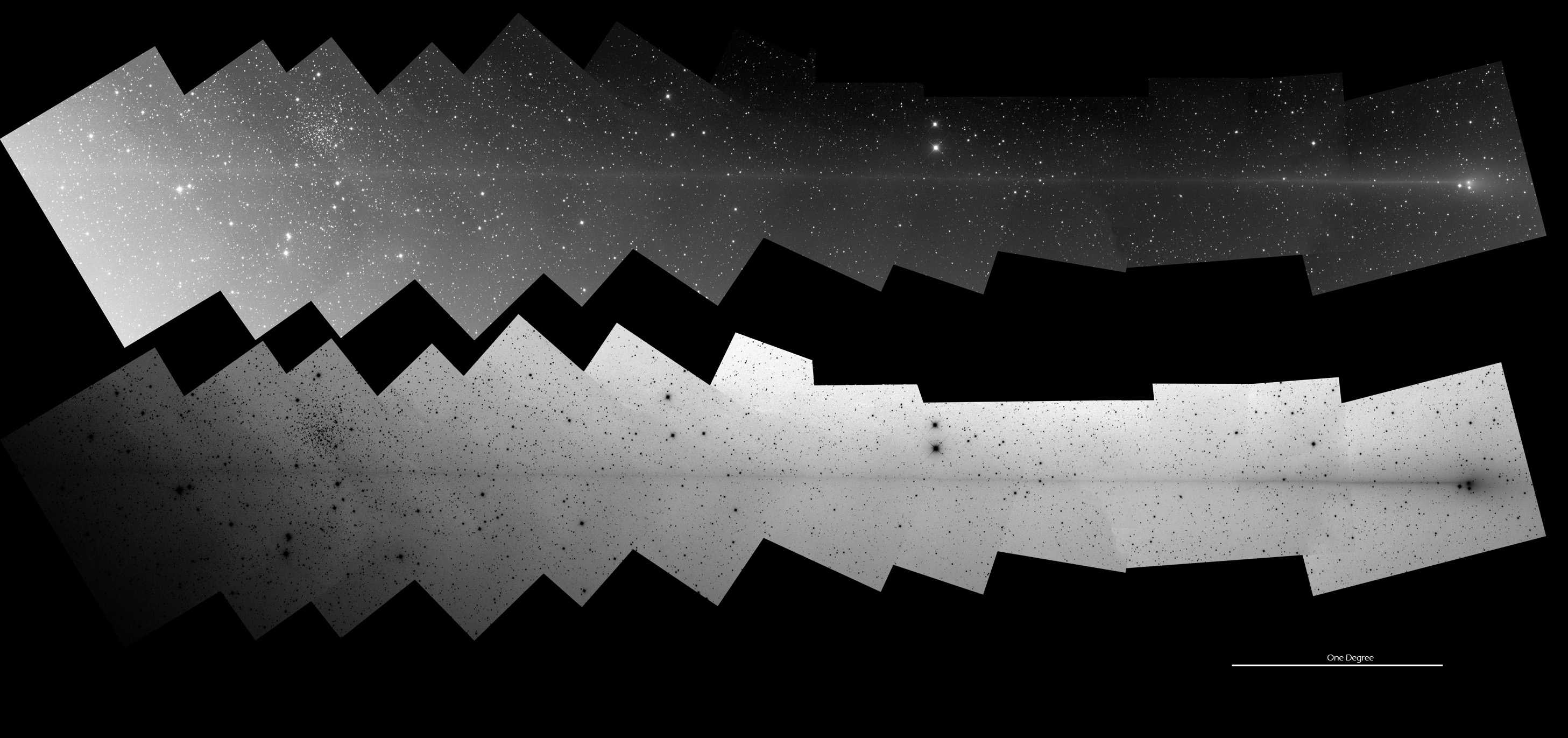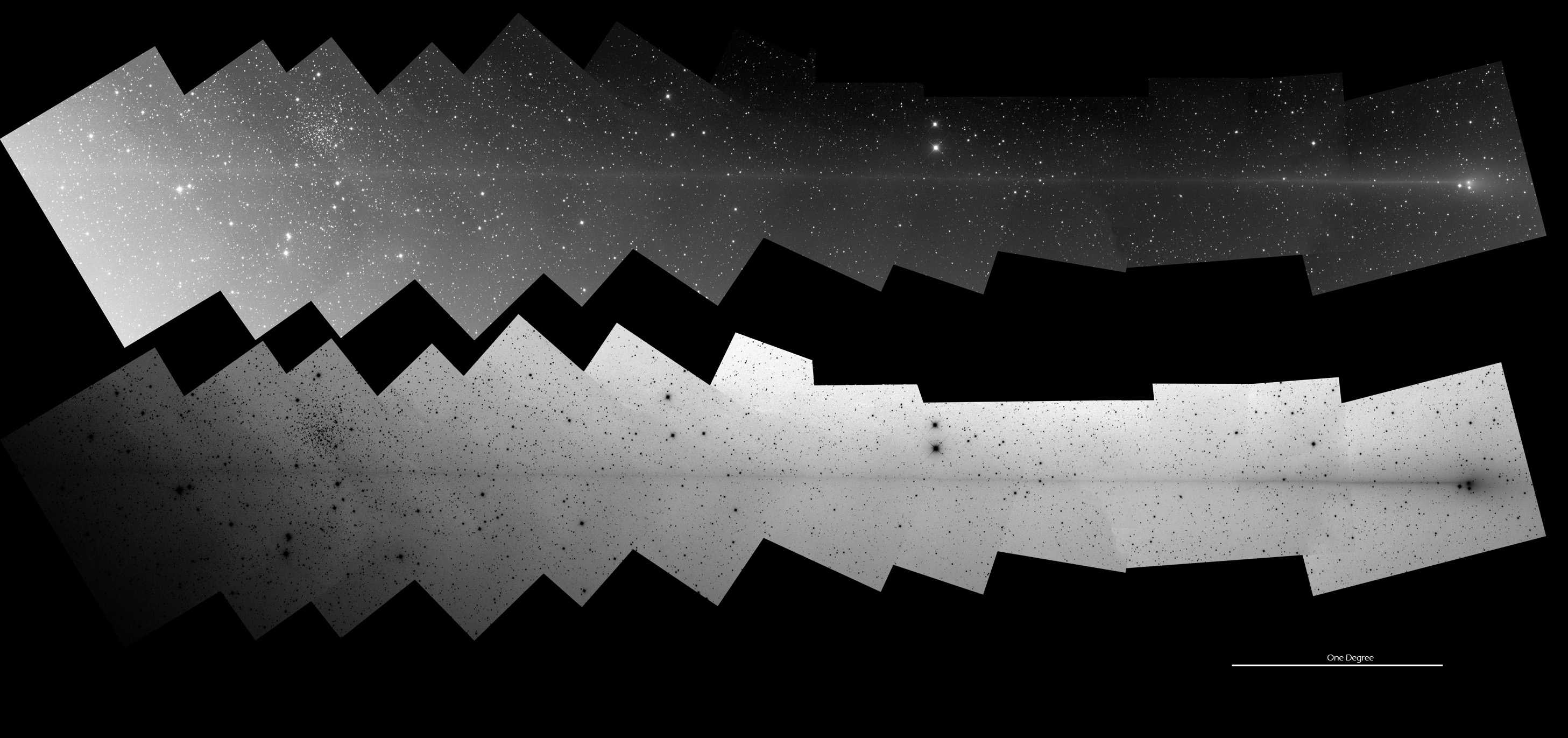
Once known as Earth's sunset comet, PanSTARRS (C/2011 L4) is up all night now, but only for northern hemisphere skygazers. Telescopes are required to track its progress as it fades and heads for the outer solar system. But because planet Earth passed through the comet's orbital plane in late May, PanSTARRS will also be remembered for its remarkably long anti-tail. That edge-on perspective looking along the broad, fanned-out dust tail as it trailed behind the comet created the appearance of an anti-tail pointing in the sunward direction, back toward the inner solar system. Recorded on the night of May 27, this 13 pane mosaic (shown in positive and negative views) follows PanSTARRS' anti-tail as it stretches over 7 degrees from the comet's coma at the far right. The anti-tail was likely much longer, but gets lost in the evening's bright moonlight encroaching on the left edge of the scene. Background star cluster NGC 188 in Cepheus shows up along the way, near top left.
Antes conocido como el cometa de la puesta de sol de la Tierra, PanSTARRS (C/2011 L4) ahora está visible toda la noche, pero solo para observadores del hemisferio norte. Se requieren telescopios para seguir su progreso a medida que se va desvaneciendo y se dirige hacia el sistema solar exterior. Sin embargo, debido a que la Tierra pasó por el plano orbital del cometa a finales de mayo, PanSTARRS también será recordado por su notable cola antiestelar. Esa perspectiva lateral al observar la amplia cola de polvo extendida detrás del cometa creó la apariencia de una cola antiestelar que apunta en la dirección del Sol, hacia el interior del sistema solar. Registrada durante la noche del 27 de mayo, esta mosaico de 13 paneles (mostrado en vistas positivas y negativas) sigue la cola antiestelar de PanSTARRS mientras se extiende más de 7 grados desde la coma del cometa en el extremo derecho. Es probable que la cola antiestelar fuera mucho más larga, pero se pierde en la brillante luz de la luna que invade el borde izquierdo de la escena. El cúmulo estelar de fondo NGC 188 en Cefeo aparece a lo largo del camino, cerca de la parte superior izquierda.