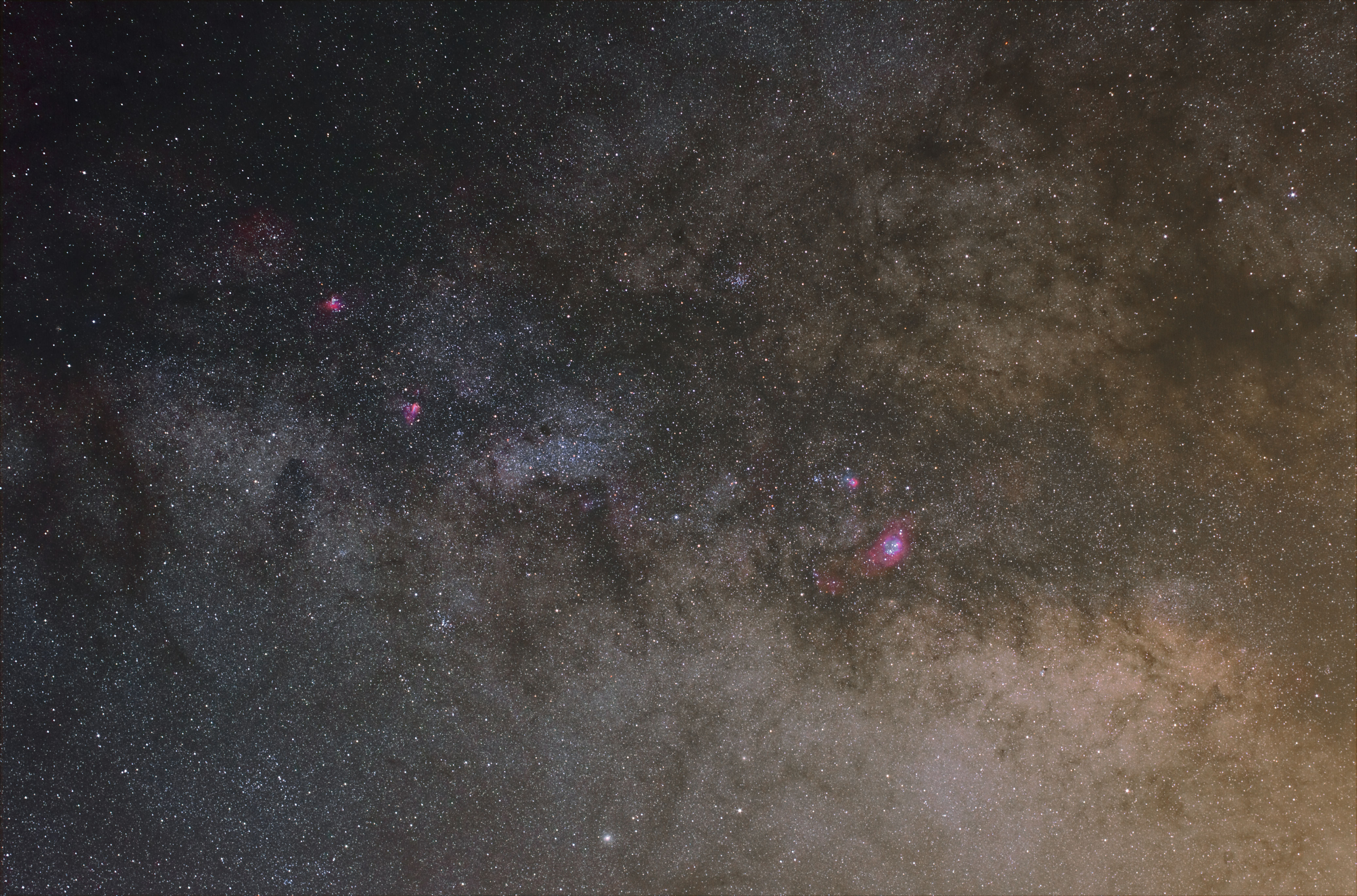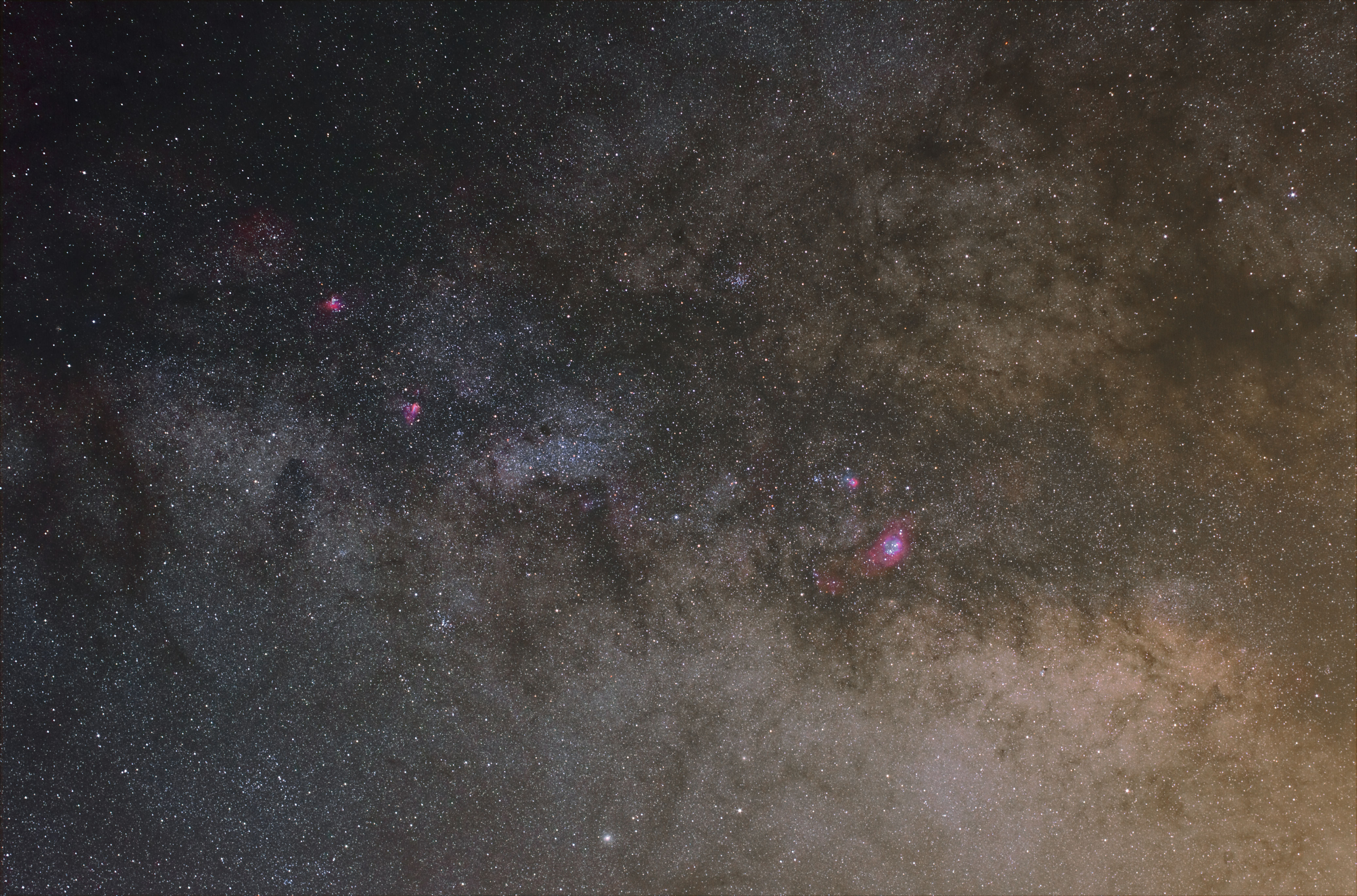
This fifteen degree wide field of view stretches across the crowded starfields of Sagittarius toward the center of our Milky Way galaxy. In fact, the center of the galaxy lies near the right edge of the rich starscape and eleven bright star clusters and nebulae fall near the center of the frame. All eleven are numbered entries in the catalog compiled by 18th century cosmic tourist Charles Messier. Gaining celebrity status with skygazers, M8 (Lagoon), M16 (Eagle), M17 (Omega), and M20 (Trifid) show off the telltale reddish hues of emission nebulae associated with star forming regions. But also eye-catching in small telescopes are star clusters in the crowded region; M18, M21, M22, M23, M25, and M28. Broader in extent than the star clusters themselves, M24 is actually a cloud of the Milky Way's stars thousands of light-years long, seen through a break in the galaxy's veil of obscuring dust. You can put your cursor over the image (or click here) for help identifying Messier's eleven.
Este campo de visión de quince grados abarca las densas regiones estelares de Sagitario hacia el centro de nuestra galaxia Vía Láctea. De hecho, el centro de la galaxia se encuentra cerca del borde derecho de este rico paisaje estelar, y once cúmulos estelares y nebulosas brillantes se ubican cerca del centro de la imagen. Todos los once son entradas numeradas en el catálogo compilado por el turista cósmico del siglo XVIII, Charles Messier. Ganando fama entre los observadores del cielo, M8 (La Laguna), M16 (El Águila), M17 (Omega) y M20 (Trifid) muestran los característicos tonos rojizos de las nebulosas emisoras asociadas a regiones de formación estelar. Pero también llamativos en telescopios pequeños son los cúmulos estelares en esta región densa: M18, M21, M22, M23, M25 y M28. Más extenso que los propios cúmulos estelares, M24 es en realidad una nube de estrellas de la Vía Láctea que se extiende durante miles de años luz, visible a través de una brecha en la cortina de polvo que oculta la galaxia. Puedes colocar el cursor sobre la imagen (o hacer clic aquí) para obtener ayuda para identificar los once objetos de Messier.