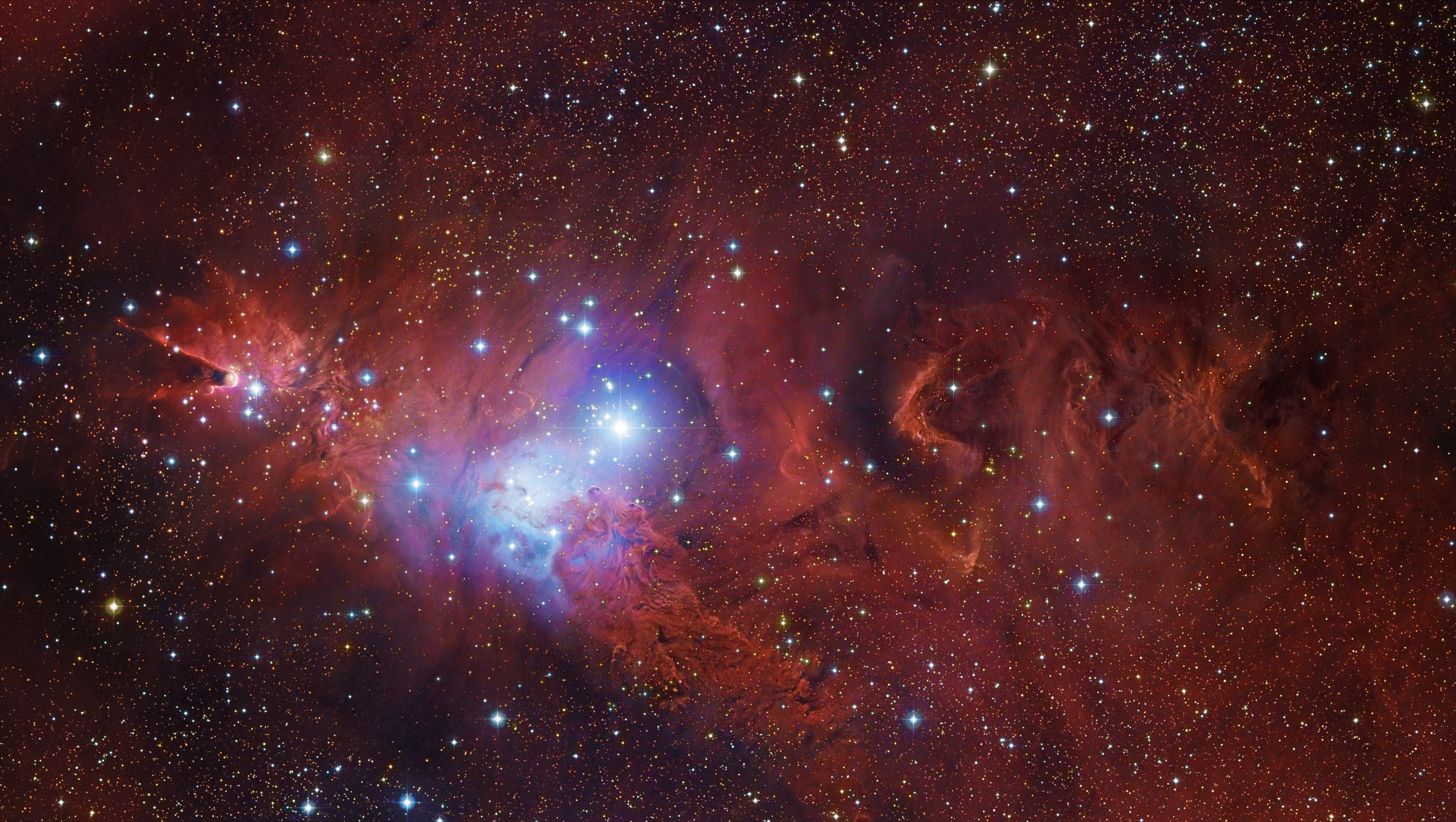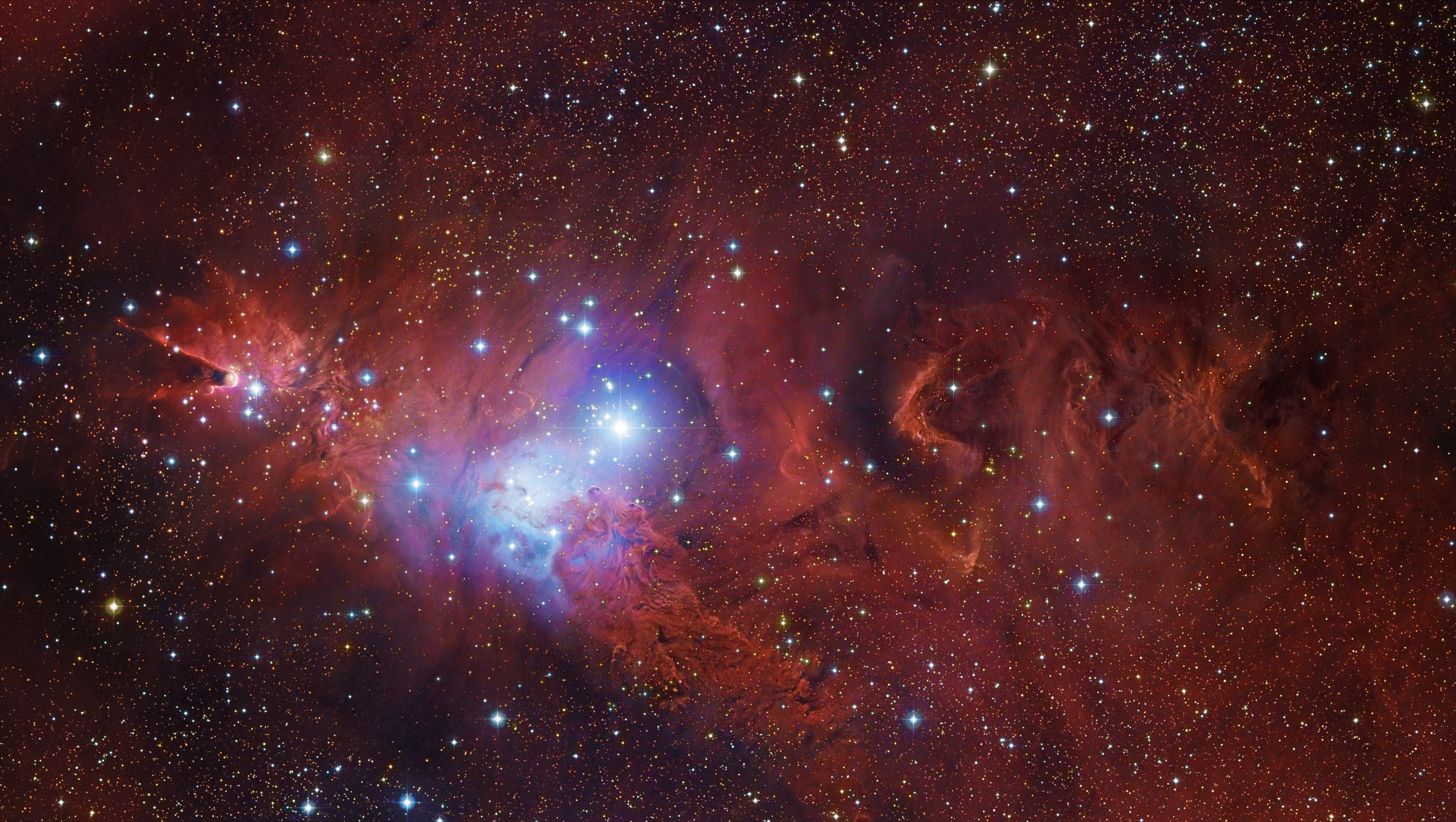
Strange shapes and textures can be found in neighborhood of the Cone Nebula. The unusual shapes originate from fine interstellar dust reacting in complex ways with the energetic light and hot gas being expelled by the young stars. The brightest star on the right of the above picture is S Mon, while the region just below it has been nicknamed the Fox Fur Nebula for its color and structure. The blue glow directly surrounding S Mon results from reflection, where neighboring dust reflects light from the bright star. The red glow that encompasses the whole region results not only from dust reflection but also emission from hydrogen gas ionized by starlight. S Mon is part of a young open cluster of stars named NGC 2264, located about 2500 light years away toward the constellation of the Unicorn (Monoceros). Even though it points right at S Mon, details of the origin of the mysterious geometric Cone Nebula, visible on the far left, remain a mystery.
Formas y texturas extrañas pueden encontrarse en las inmediaciones de la Nebulosa del Cono. Estas formas inusuales provienen del polvo interestelar fino que reacciona de maneras complejas con la luz energética y el gas caliente expulsado por las estrellas jóvenes. La estrella más brillante a la derecha de la imagen anterior es S Mon, mientras que la región justo debajo de ella ha sido apodada Nebulosa de la Piel de Zorro por su color y estructura. El brillo azul que rodea directamente a S Mon se debe a la reflexión, donde el polvo vecino refleja la luz de la estrella brillante. El brillo rojo que abarca toda la región proviene no solo de la reflexión del polvo, sino también de la emisión del gas hidrógeno ionizado por la luz estelar. S Mon forma parte de un joven cúmulo estelar abierto llamado NGC 2264, ubicado aproximadamente a 2500 años luz hacia la constelación del Unicornio (Monoceros). Aunque apunta directamente hacia S Mon, los detalles del origen de la misteriosa nebulosa geométrica del Cono, visible en el extremo izquierdo, aún permanecen como un misterio.