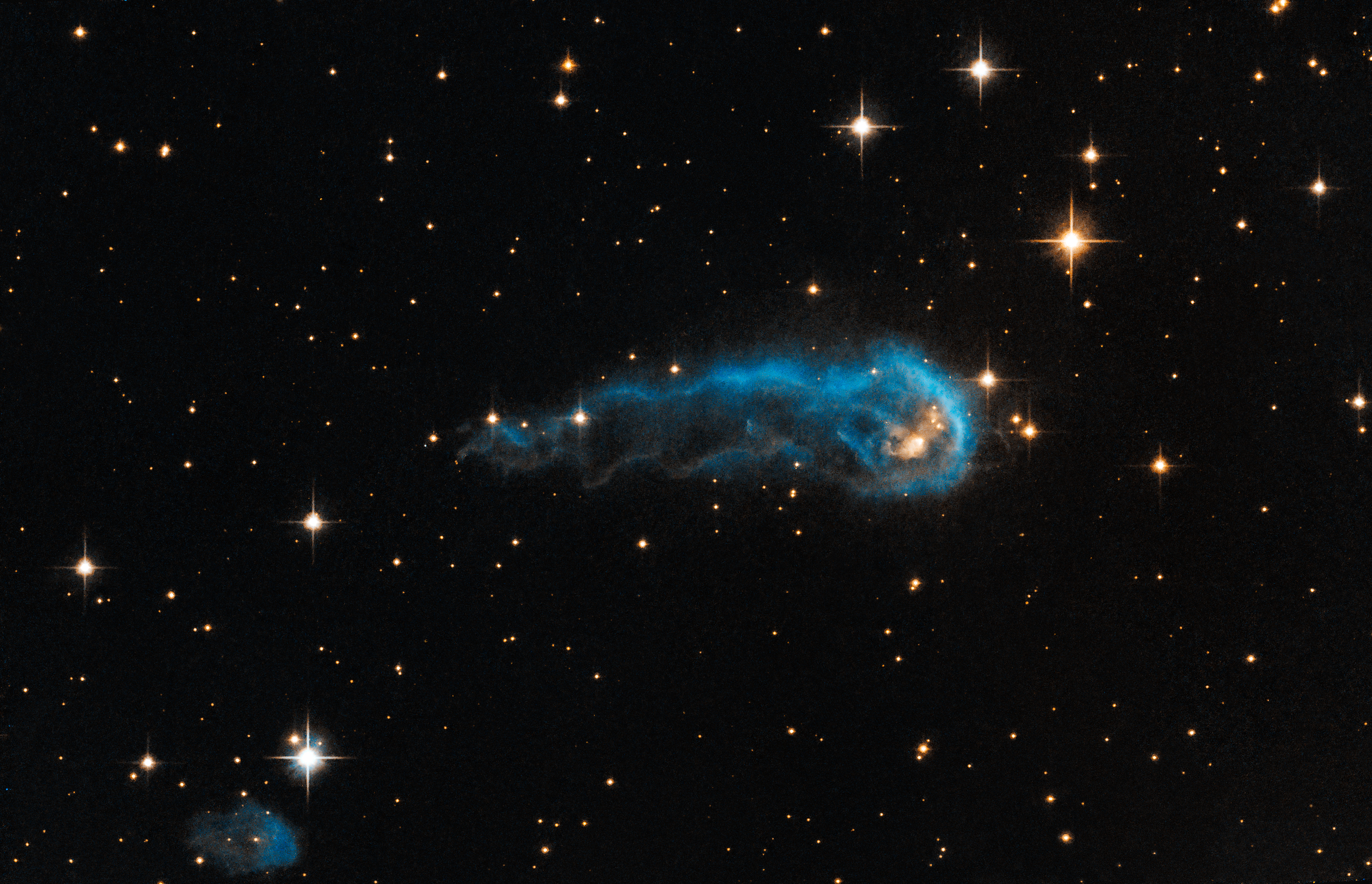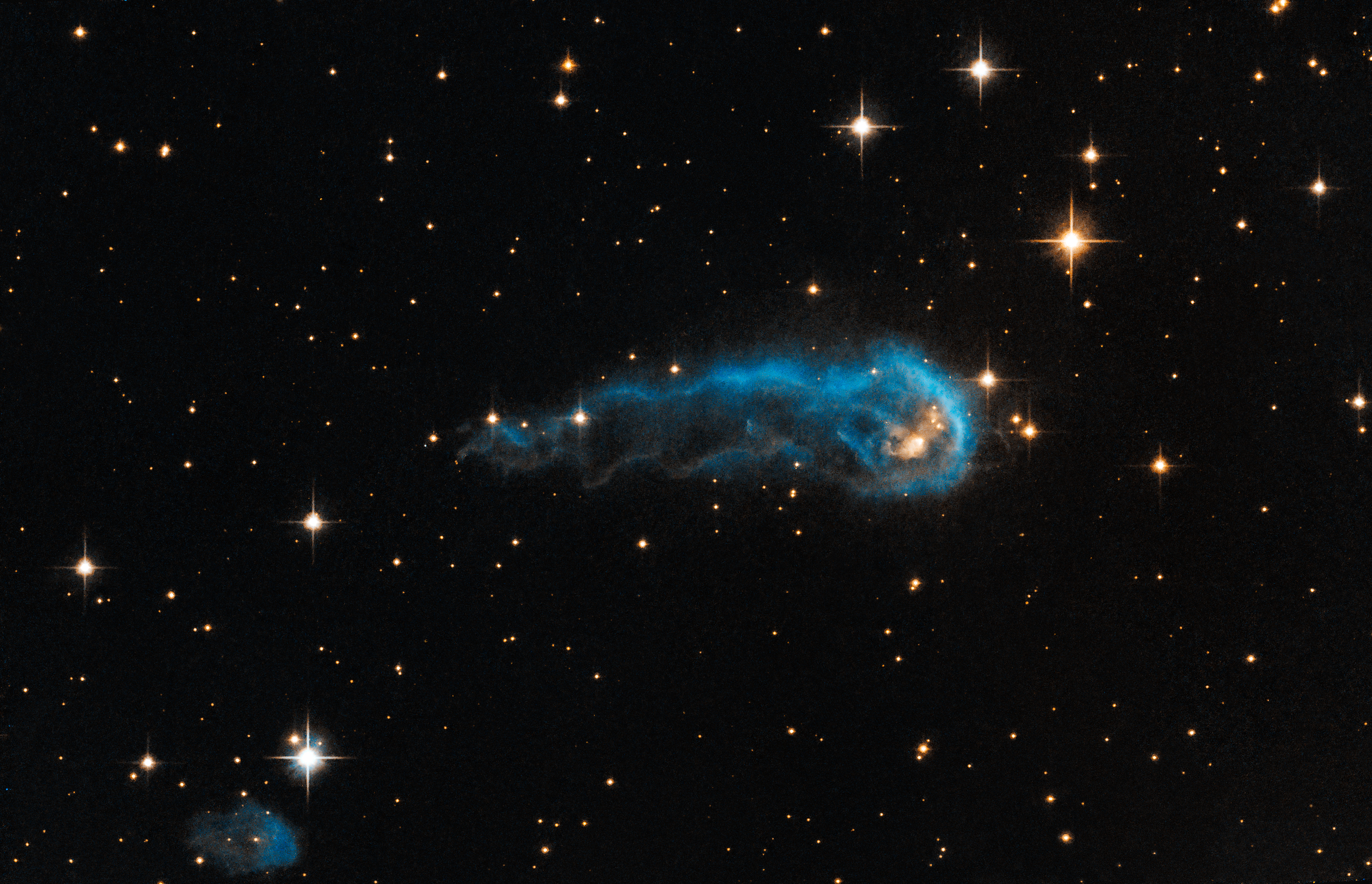
Will this caterpillar-shaped interstellar cloud one day evolve into a butterfly-shaped nebula? No one is sure. What is sure is that IRAS 20324+4057, on the inside, is contracting to form a new star. On the outside, however, energetic winds are blowing and energetic light is eroding away much of the gas and dust that might have been used to form the star. Therefore, no one is sure what mass the resulting star will have, and, therefore, no one knows the fate of this star. Were the winds and light to whittle the protostar down near the mass of the Sun, the outer atmosphere of this new star may one day expand into a planetary nebula, possibly even one that looks like a butterfly. Alternatively, if the stellar cocoon retains enough mass, a massive star will form that will one day explode in a supernova. The eroding protostellar nebula IRAS 20324+4057 spans about one light year and lies about 4,500 light years away toward the constellation of the Swan (Cygnus). The above image of IRAS 20324+4057 was taken with the Hubble Space Telescope in 2006 but released last week. The battle between gravity and light will likely take over 100,000 years to play out, but clever observations and deductions may yet yield telling clues well before that.
¿Esta nube interestelar de forma de gusano evolucionará algún día en una nebulosa de forma de mariposa? Nadie lo sabe con certeza. Lo que sí está claro es que IRAS 20324+4057, en el interior, está contrayéndose para formar una nueva estrella. Sin embargo, en el exterior, vientos energéticos están soplando y la luz energética está erosionando gran parte del gas y el polvo que podrían haber sido utilizados para formar la estrella. Por lo tanto, nadie sabe con certeza qué masa tendrá la estrella resultante, y, por lo tanto, nadie conoce el destino de esta estrella. Si los vientos y la luz redujeran al protostrella a una masa cercana a la del Sol, la atmósfera exterior de esta nueva estrella podría expandirse algún día en una nebulosa planetaria, posiblemente incluso una que se parezca a una mariposa. Por otro lado, si la envoltura estelar conserva suficiente masa, se formará una estrella masiva que algún día explotará en una supernova. La nebulosa protostelar en evaporación IRAS 20324+4057 abarca aproximadamente un año luz y se encuentra a unos 4500 años luz de distancia, hacia la constelación del Cisne (Cygnus). La imagen de IRAS 20324+4057 mostrada aquí fue tomada con el Telescopio Espacial Hubble en 2006, pero fue liberada la semana pasada. La batalla entre la gravedad y la luz probablemente tomará más de 100 000 años para desarrollarse, pero observaciones inteligentes y deducciones pueden aún proporcionar pistas reveladoras mucho antes de eso.