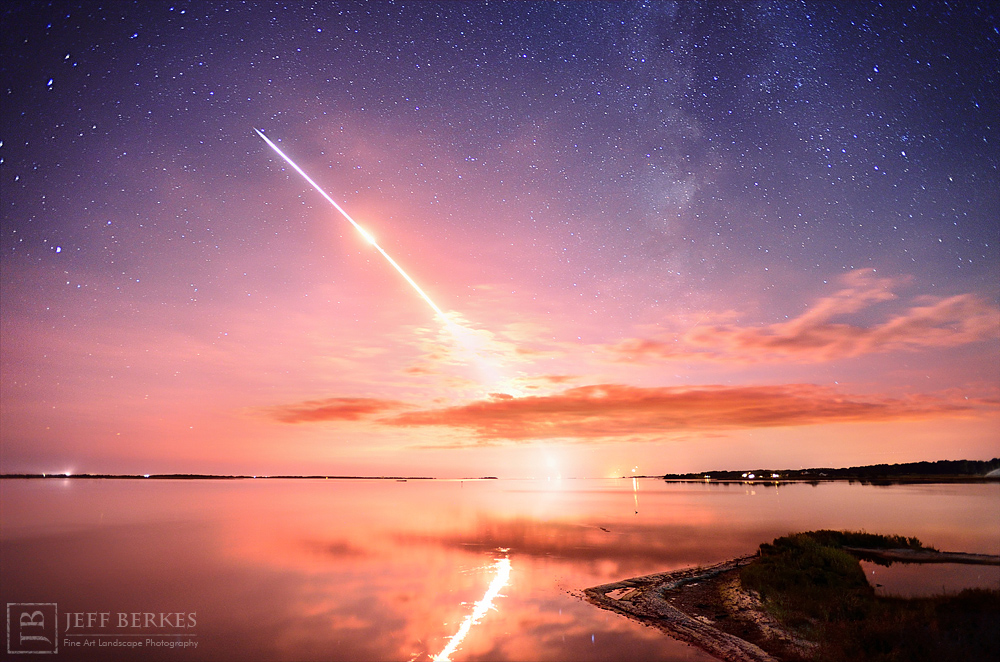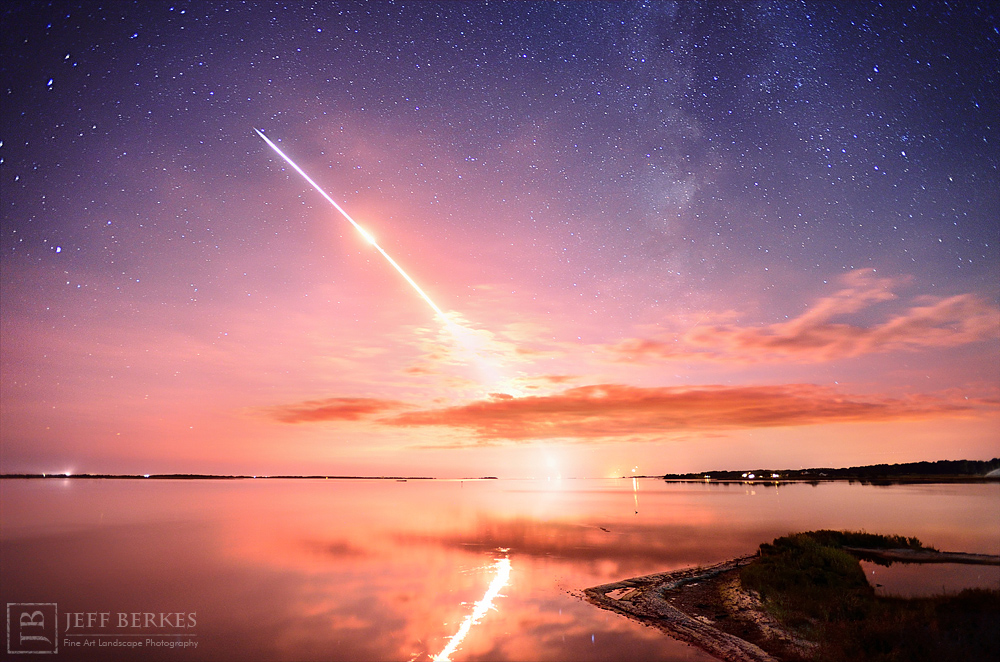
On September 6, a starry night and the Milky Way witnessed the launch of a Minotaur V rocket from NASA's Wallops Flight Facility on Wallops Island, Virginia. So did a large part of the eastern United States, as the spectacular night launch was easily visible even from light polluted urban areas. This 35 second exposure captures part of the rocket's initial launch streak and 2nd stage ignition flare along with a fiery reflection in calm waters. The stunning view faces south and west from a vantage point overlooking Sinepuxent Bay in Maryland about 20 miles north of the launch pad. Heading east over the Atlantic, the multi-stage rocket placed LADEE, the Lunar Atmosphere and Dust Environment Explorer, into a highly elliptical Earth orbit to begin its journey to the Moon.
El 6 de septiembre, una noche estrellada y la Vía Láctea presenciaron el lanzamiento de un cohete Minotaur V desde la instalación de vuelo de la NASA en Wallops Island, Virginia. Así lo hizo también gran parte del este de los Estados Unidos, ya que el espectacular lanzamiento nocturno fue fácilmente visible incluso desde áreas urbanas con alta contaminación lumínica. Esta exposición de 35 segundos captura parte de la estela inicial del cohete y la chispa de ignición de su segunda etapa, junto con una reflejación incandescente en aguas tranquilas. La impresionante vista se obtuvo mirando hacia el sur y el oeste desde un punto de observación que domina la bahía de Sinepuxent en Maryland, aproximadamente 20 millas al norte del lugar de lanzamiento. Dirigiéndose hacia el este sobre el Atlántico, el cohete de múltiples etapas colocó a LADEE, el Explorador del Ambiente Atmosférico Lunar y del Polvo, en una órbita terrestre altamente elíptica para comenzar su viaje hacia la Luna.