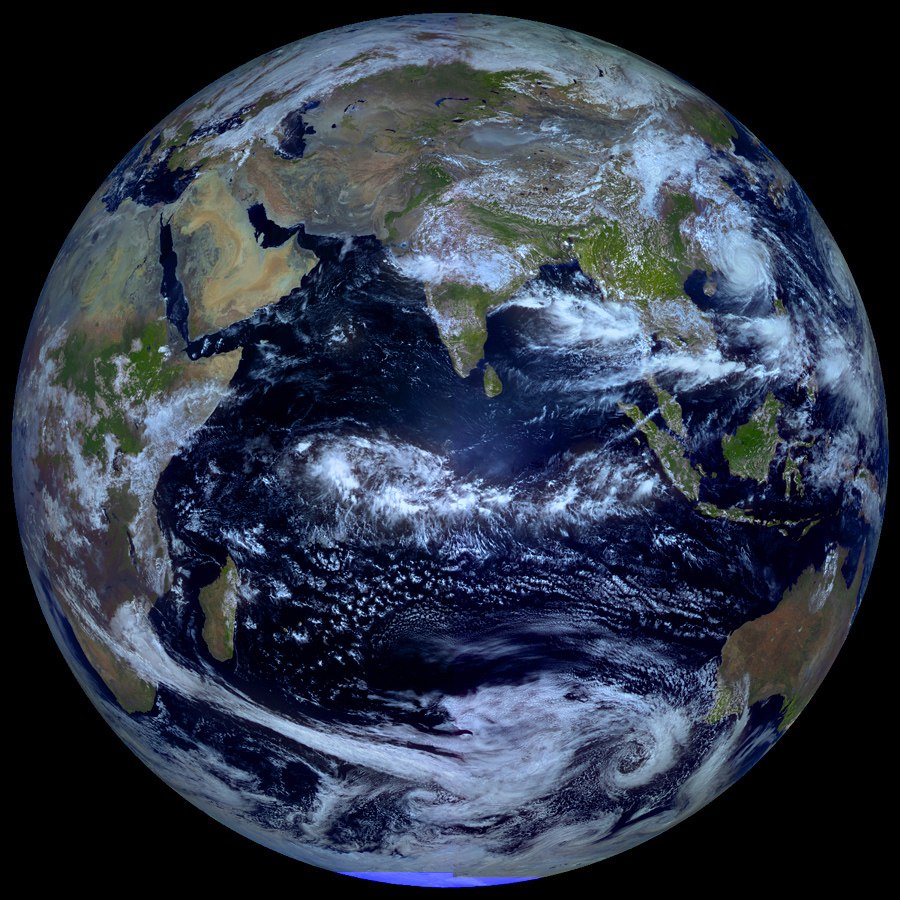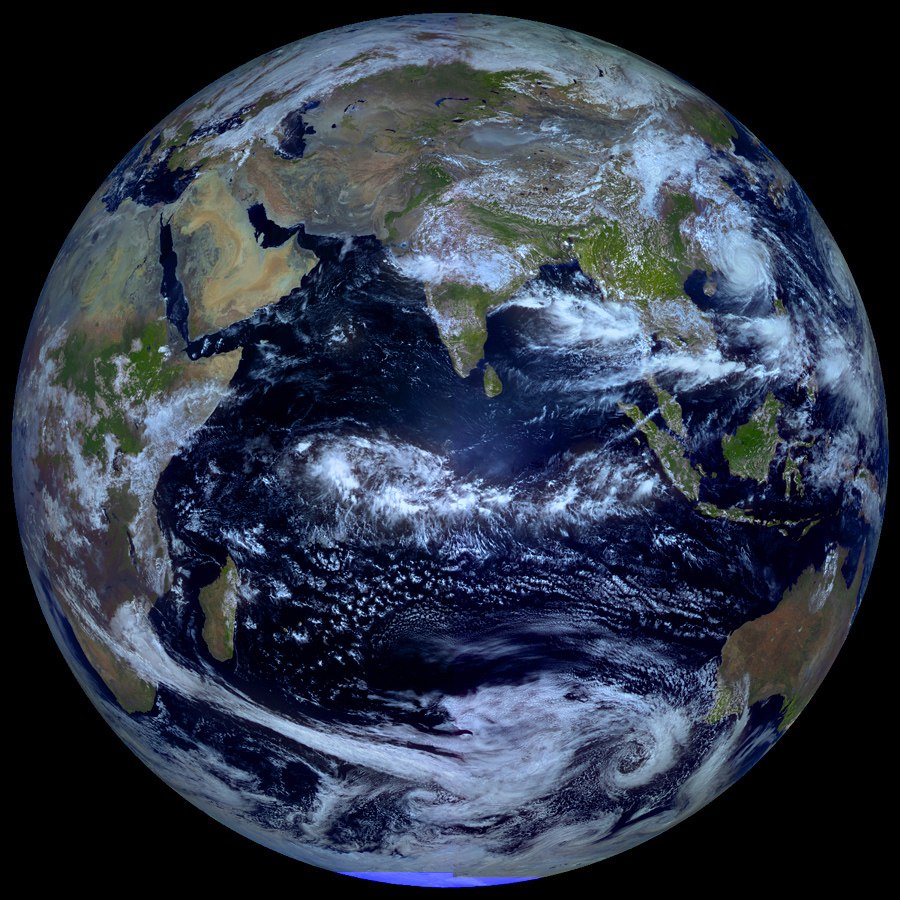
From a geostationary orbit 36,000 kilometers above the equator, Russian meteorological satellite Elektro-L takes high-resolution images of our fair planet every 30 minutes. But only twice a year, during an Equinox, can it capture an image like this one, showing an entire hemisphere bathed in sunlight. At an Equinox, the Earth's axis of rotation is not tilted toward or away from the Sun, so the solar illumination can extend to both the planet's poles. Of course, this Elektro-L picture was recorded on September 22nd, at the northern hemisphere's autumnal equinox. For a moment on that date, the Sun was behind the geostationary satellite and a telltale glint of reflected sunlight is seen crossing the equator, at the location on the planet with satellite and sun directly overhead (5MB animated gif).
Desde una órbita geoestacionaria a 36.000 kilómetros sobre el ecuador, el satélite meteorológico ruso Elektro-L toma imágenes de alta resolución de nuestro planeta cada 30 minutos. Pero solo dos veces al año, durante un equinoccio, puede capturar una imagen como esta, mostrando un hemisferio completamente iluminado por el Sol. Durante un equinoccio, el eje de rotación de la Tierra no está inclinado hacia ni alejado del Sol, por lo que la iluminación solar puede llegar a ambos polos del planeta. Por supuesto, esta imagen de Elektro-L fue grabada el 22 de septiembre, durante el equinoccio de otoño en el hemisferio norte. En un momento de esa fecha, el Sol estaba detrás del satélite geoestacionario y un reflejo característico de la luz solar se ve cruzando el ecuador, en la ubicación del planeta donde el satélite y el Sol estaban directamente sobre la cabeza (animación en formato gif de 5 MB).