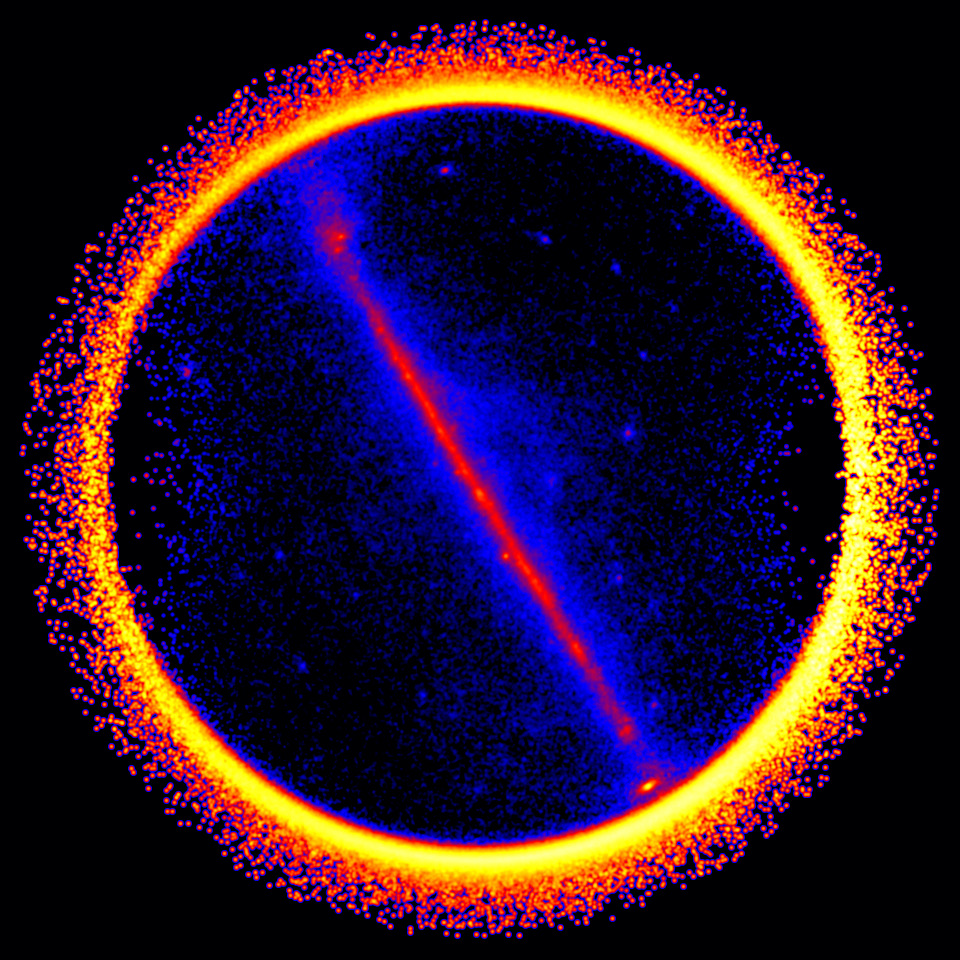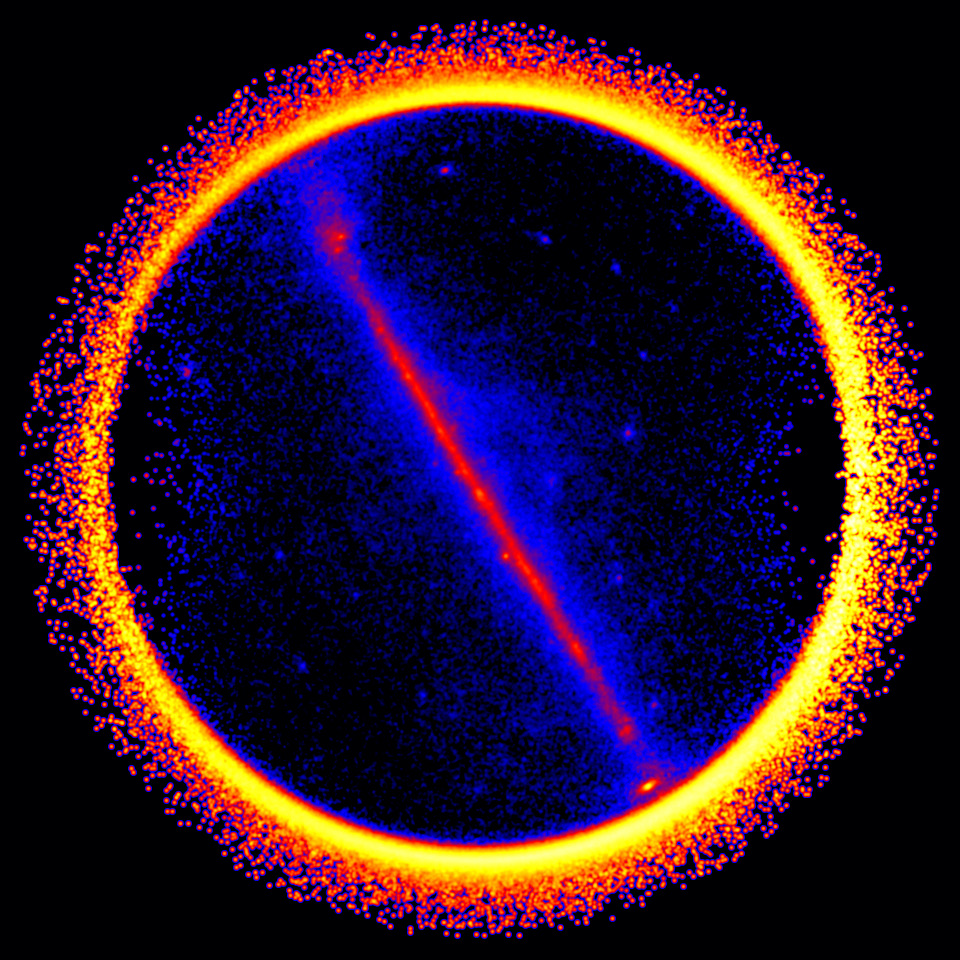
For an Earth-orbiting gamma-ray telescope, Earth is actually the brightest source of gamma-rays, the most energetic form of light. Gamma-rays from Earth are produced when high energy particles, cosmic rays from space, crash into the atmosphere. While that interaction blocks harmful radiation from reaching the surface, those gamma-rays dominate in this remarkable Earth and sky view from the orbiting Fermi Gamma-ray Space Telescope's Large Area Telescope. The image was constructed using only observations made when the center of our Milky Way galaxy was near the zenith, directly above the Fermi satellite. The zenith is mapped to the center of the field. The Earth and points near the nadir, directly below the satellite, are mapped to the edges of the field resulting in an Earth and all-sky projection from Fermi's orbital perspective. The color scheme shows low intensities of gamma-rays as blue and high intensities as yellowish hues on a logarithmic scale. Our fair planet's brighter gamma-ray glow floods the edges of field, the high intensity yellow ring tracing Earth's limb. Gamma-ray sources in the sky along the relatively faint Milky Way stretch diagonally across the middle. Launched June 11, 2008 to explore the high-energy Universe, this week Fermi celebrated its 2,000th day in low Earth orbit.
Para un telescopio de rayos gamma en órbita terrestre, la Tierra es en realidad la fuente más brillante de rayos gamma, la forma más energética de luz. Los rayos gamma de la Tierra se producen cuando partículas de alta energía, los rayos cósmicos del espacio, chocan contra la atmósfera. Aunque esa interacción bloquea la radiación dañina de llegar a la superficie, esos rayos gamma dominan en esta impresionante vista de la Tierra y el cielo desde el telescopio espacial Fermi de rayos gamma, con su Gran Área de Telescopio. La imagen fue construida utilizando solo observaciones realizadas cuando el centro de nuestra galaxia Vía Láctea estaba cerca del cenit, directamente sobre el satélite Fermi. El cenit se mapea al centro del campo. La Tierra y los puntos cercanos al nadir, directamente debajo del satélite, se mapean a los bordes del campo, resultando en una proyección de la Tierra y del cielo completo desde la perspectiva orbital de Fermi. La paleta de colores muestra intensidades bajas de rayos gamma como azules y altas intensidades como tonos amarillentos en una escala logarítmica. La brillante emisión de rayos gamma de nuestro planeta inunda los bordes del campo, con el anillo amarillo de alta intensidad siguiendo el borde de la Tierra. Las fuentes de rayos gamma en el cielo a lo largo de la Vía Láctea, relativamente tenue, se extienden diagonalmente a través del centro. Lanzado el 11 de junio de 2008 para explorar el universo de alta energía, esta semana Fermi celebró su 2000º día en órbita terrestre baja.