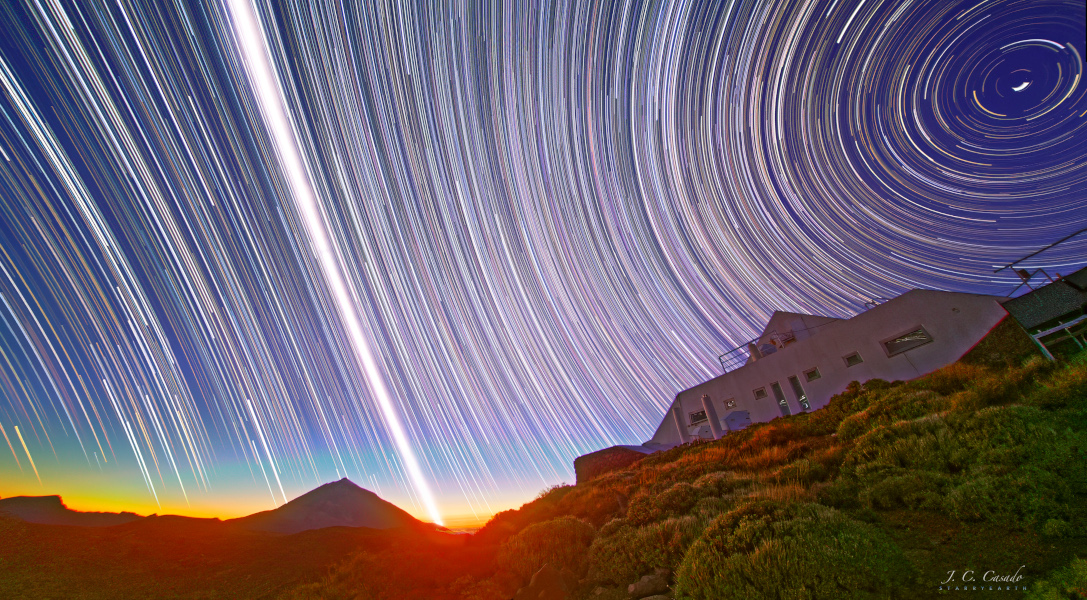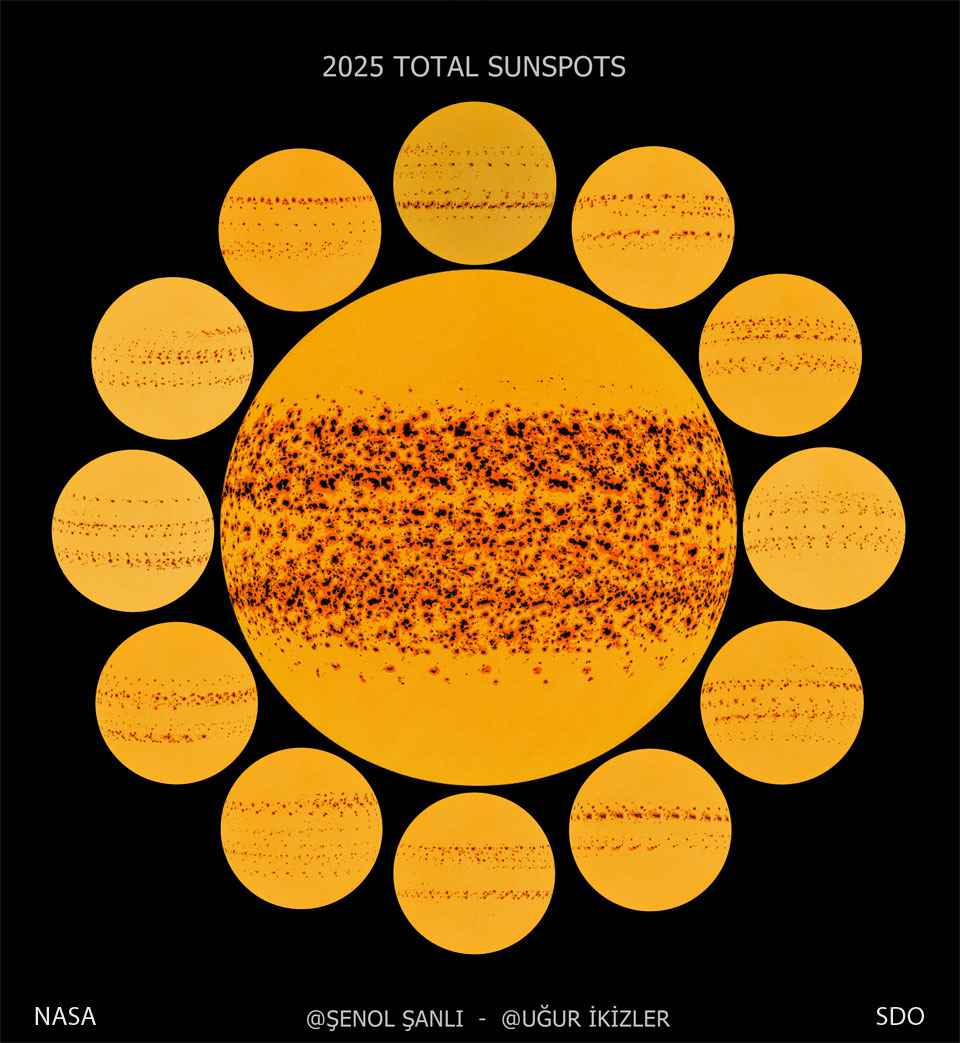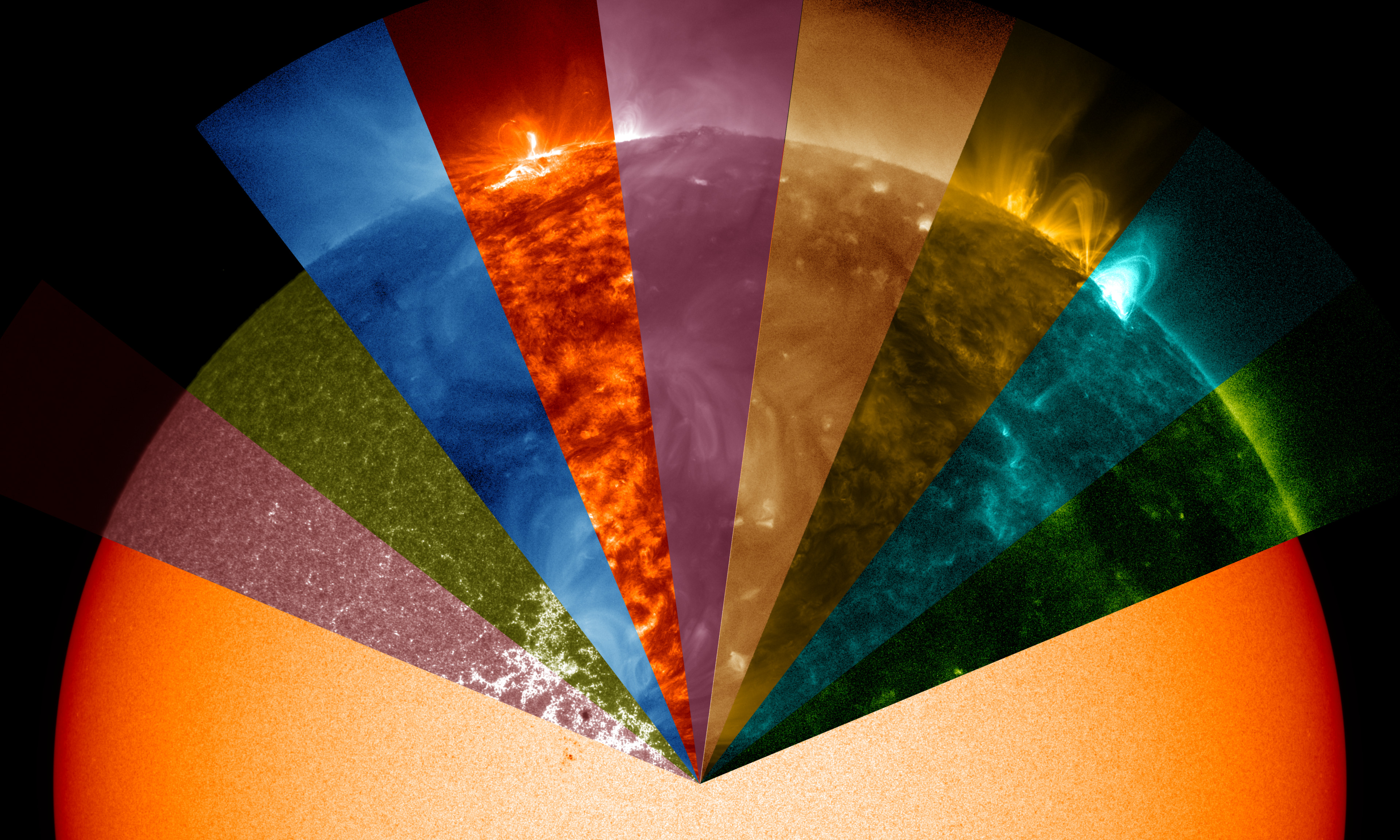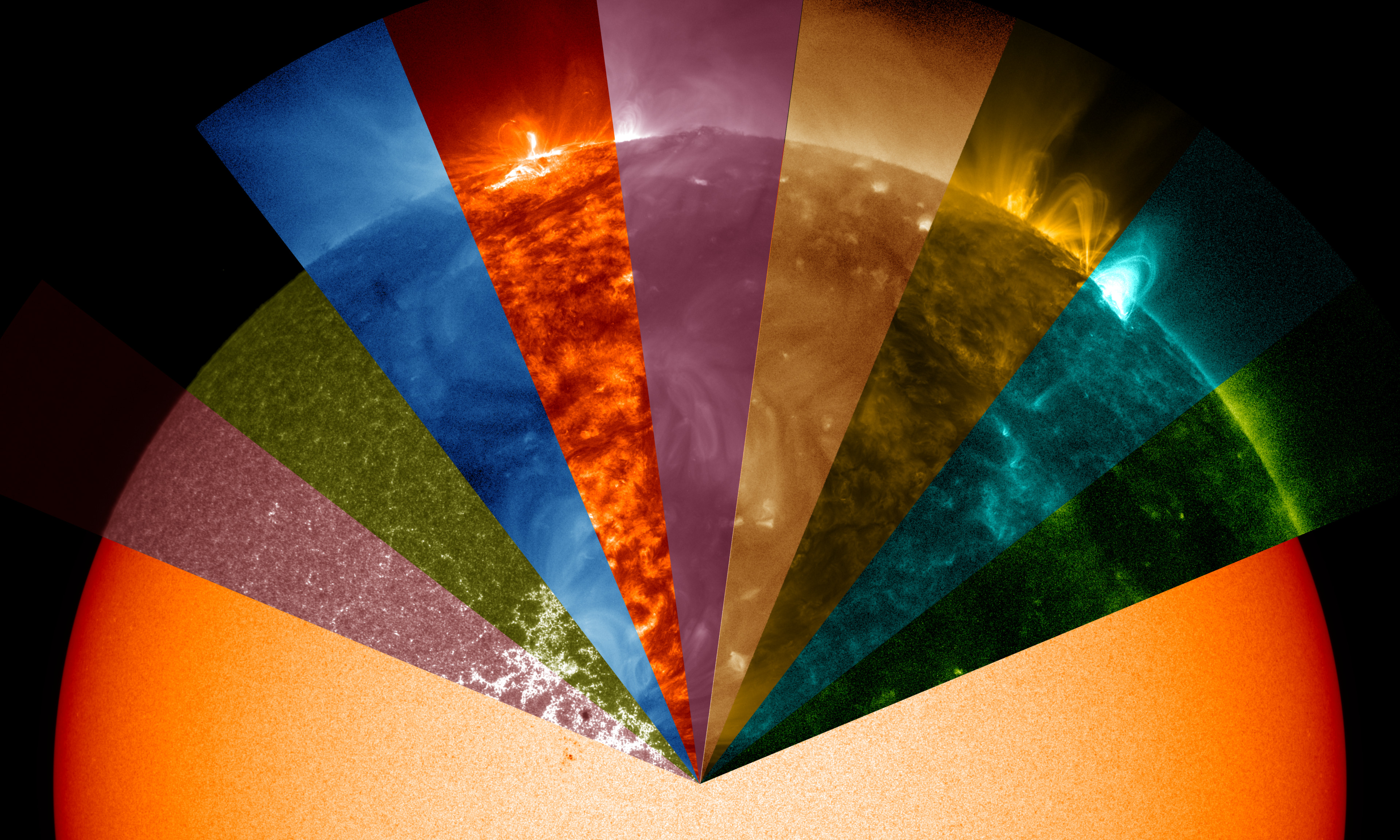
Today, the solstice is at 17:11 Universal Time, the Sun reaching the southernmost declination in its yearly journey through planet Earth's sky. The December solstice marks the astronomical beginning of winter in the northern hemisphere and summer in the south. To celebrate, explore this creative visualization of the Sun from visible to extreme ultraviolet wavelengths, using image data from the orbiting Solar Dynamics Observatory (SDO). Against a base image made at a visible wavelengths, the wedge-shaped segments show the solar disk at increasingly shorter ultraviolet and extreme ultraviolet wavelengths. Shown in false-color and rotating in a clockwise direction, the filters decrease in wavelength from 170 nanometers (in pink) through 9.4 nanometers (green). At shorter wavelengths, the altitude and temperature of the regions revealed in the solar atmosphere tend to increase. Bright at visible wavelengths, the solar photosphere looks darker in the ultraviolet, but sunspots glow and bright plasma traces looping magnetic fields. Watch the filters sweep around the solar disk in this animation of SDO's multiwavelength view of the Sun.
Hoy, el solsticio ocurre a las 17:11 en Tiempo Universal, momento en el que el Sol alcanza su declinación más meridional en su trayectoria anual a través del cielo terrestre. El solsticio de diciembre marca el inicio astronómico del invierno en el hemisferio norte y el verano en el hemisferio sur. Para celebrarlo, explore esta visualización creativa del Sol, que abarca desde longitudes de onda visibles hasta el ultravioleta extremo, utilizando datos de imagen del Observatorio Dinámico Solar (SDO) en órbita. Sobre una imagen base capturada en longitudes de onda visibles, los segmentos en forma de cuña muestran el disco solar a longitudes de onda cada vez más cortas en el ultravioleta y el ultravioleta extremo. Mostrados en color falso y rotando en sentido horario, los filtros disminuyen en longitud de onda desde 170 nanómetros (en rosa) hasta 9.4 nanómetros (en verde). A longitudes de onda más cortas, la altitud y la temperatura de las regiones reveladas en la atmósfera solar tienden a aumentar. Brillante en longitudes de onda visibles, la fotosfera solar aparece más oscura en el ultravioleta, pero las manchas solares brillan y el plasma brillante sigue las líneas de campo magnético en forma de bucles. Observe cómo los filtros se desplazan alrededor del disco solar en esta animación de la visión multibanda del Sol según SDO.