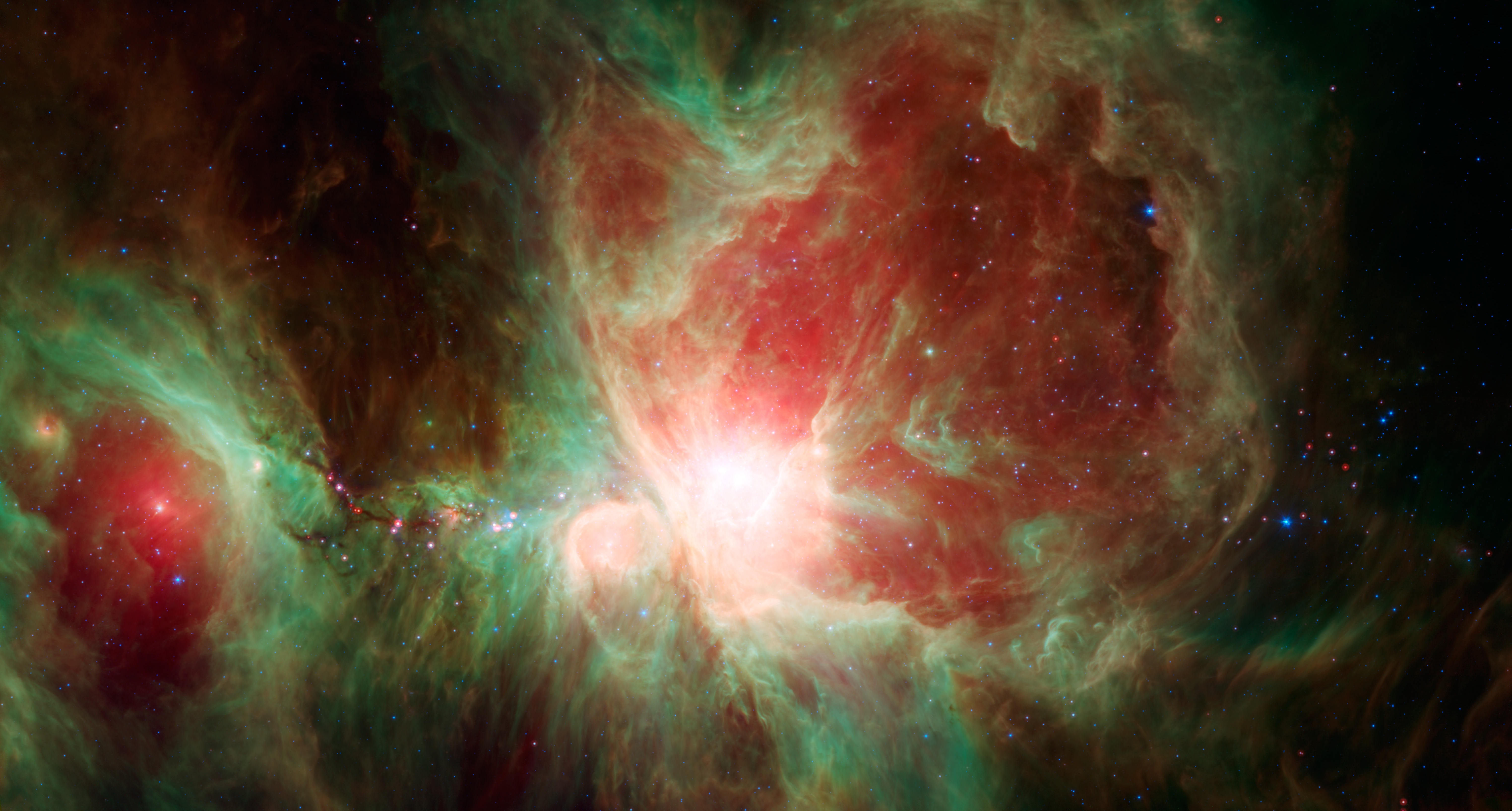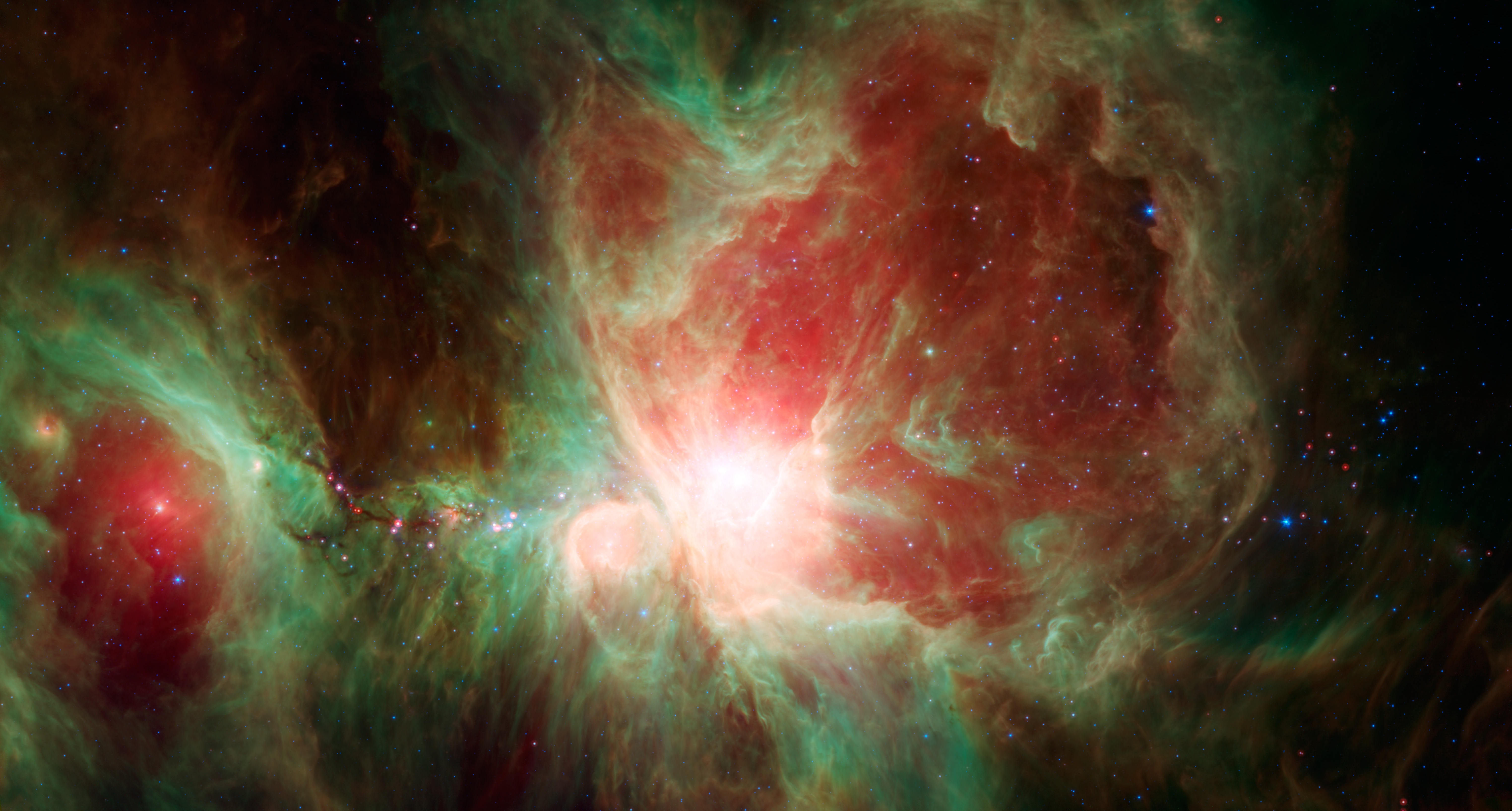
Few cosmic vistas excite the imagination like the Orion Nebula, an immense stellar nursery some 1,500 light-years away. This stunning false-color view spans about 40 light-years across the region, constructed using infrared data from the Spitzer Space Telescope. Compared to its visual wavelength appearance, the brightest portion of the nebula is likewise centered on Orion's young, massive, hot stars, known as the Trapezium Cluster. But the infrared image also detects the nebula's many protostars, still in the process of formation, seen here in red hues. In fact, red spots along the dark dusty filament to the left of the bright cluster include the protostar cataloged as HOPS 68, recently found to have crystals of the silicate mineral olivine within its protostellar envelope.
Pocas vistas cósmicas estimulan la imaginación tanto como la nebulosa de Orión, un inmenso criadero estelar ubicado a unos 1.500 años luz de distancia. Esta impresionante imagen en falso color abarca aproximadamente 40 años luz a través de la región, construida utilizando datos infrarrojos del telescopio espacial Spitzer. En comparación con su apariencia en longitudes de onda visibles, la porción más brillante de la nebulosa también está centrada en las jóvenes, masivas y calientes estrellas de Orión, conocidas como el Grupo Trapecio. Sin embargo, la imagen en infrarrojos también detecta muchas protostrellas de la nebulosa, aún en proceso de formación, visibles aquí en tonos rojos. De hecho, las manchas rojas a lo largo del filamento oscuro y polvoriento a la izquierda del grupo brillante incluyen la protostrella catalogada como HOPS 68, recientemente descubierta como poseedora de cristales del mineral silicato olivino dentro de su envoltura protostelar.