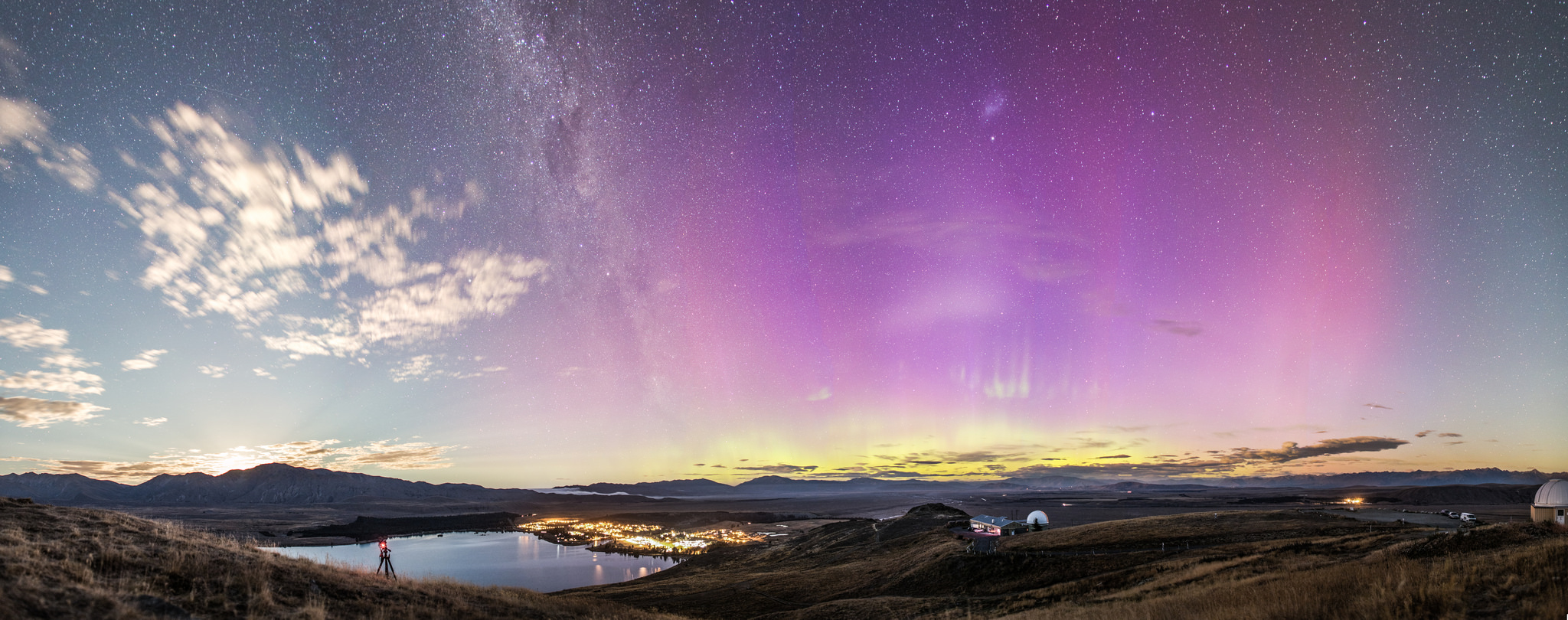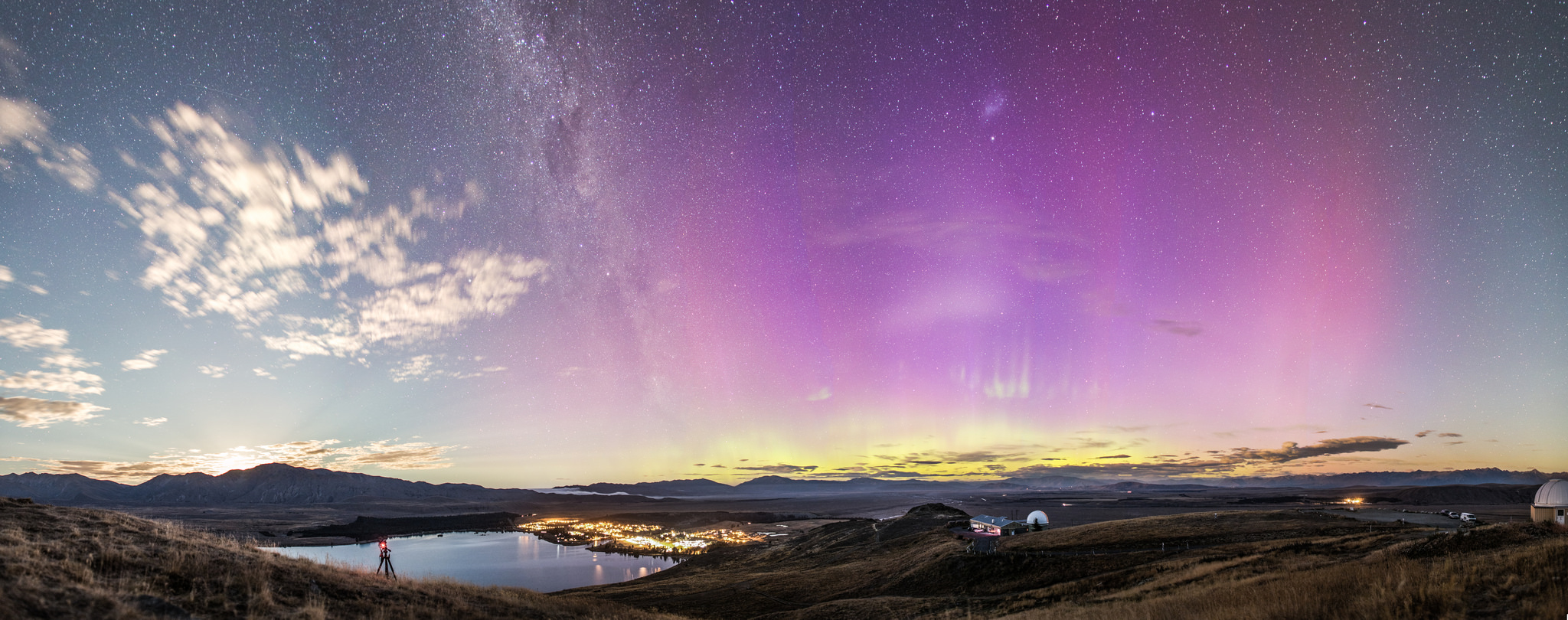
Sometimes the more you look at an image, the more you see. Such may be the case for this beautiful nighttime panorama taken last week in New Zealand. Visible right off, on the far left, are common clouds, slightly altered by the digital fusion of combining 11 separate 20-second exposures. More striking, perhaps, is the broad pink aurora that dominates the right part of the image, a less common auroral color that is likely tinted by excited oxygen atoms high in Earth's atmosphere. Keep looking and you might notice a bright light just beyond the mountain on the left. That is the rising Moon -- and an even closer look will reveal faint crepuscular rays emanating from it. Musing over the image center may cause you to notice the central band of the Milky Way Galaxy which here appears to divide, almost vertically, the left clouds from the right aurora. Inspecting the upper right of the image reveals a fuzzy patch, high in the sky, that is the Small Magellanic Cloud. Numerous stars discretely populate the distant background. Back on Earth, the image foreground features two domes of the Mt. John University Observatory and a camera tripod looking to capture much of this scene over a serene Lake Tekapo.
A veces, cuanto más miras una imagen, más cosas ves. Puede ser el caso de esta hermosa panorámica nocturna tomada la semana pasada en Nueva Zelanda. A simple vista, en el extremo izquierdo, se ven nubes comunes, ligeramente alteradas por la fusión digital de 11 exposiciones separadas de 20 segundos cada una. Más llamativo, quizás, es el amplio arco de color rosa que domina la parte derecha de la imagen, un color auroral menos común que probablemente se debe al tinte producido por átomos de oxígeno excitados en altas capas de la atmósfera terrestre. Si continúas observando, podrías notar una luz brillante justo más allá de la montaña en el lado izquierdo. Esa es la Luna en su fase de salida — y una mirada más cercana revelará tenues rayos crepusculares que emanan de ella. Al reflexionar sobre el centro de la imagen, podrías darte cuenta de la banda central de la Galaxia de la Vía Láctea, que aquí parece dividir, casi verticalmente, las nubes del lado izquierdo del arco auroral del lado derecho. Al inspeccionar la parte superior derecha de la imagen, se revela un parche difuso, alto en el cielo, que es la Nube Magallánica Pequeña. Numerosas estrellas poblan discretamente el fondo lejano. De vuelta a la Tierra, el primer plano de la imagen muestra dos cúpulas del Observatorio Universitario de Mt. John y un trípode de cámara que intenta capturar gran parte de este escenario sobre el tranquilo Lago Tekapo.