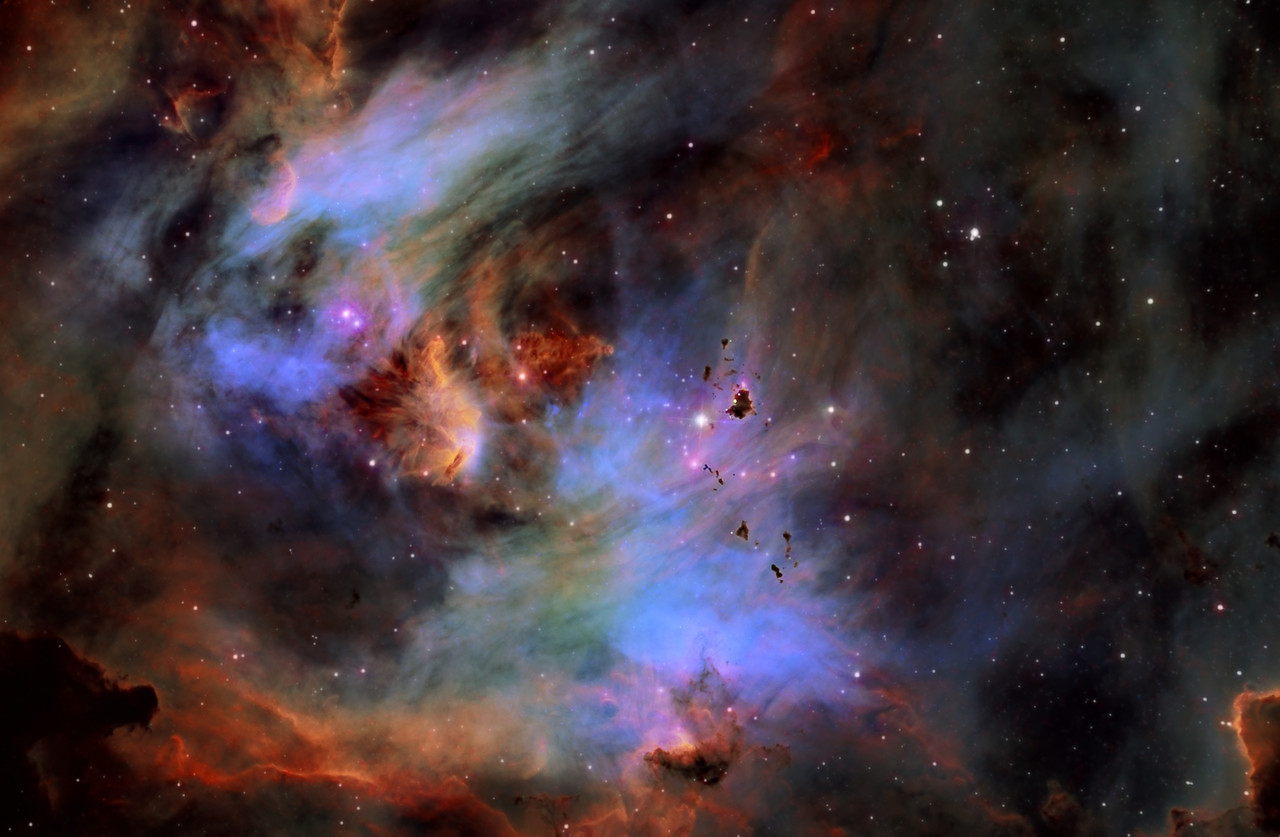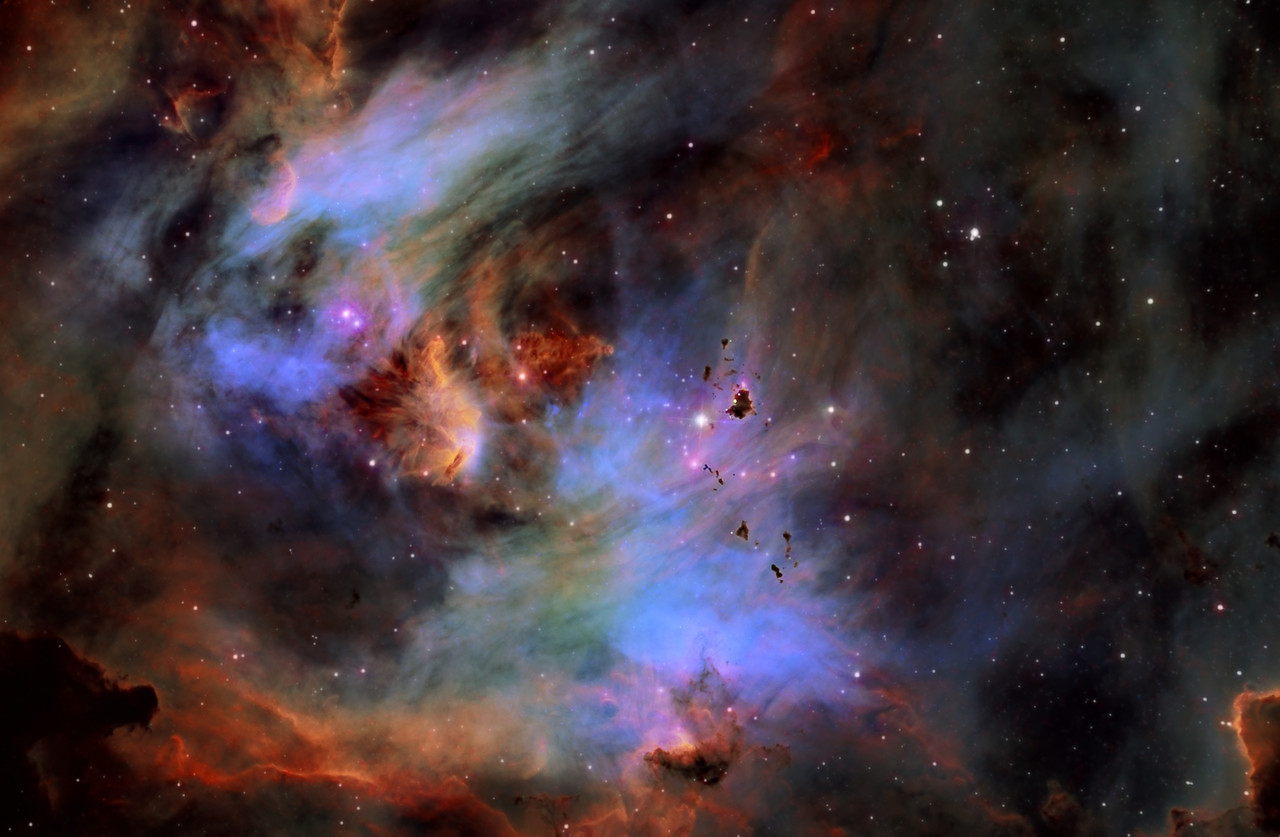
The eggs from this chicken may form into stars. The above pictured emission nebula, cataloged as IC 2944, is called the Running Chicken Nebula for the shape of its greater appearance. The image was taken recently from Siding Spring Observatory in Australia and presented in scientifically assigned colors. Seen near the center of the image are small, dark molecular clouds rich in obscuring cosmic dust. Called Thackeray's Globules for their discoverer, these "eggs" are potential sites for the gravitational condensation of new stars, although their fates are uncertain as they are also being rapidly eroded away by the intense radiation from nearby young stars. Together with patchy glowing gas and complex regions of reflecting dust, these massive and energetic stars form the open cluster Collinder 249. This gorgeous skyscape spans about 70 light-years at the nebula's estimated 6,000 light-year distance.
Los huevos de este pollo pueden convertirse en estrellas. La nebulosa de emisión mostrada en la imagen, catalogada como IC 2944, se llama Nebulosa del Pollo Corriendo por la forma de su apariencia general. La imagen fue tomada recientemente desde el Observatorio Siding Spring en Australia y presentada en colores asignados científicamente. Cerca del centro de la imagen se ven pequeñas nubes moleculares oscuras ricas en polvo cósmico oscurecedor. Llamadas Globulos de Thackeray por su descubridor, estos "huevos" son posibles lugares para la condensación gravitacional de nuevas estrellas, aunque sus destinos son inciertos ya que también están siendo erosionados rápidamente por la intensa radiación de estrellas jóvenes cercanas. Juntas con el gas brillante en parches y regiones complejas de polvo reflectante, estas estrellas masivas y energéticas forman el cúmulo abierto Collinder 249. Esta hermosa escena del cielo abarca aproximadamente 70 años luz a la distancia estimada de 6,000 años luz de la nebulosa.