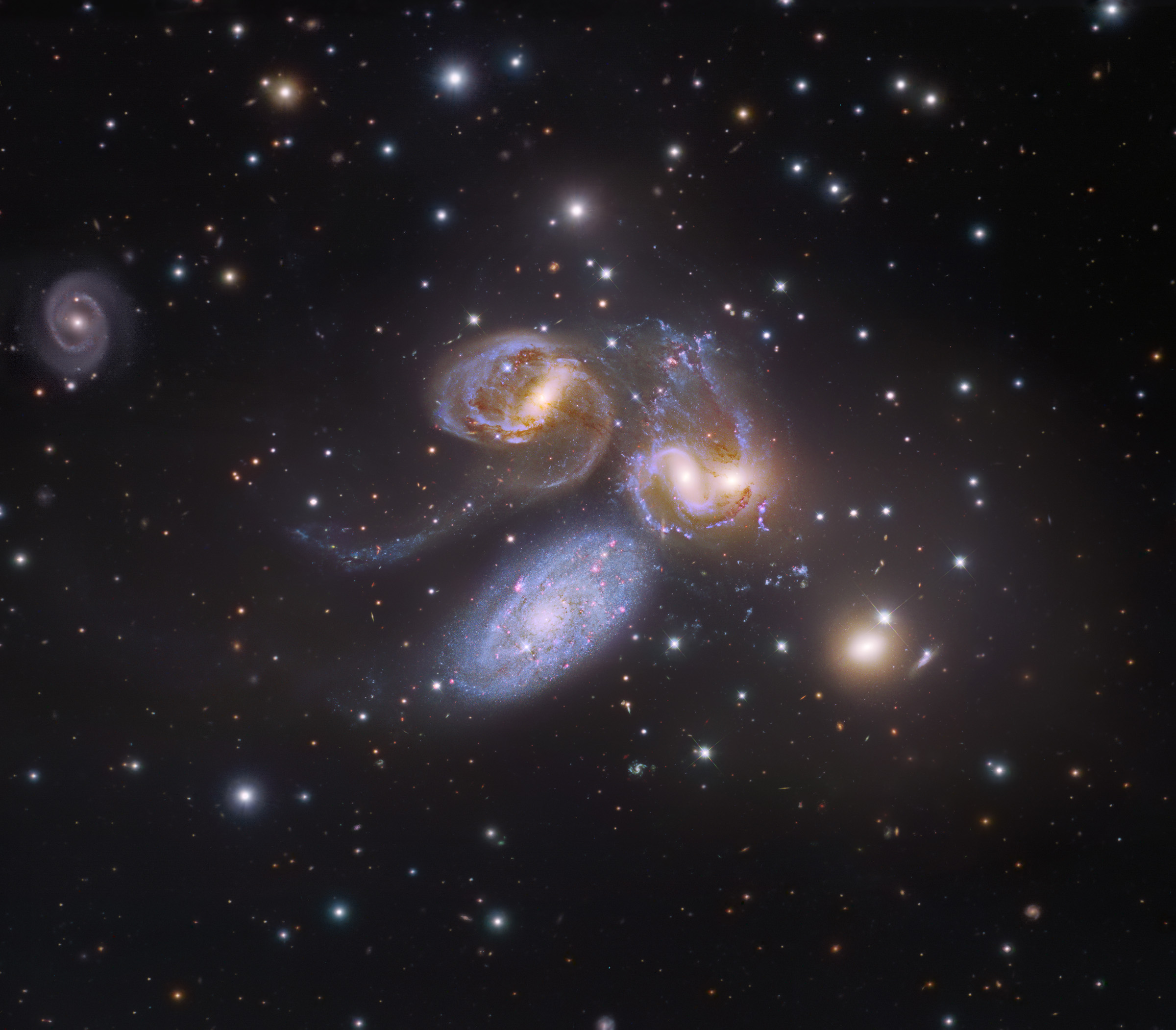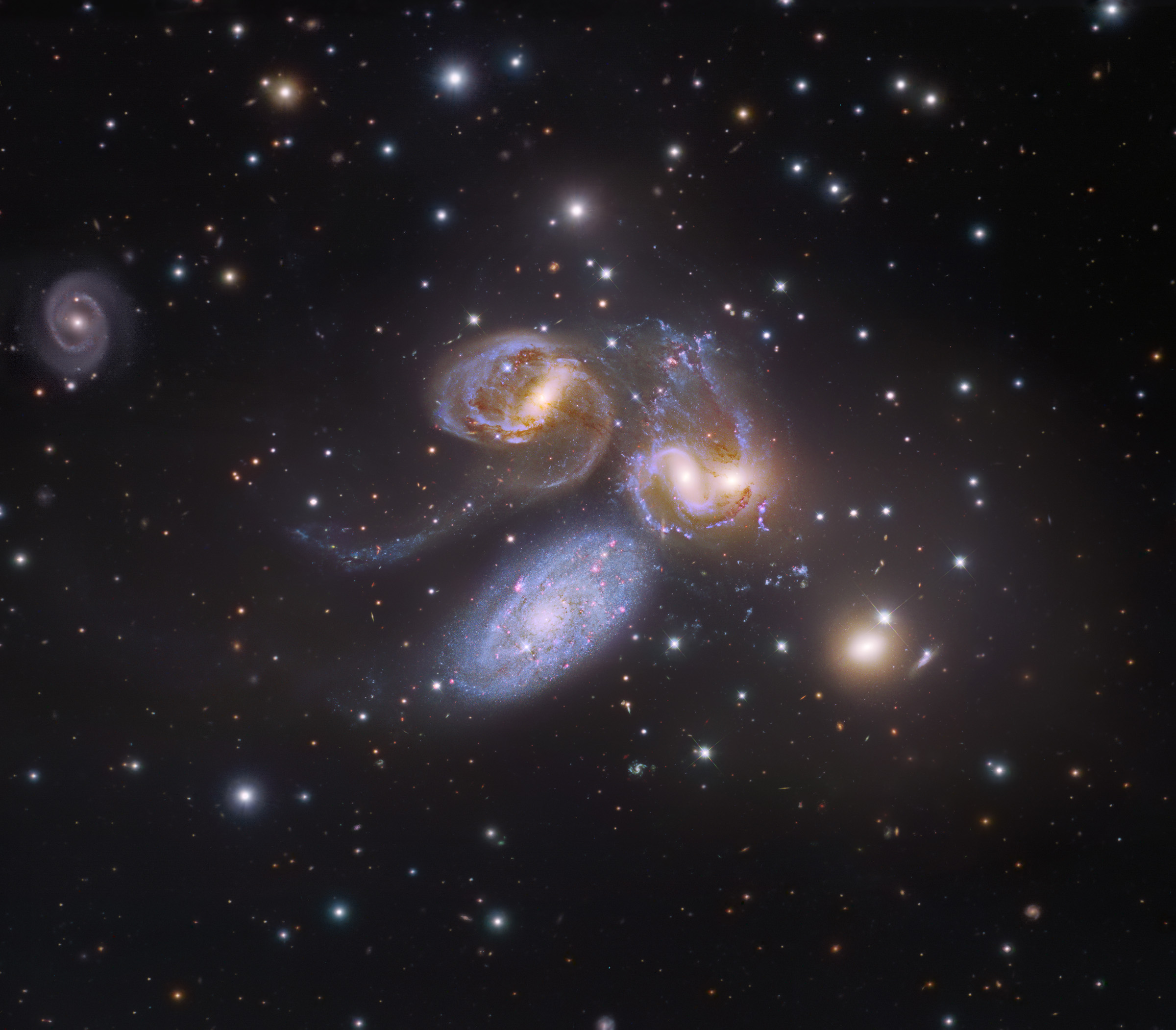
The first identified compact galaxy group, Stephan's Quintet is featured in this remarkable image constructed with data drawn from Hubble Legacy Archive and the Subaru Telescope on the summit of Mauna Kea. The galaxies of the quintet are gathered near the center of the field, but really only four of the five are locked in a cosmic dance of repeated close encounters taking place some 300 million light-years away. The odd man out is easy to spot, though. The interacting galaxies, NGC 7319, 7318A, 7318B, and 7317 have a more dominant yellowish cast. They also tend to have distorted loops and tails, grown under the influence of disruptive gravitational tides. The mostly bluish galaxy, NGC 7320, is in the foreground about 40 million light-years distant, and isn't part of the interacting group. Still, captured in this field above and to the left of Stephan's Quintet is another galaxy, NGC 7320C, that is also 300 million light-years distant. Of course, including it would bring the four interacting galaxies back up to quintet status. Stephan's Quintet lies within the boundaries of the high flying constellation Pegasus. At the estimated distance of the quintet's interacting galaxies, this field of view spans over 500,000 light-years.
El primer grupo compacto de galaxias identificado, el Cuarteto de Stephan, se muestra en esta impresionante imagen construida con datos obtenidos del Hubble Legacy Archive y del telescopio Subaru en la cima de Mauna Kea. Las galaxias del cuarteto se agrupan cerca del centro del campo, pero en realidad solo cuatro de las cinco están en una danza cósmica de encuentros cercanos repetidos que tienen lugar a unos 300 millones de años luz de distancia. El que se destaca es fácil de identificar. Las galaxias interactivas, NGC 7319, 7318A, 7318B y 7317, tienen un tono amarillento más dominante. También suelen tener bucles y colas distorsionadas, formadas bajo la influencia de mareas gravitacionales disruptivas. La galaxia principalmente azul, NGC 7320, está en primer plano a unos 40 millones de años luz de distancia y no forma parte del grupo interactivo. Sin embargo, capturada en este campo, arriba y a la izquierda del Cuarteto de Stephan, hay otra galaxia, NGC 7320C, que también se encuentra a 300 millones de años luz de distancia. Por supuesto, incluirla devolvería a las cuatro galaxias interactivas al estatus de cuarteto. El Cuarteto de Stephan se encuentra dentro de los límites de la constelación de Pegaso, que se encuentra muy elevada en el cielo. A la distancia estimada de las galaxias interactivas del cuarteto, este campo de visión abarca más de 500,000 años luz.