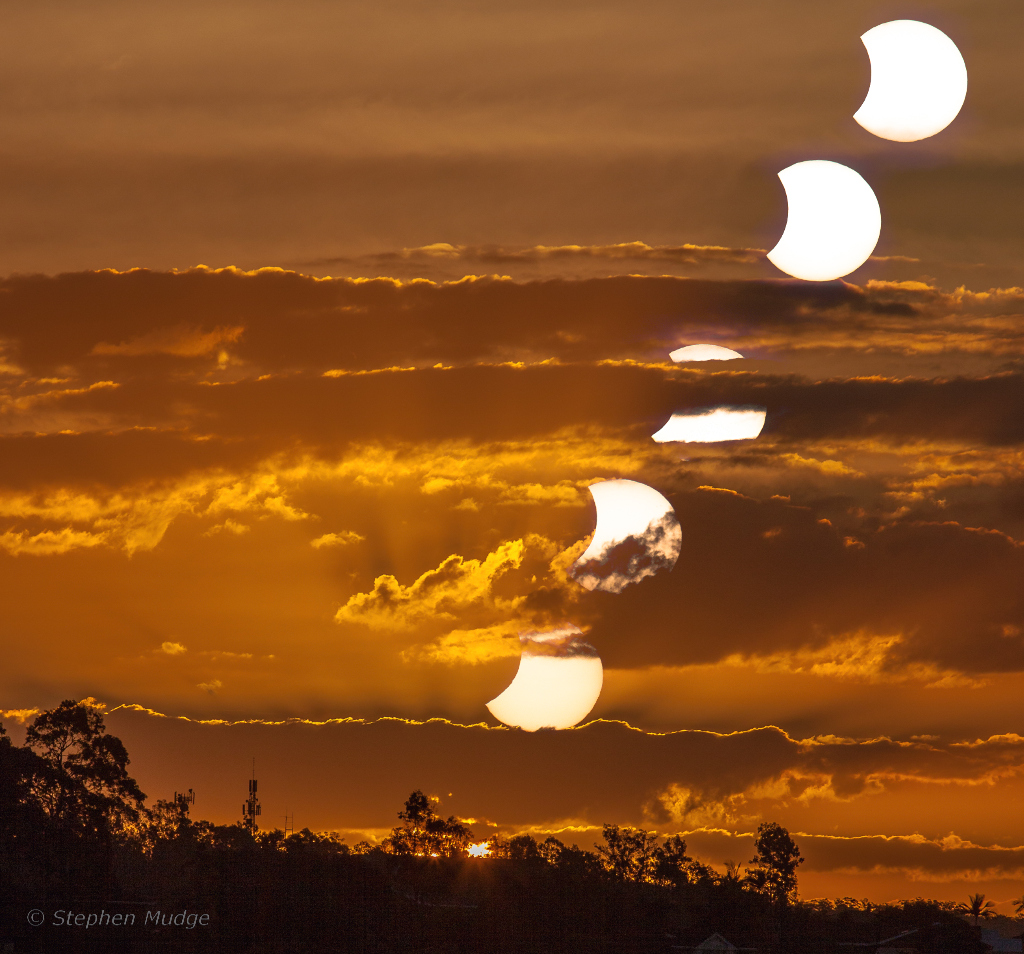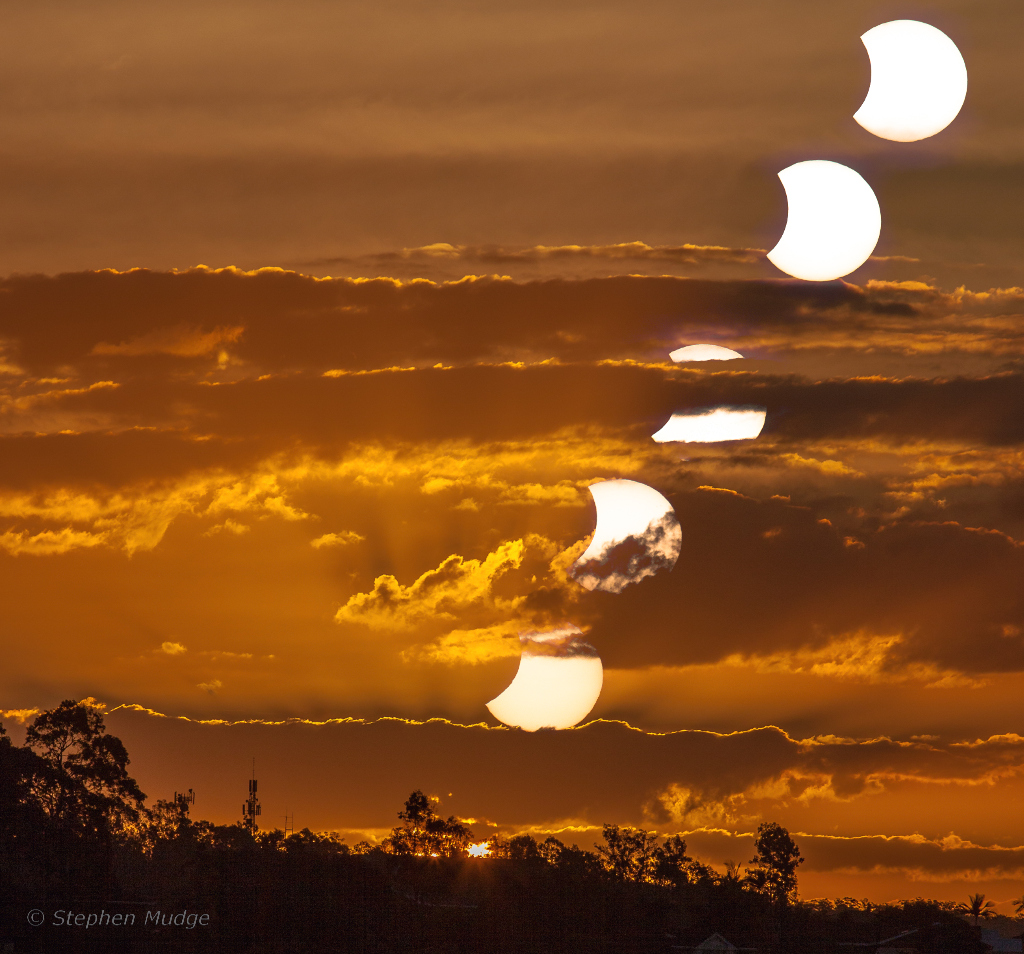
In skies over Brisbane at the southeastern corner of Queensland, Australia, Planet Earth, the Sun and New Moon set together on April 29. There the celestial line-up, the first solar eclipse of 2014, was seen as a partial solar eclipse. This dramatic composite is a digital stack of images taken about 5 minutes apart with telephoto lens and solar filter. It follows the eclipse in progress, approaching a western horizon where crepuscular rays from cloud banks in silhouette joined the silhouetted Moon. From Brisbane, the maximum eclipse phase with the Moon covering about 25% of the Sun occurred just after sunset. Only from a remote spot on the continent of Antarctica was it even possible to see the eclipse in its brief annular phase, the entire dark lunar disk surrounded by a thin, bright ring of fire.
En los cielos sobre Brisbane, en el sureste de Queensland, Australia, la Tierra, el Sol y la Luna nueva se ponen juntos el 29 de abril. Allí, la alineación celestial, la primera eclipse solar de 2014, fue vista como un eclipse solar parcial. Esta dramática composición es un montaje digital de imágenes tomadas aproximadamente cada 5 minutos con lente teleobjetivo y filtro solar. Muestra el eclipse en progreso, acercándose al horizonte occidental donde los rayos crepusculares de bancos de nubes en silueta se unieron a la luna en silueta. Desde Brisbane, la fase máxima del eclipse, con la luna cubriendo aproximadamente el 25% del Sol, ocurrió justo después del atardecer. Solo desde un lugar remoto en el continente de Antártida fue posible ver el eclipse en su breve fase anular, donde todo el disco lunar oscuro estaba rodeado por un delgado anillo brillante de fuego.