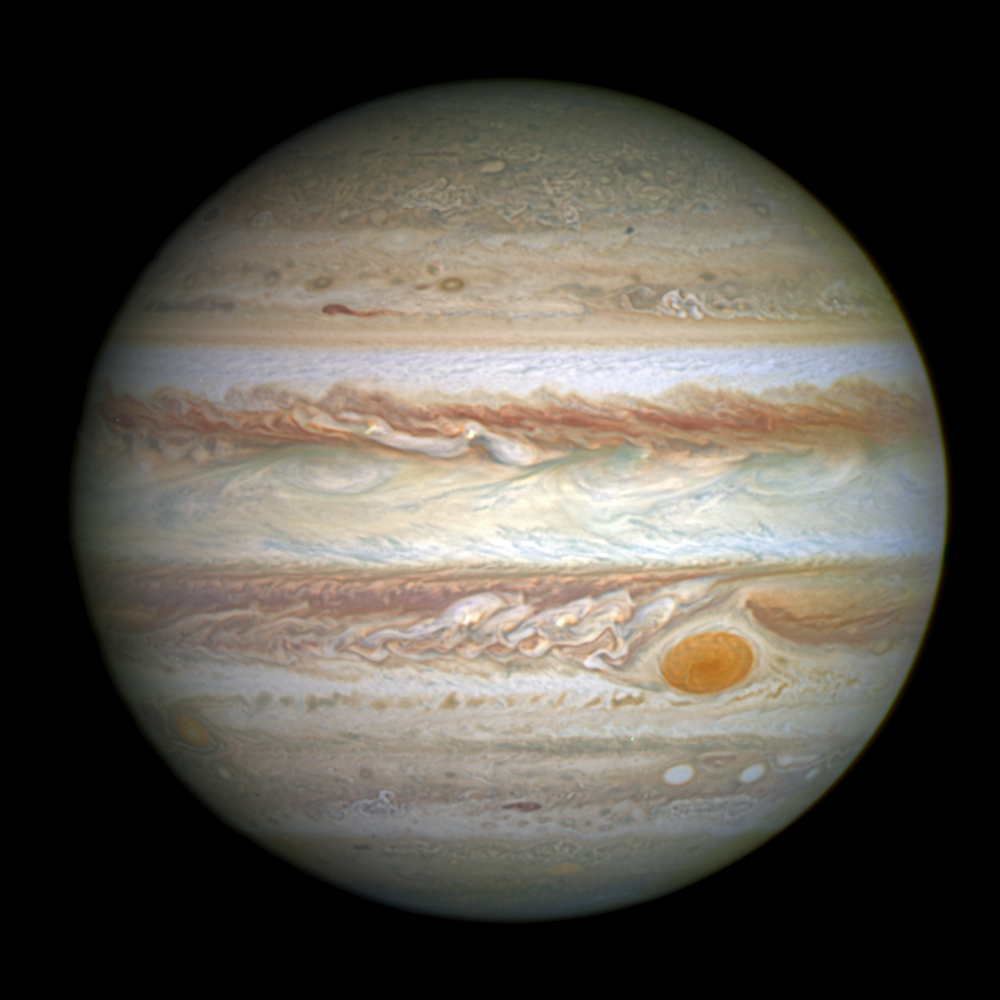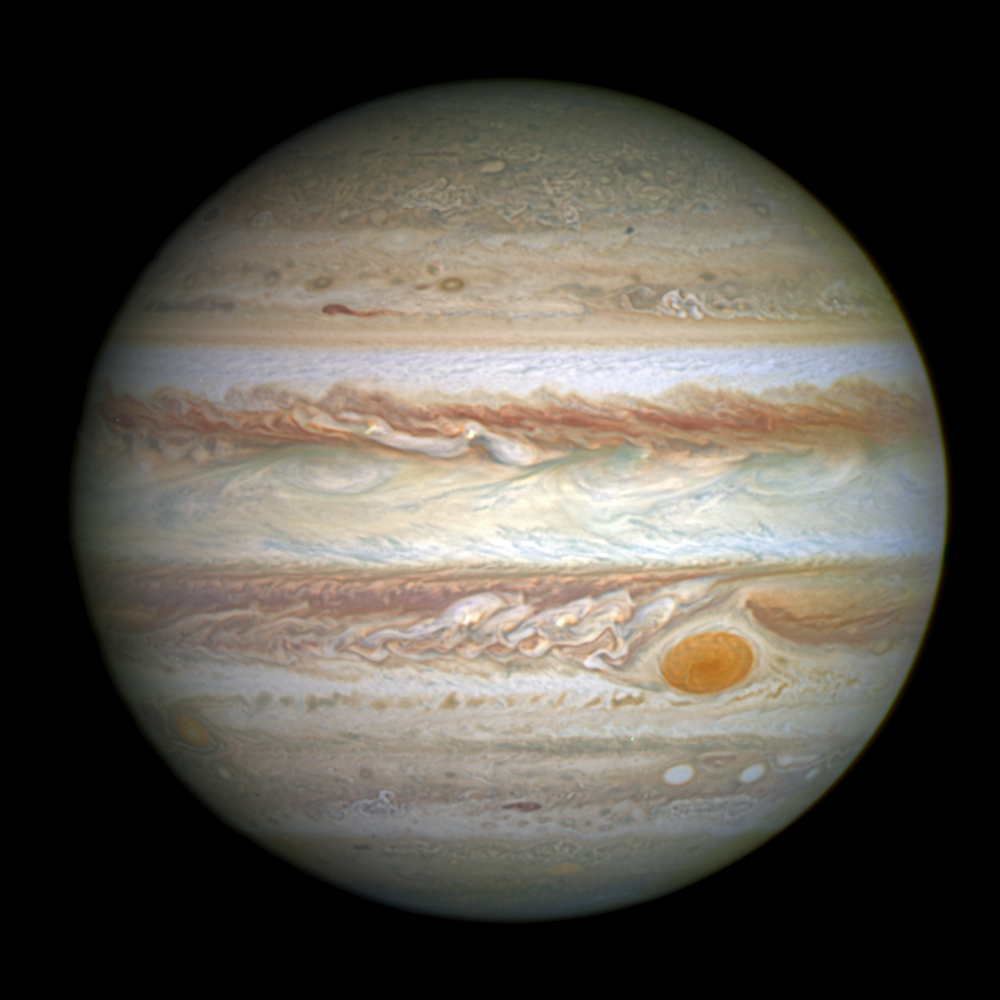
Gas giant Jupiter is the solar system's largest world with about 320 times the mass of planet Earth. It's also known for a giant swirling storm system, the Great Red Spot, featured in this sharp Hubble image from April 21. Nestled between Jupiter-girdling cloud bands, the Great Red Spot itself could still easily swallow Earth, but lately it has been shrinking. The most recent Hubble observations measure the spot to be about 10,250 miles (16,500 kilometers) across. That's the smallest ever measured by Hubble and particularly dramatic when compared to 14,500 miles measured by the Voyager 1 and 2 flybys in 1979, and historic telescopic observations from the 1800s indicating a width of about 25,500 miles on its long axis. Current indications are that the rate of shrinking is increasing for the long-lived Great Red Spot.
El gigante gaseoso Júpiter es el mundo más grande del sistema solar, con una masa aproximadamente 320 veces mayor que la de la Tierra. También es conocido por un sistema de tormenta gigante, la Gran Mancha Roja, que se muestra en esta nítida imagen captada por el telescopio espacial Hubble el 21 de abril. Anidada entre las bandas de nubes que rodean a Júpiter, la Gran Mancha Roja podría aún fácilmente tragar a la Tierra, pero recientemente ha estado disminuyendo de tamaño. Las observaciones más recientes del Hubble miden que la mancha tiene aproximadamente 10,250 millas (16,500 kilómetros) de ancho. Ese es el tamaño más pequeño jamás medido por el Hubble, y especialmente llamativo al compararlo con las mediciones de 14,500 millas obtenidas durante los sobrevuelos de las sondas Voyager 1 y 2 en 1979, y con observaciones históricas telescópicas del siglo XIX que indicaban una anchura de aproximadamente 25,500 millas en su eje largo. Las indicaciones actuales sugieren que la tasa de encogimiento de la Gran Mancha Roja, que ha existido durante mucho tiempo, está aumentando.