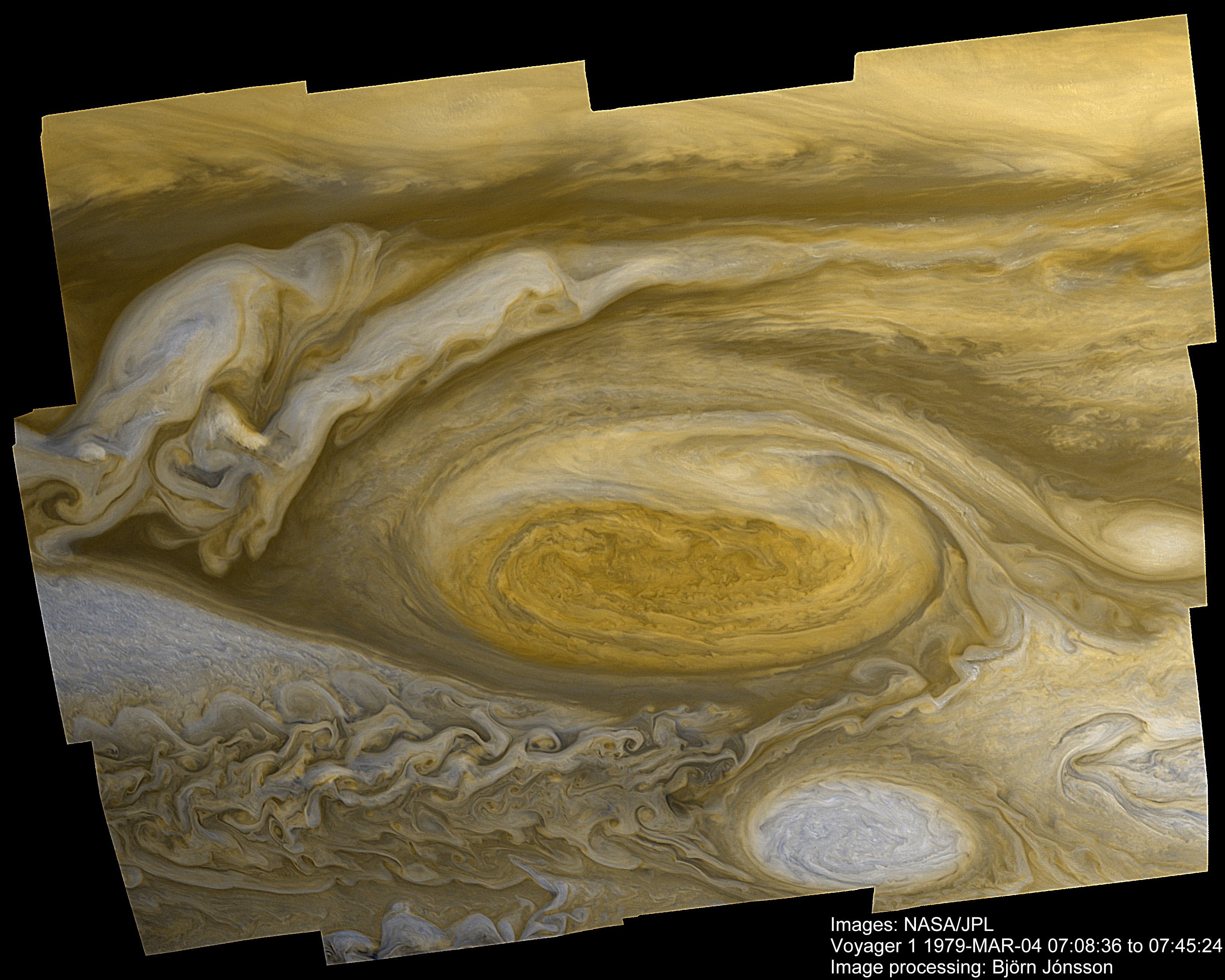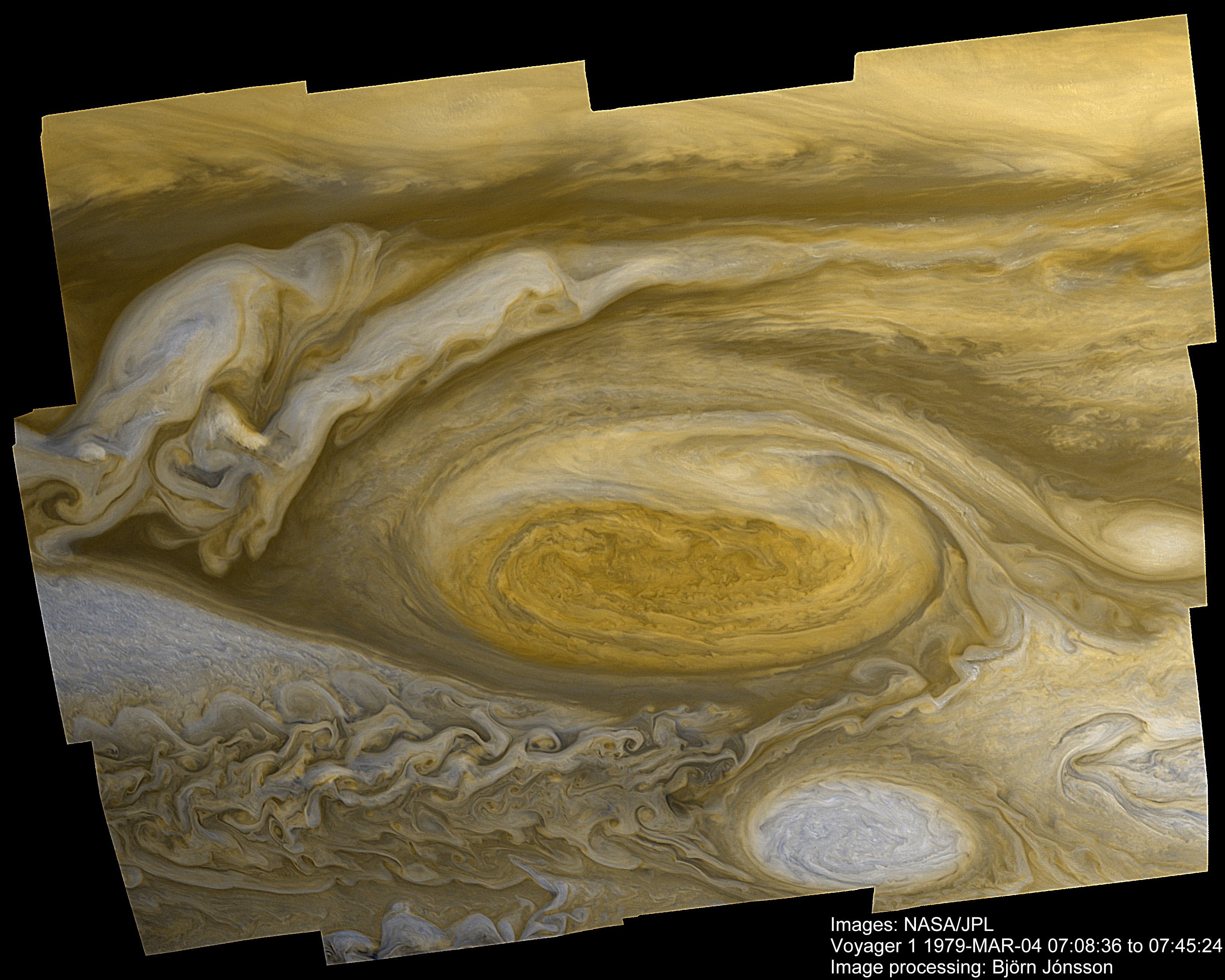
What will become of Jupiter's Great Red Spot? Recorded as shrinking since the 1930s, the rate of the Great Red Spot's size appears to have accelerated just in the past few years. A hurricane larger than Earth, the Great Red Spot has been raging at least as long as telescopes could see it. Like most astronomical phenomena, the Great Red Spot was neither predicted nor immediately understood after its discovery. Although small eddies that feed into the storm system seem to play a role, a more full understanding of the gigantic storm cloud remains a topic of continued research, and may result in a better understanding of weather here on Earth. The above image is a digital enhancement of an image of Jupiter taken in 1979 by the Voyager 1 spacecraft as it zoomed by the Solar System's largest planet. NASA's Juno spacecraft is currently heading toward Jupiter and will arrive in 2016. Poll: Do you like APOD's leading question?
¿Qué será del futuro de la Gran Mancha Roja de Júpiter? Registrada como en proceso de reducción desde la década de 1930, la velocidad de reducción del tamaño de la Gran Mancha Roja parece haberse acelerado en los últimos años. Una tormenta más grande que la Tierra, la Gran Mancha Roja ha estado rugiendo al menos desde que los telescopios pudieron observarla. Al igual que la mayoría de los fenómenos astronómicos, la Gran Mancha Roja no fue predicha ni comprendida inmediatamente tras su descubrimiento. Aunque pequeños remolinos que alimentan el sistema de tormenta parecen desempeñar un papel, una comprensión más completa de esta gigantesca nube tormentosa sigue siendo un tema de investigación continua, y podría conducir a una mejor comprensión del clima en la Tierra. La imagen anterior es una mejora digital de una imagen de Júpiter tomada en 1979 por la nave espacial Voyager 1 mientras pasaba junto al planeta más grande del Sistema Solar. La nave espacial Juno de NASA actualmente se dirige hacia Júpiter y llegará allí en 2016.