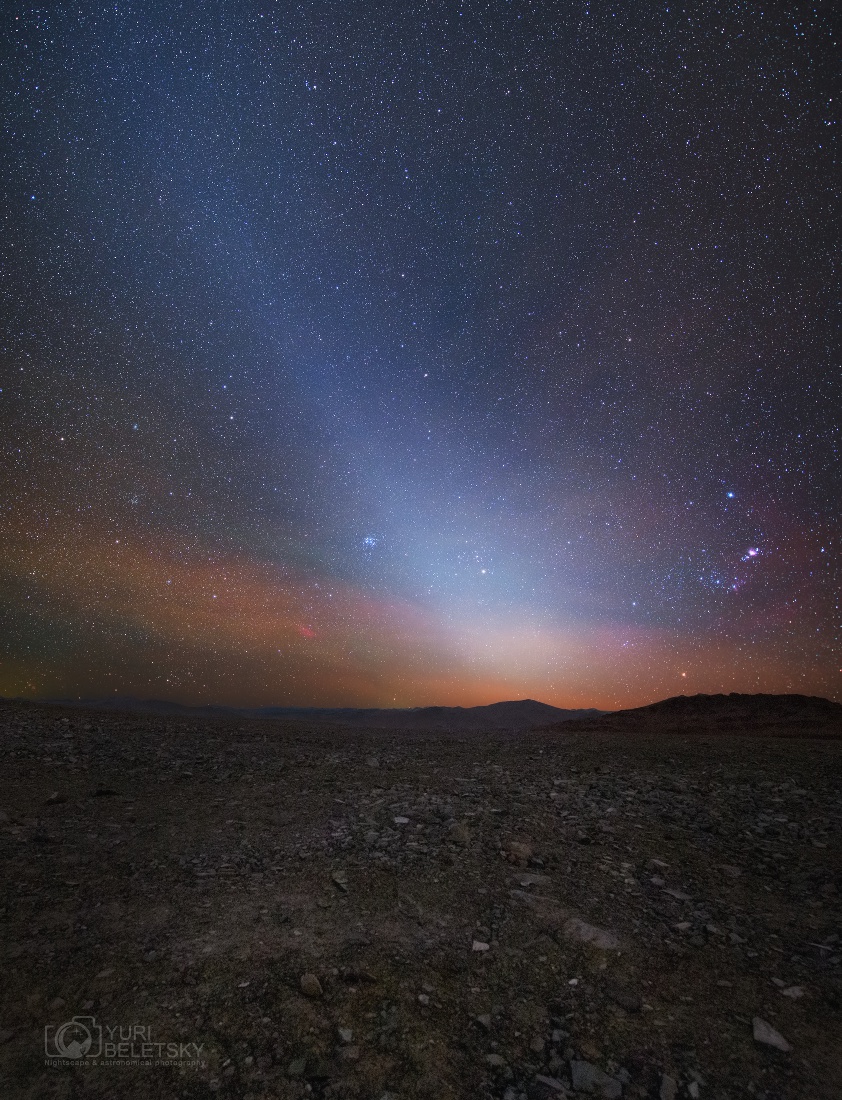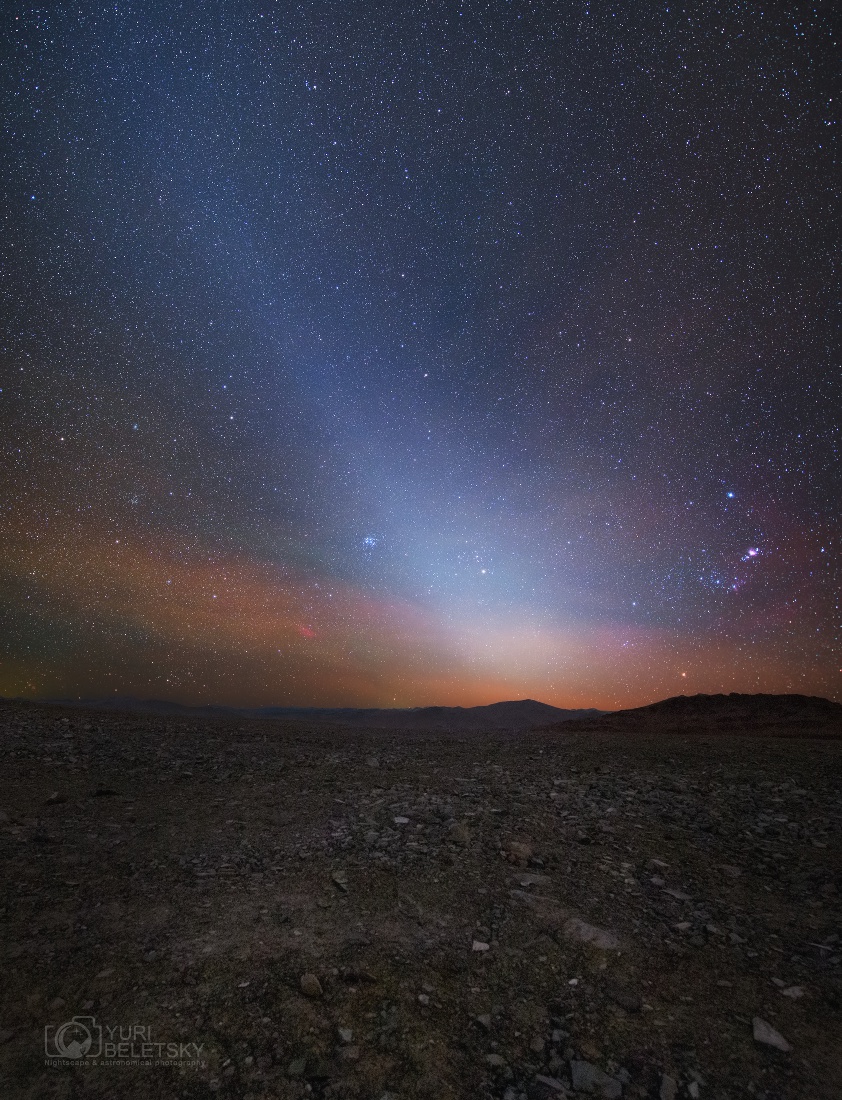
You might not guess it, but sunrise was still hours away when this nightscape was taken, a view along the eastern horizon from a remote location in Chile's Atacama desert. Stretching high into the otherwise dark, starry sky the unusually bright conical glow is sunlight though, scattered by dust along the solar system's ecliptic plane . Known as Zodiacal light, the apparition is also nicknamed the "false dawn". Near center, bright star Aldebaran and the Pleiades star cluster seem immersed in the Zodiacal light, with Orion toward the right edge of the frame. Reddish emission from NGC 1499, the California Nebula, can also be seen through the tinge of airglow along the horizon. Sliding your cursor over the picture (or following this link) will label the sky over this future site of the Giant Magellan Telescope at Las Campanas Observatory.
Puede que no lo adivine, pero el amanecer aún estaba horas lejos cuando se tomó esta imagen del cielo nocturno, una vista a lo largo del horizonte oriental desde una ubicación remota en el desierto de Atacama en Chile. Extendiéndose alto en el cielo de lo contrario oscuro y estrellado, la brillante luz cónica inusual es luz solar dispersada por el polvo a lo largo del plano ecuatorial del sistema solar. Conocida como luz zodiacal, esta aparición también se conoce con el apodo de "amanecer falso". Cerca del centro, la brillante estrella Aldebarán y el cúmulo estelar de las Pléyades parecen inmersos en la luz zodiacal, con Orión hacia el borde derecho de la imagen. También se puede ver la emisión rojiza del nebulosa NGC 1499, la Nebulosa de California, a través del tinte de la luminiscencia atmosférica a lo largo del horizonte. Desplazando el cursor sobre la imagen (o siguiendo este enlace) se etiquetará el cielo sobre este futuro lugar del Gran Telescopio Magallanes en el Observatorio Las Campanas.