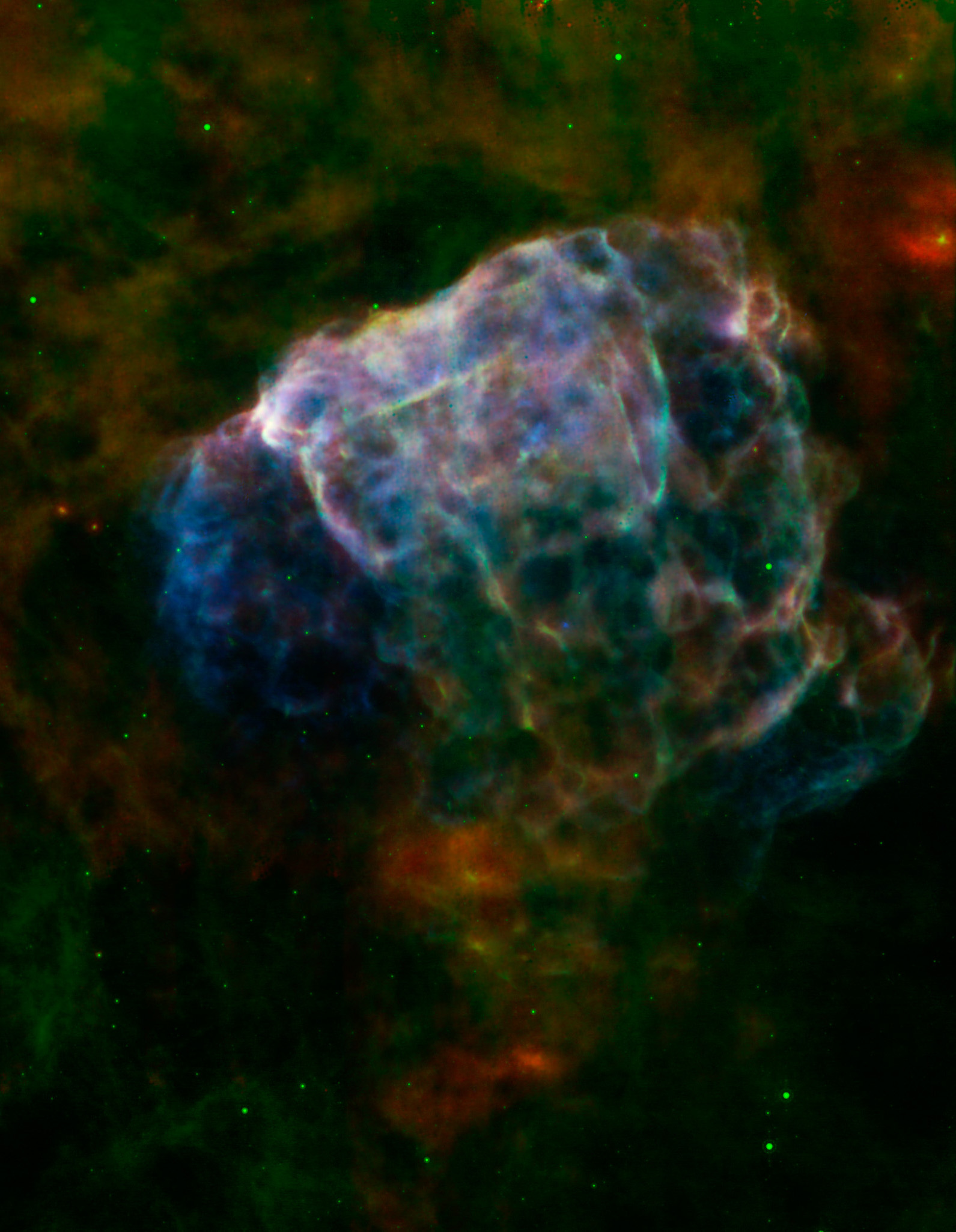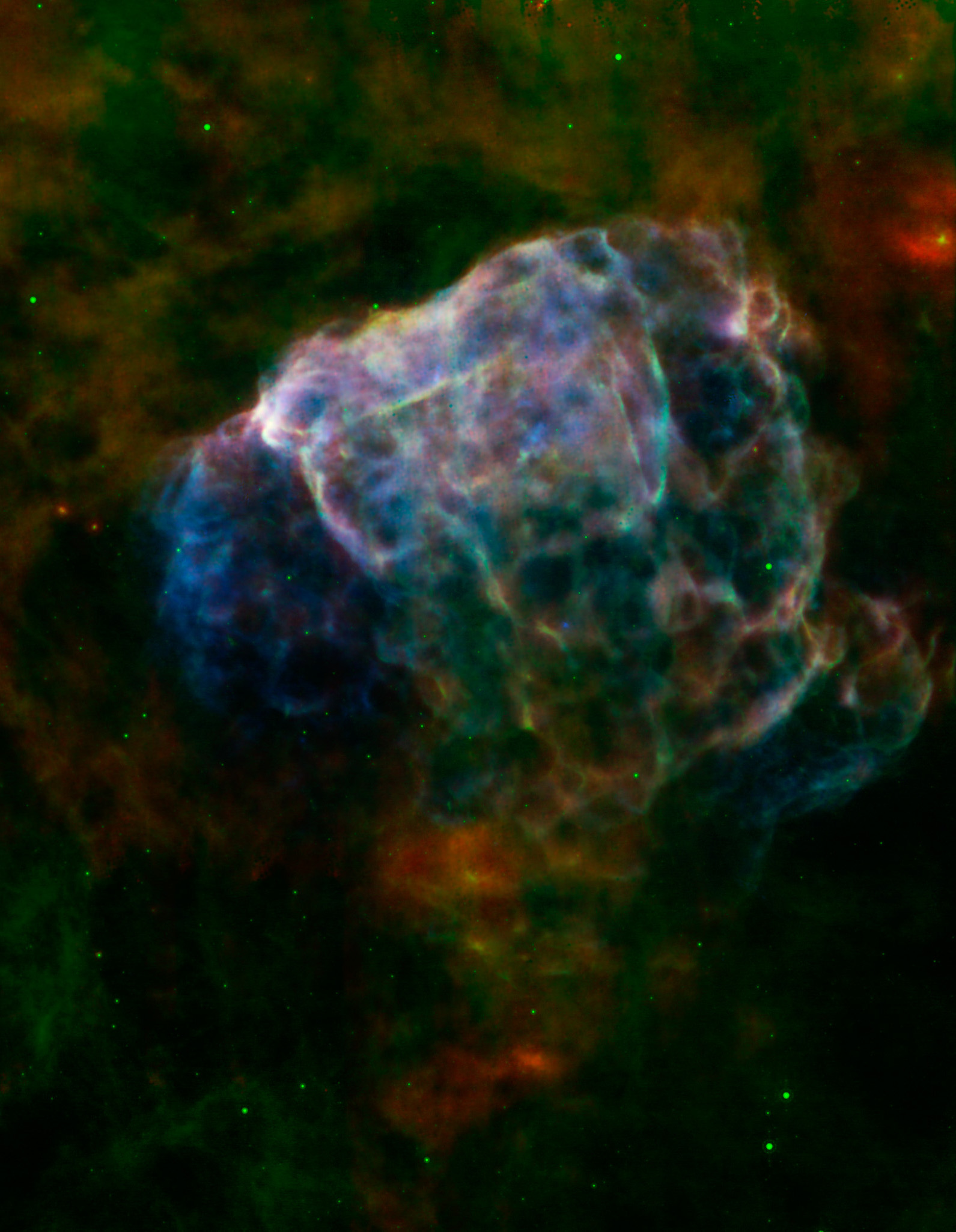
Driven by the explosion of a massive star, supernova remnant Puppis A is blasting into the surrounding interstellar medium about 7,000 light-years away. At that distance, this remarkable false-color exploration of its complex expansion is about 180 light-years wide. It is based on the most complete X-ray data set so far from the Chandra and XMM/Newton observations, and infrared data from the Spitzer Space Telescope. In blue hues, the filamentary X-ray glow is from gas heated by the supernova's shock wave, while the infrared emission shown in red and green is from warm dust. The bright pastel tones trace the regions where shocked gas and warmed dust mingle. Light from the initial supernova itself, triggered by the collapse of the massive star's core, would have reached Earth about 3,700 years ago, though the Puppis A supernova remnant remains a strong source in the X-ray sky.
Movido por la explosión de una estrella masiva, el remanente de supernova Puppis A está expandiéndose dentro del medio interestelar circundante, a unos 7.000 años luz de distancia. A esa distancia, esta asombrosa exploración en color falso de su compleja expansión tiene aproximadamente 180 años luz de ancho. Se basa en el conjunto más completo de datos de rayos X hasta ahora obtenidos por las observaciones del telescopio espacial Chandra y del XMM/Newton, así como en datos infrarrojos del telescopio espacial Spitzer. En tonos azules, el resplandor en forma de filamentos de rayos X proviene del gas calentado por la onda de choque de la supernova, mientras que la emisión infrarroja mostrada en rojo y verde proviene del polvo cálido. Los brillantes tonos pastel marcan las regiones donde el gas impactado y el polvo calentado se mezclan. La luz de la propia supernova original, provocada por el colapso del núcleo de la estrella masiva, habría llegado a la Tierra hace aproximadamente 3.700 años, aunque el remanente de la supernova Puppis A sigue siendo una fuente fuerte en el cielo de rayos X.