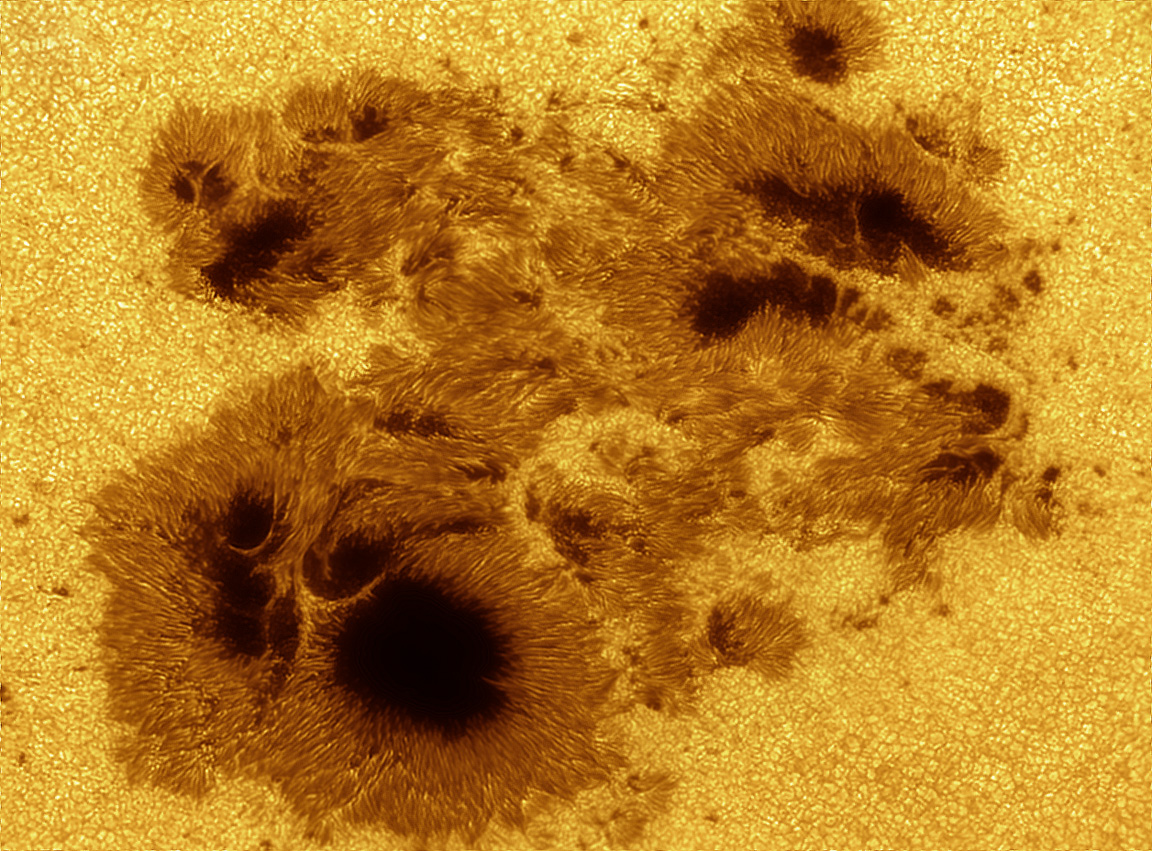
As you (safely!) watched the progress of yesterday's partial solar eclipse, you probably also spotted a giant sunspot group. Captured in this sharp telescopic image from October 22nd the complex AR 2192 is beautiful to see, a sprawling solar active region comparable in size to the diameter of Jupiter. Like other smaller sunspot groups, AR 2192 is now crossing the Earth-facing side of the Sun and appears dark in visible light because it is cooler than the surrounding surface. Still, the energy stored in the region's twisted magnetic fields is enormous and has already generated powerful explosions, including two X-class solar flares this week. Coronal mass ejections (CMEs) associated with the flares have not affected planet Earth, so far. The forecast for further activity from AR 2192 is still significant though, as it swings across the center of the solar disk and Earth-directed CMEs become possible.
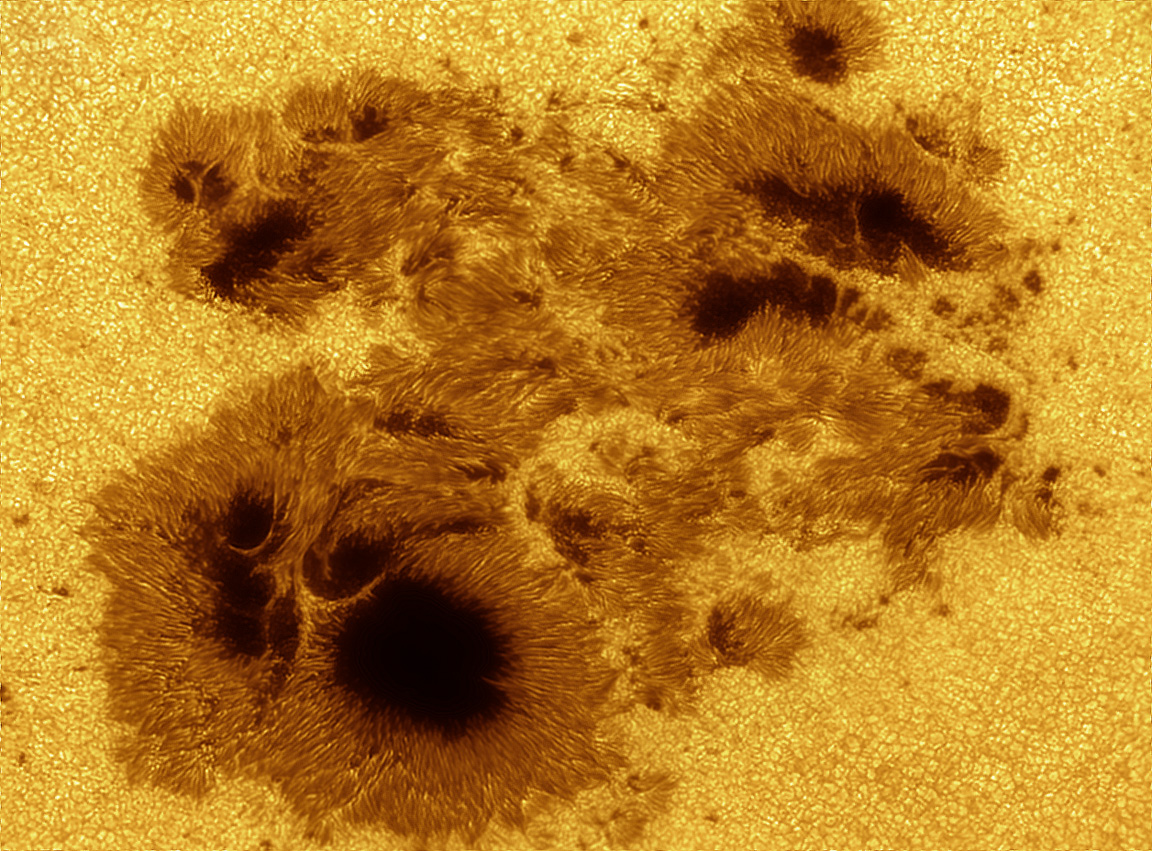
Mientras usted (seguramente de forma segura) observaba el progreso del eclipse solar parcial del día anterior, probablemente también vio un gran grupo de manchas solares. Capturado en esta nítida imagen telescópica del 22 de octubre, el complejo AR 2192 es hermoso de ver, una extensa región activa solar comparable en tamaño al diámetro de Júpiter. Al igual que otros grupos de manchas solares más pequeños, el AR 2192 ahora está cruzando el lado orientado hacia la Tierra del Sol y aparece oscuro en la luz visible porque es más frío que la superficie circundante. Sin embargo, la energía almacenada en los campos magnéticos retorcidos de la región es enorme y ya ha generado explosiones poderosas, incluyendo dos erupciones solares de clase X esta semana. Las eyecciones de masa coronal (CME) asociadas a las erupciones aún no han afectado a la Tierra, hasta ahora. El pronóstico para una mayor actividad del AR 2192 sigue siendo significativo, ya que atraviesa el centro del disco solar y se hacen posibles eyecciones de masa coronal dirigidas hacia la Tierra.