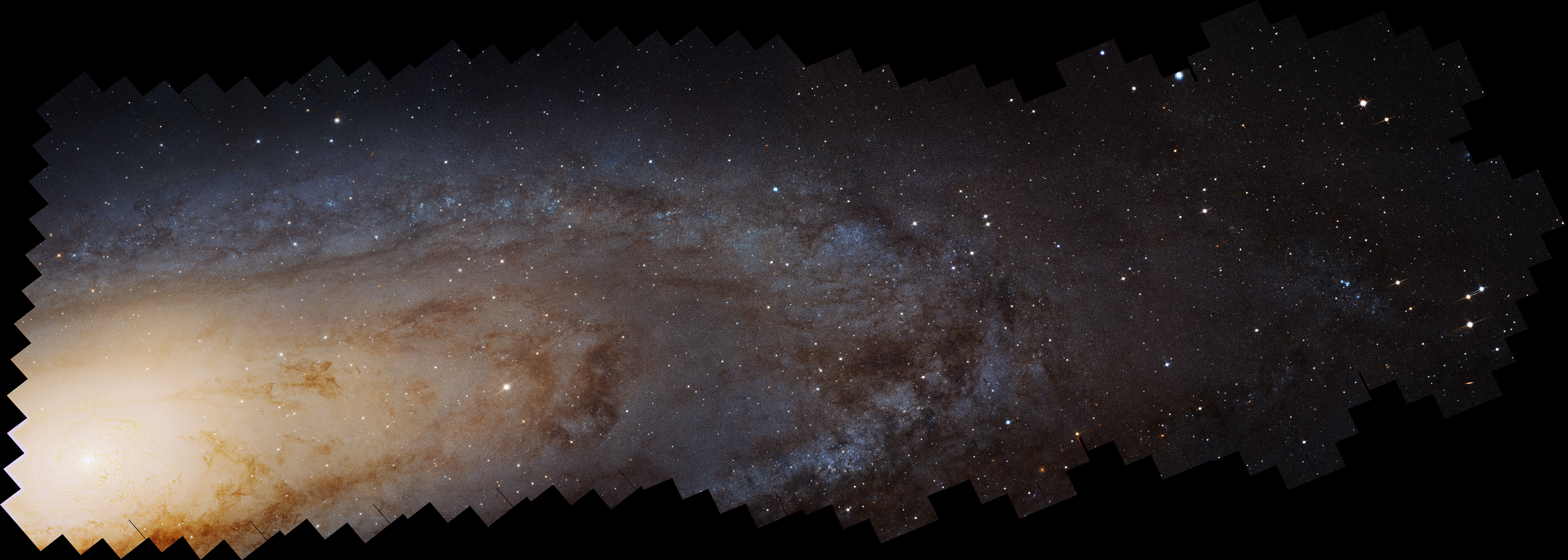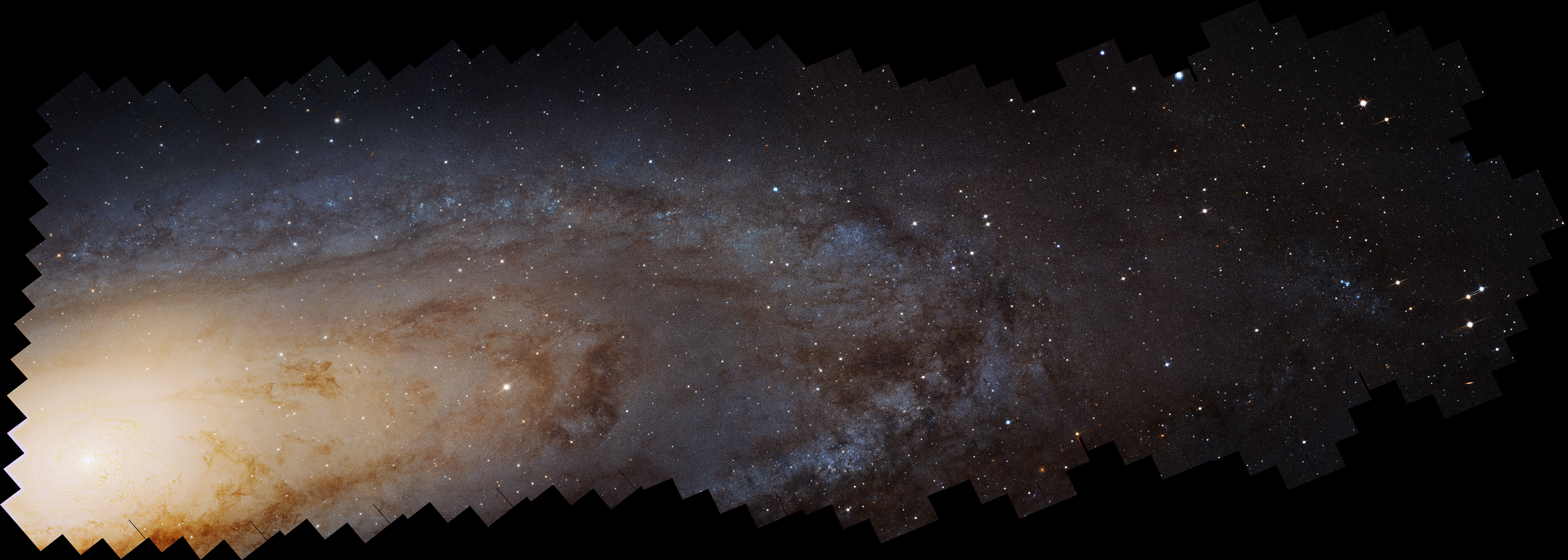
What stars compose the Andromeda galaxy? To better understand, a group of researchers studied the nearby spiral by composing the largest image ever taken with the Hubble Space Telescope. The result, called the Panchromatic Hubble Andromeda Treasury (PHAT), involved thousands of observations, hundreds of fields, spanned about a third of the galaxy, and resolved over 100 million stars. In the featured composite image, the central part of the galaxy is seen on the far left, while a blue spiral arm is prominent on the right. The brightest stars, scattered over the frame, are actually Milky Way foreground stars. The PHAT data is being analyzed to better understand where and how stars have formed in M31 in contrast to our Milky Way Galaxy, and to identify and characterize Andromeda's stellar clusters and obscuring dust.
¿Qué estrellas componen la galaxia Andrómeda? Para comprender mejor, un grupo de investigadores estudió la galaxia espiral cercana compuesta por la mayor imagen jamás tomada con el Telescopio Espacial Hubble. El resultado, llamado Panchromatic Hubble Andromeda Treasury (PHAT), involucró miles de observaciones, cientos de campos, abarcó aproximadamente un tercio de la galaxia y resolvió más de 100 millones de estrellas. En la imagen compuesta destacada, la parte central de la galaxia se ve en el extremo izquierdo, mientras que un brazo espiral azul es prominente en el derecho. Las estrellas más brillantes, dispersas por el marco, son en realidad estrellas delgado de la Vía Láctea. Los datos de PHAT se están analizando para comprender mejor dónde y cómo se han formado las estrellas en M31 en comparación con nuestra galaxia Vía Láctea, y para identificar y caracterizar los cúmulos estelares y el polvo oscurecedor de Andrómeda.