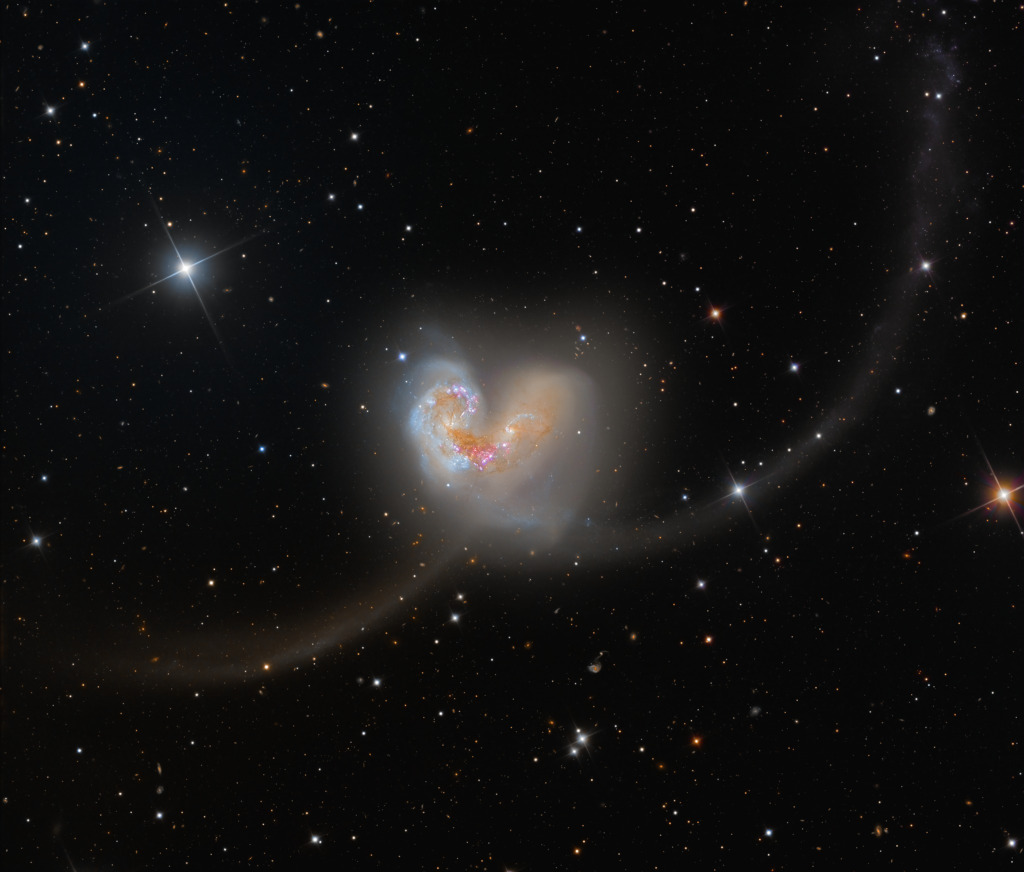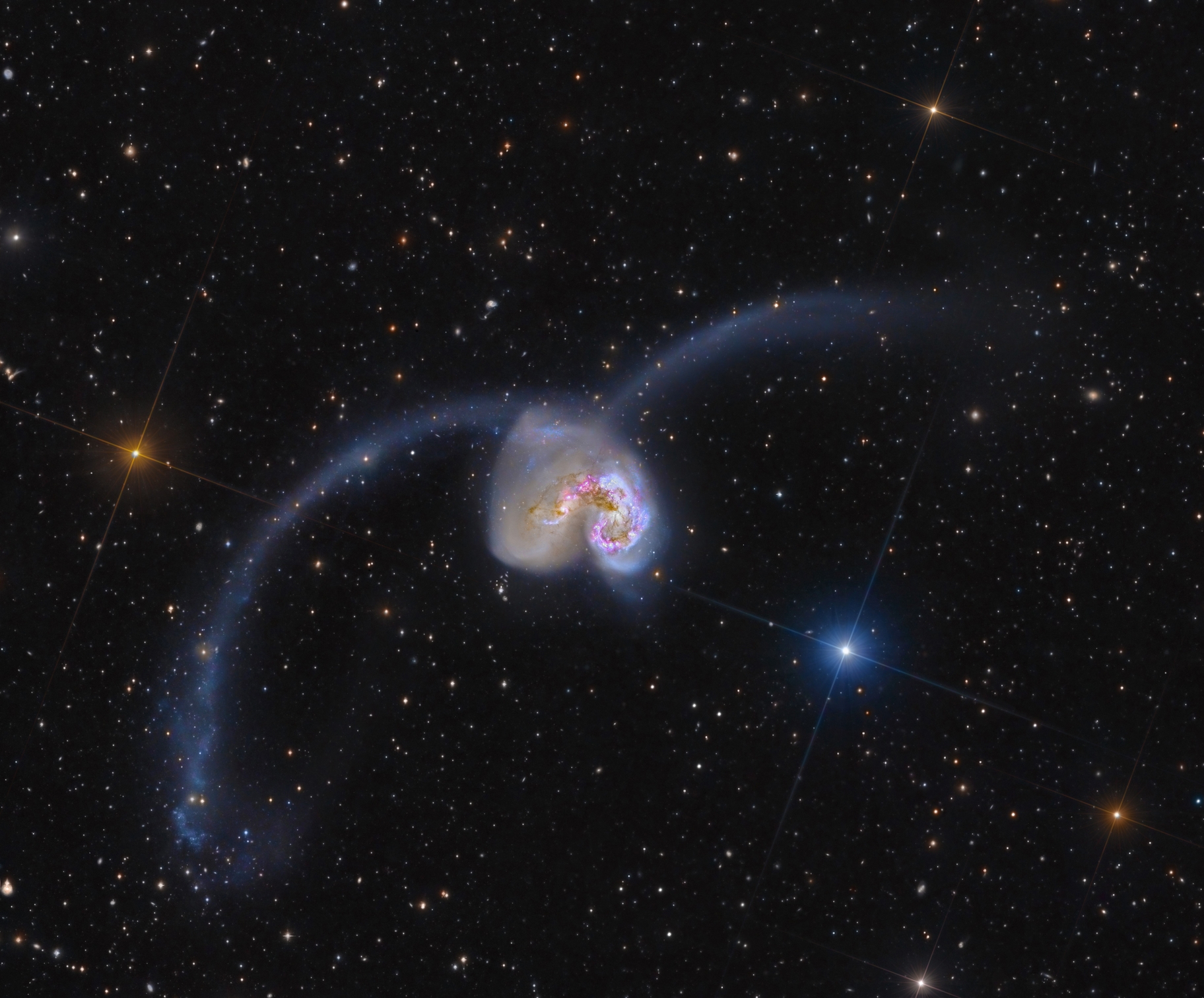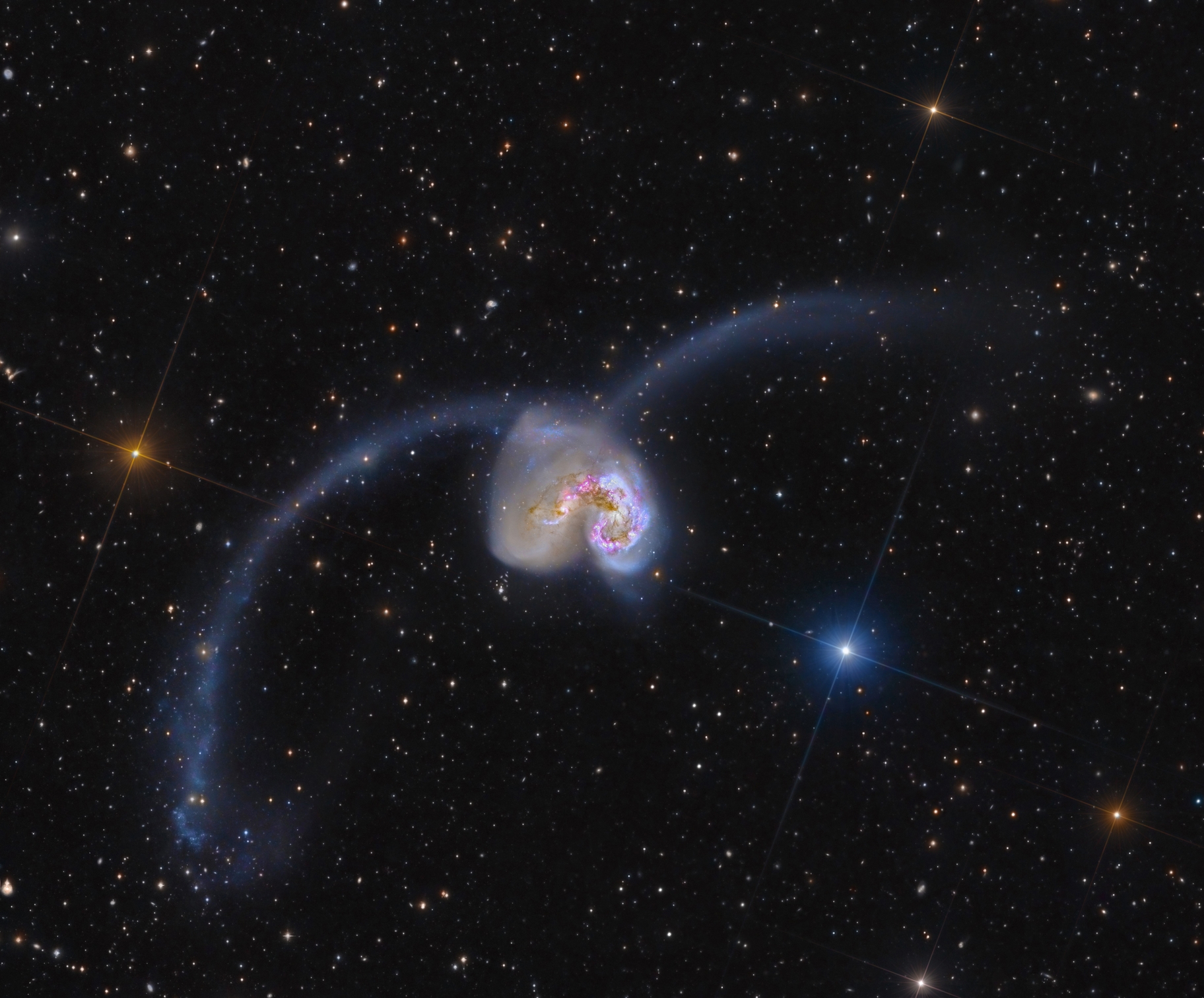
Some 60 million light-years away in the southerly constellation Corvus, two large galaxies are colliding. The stars in the two galaxies, cataloged as NGC 4038 and NGC 4039, very rarely collide in the course of the ponderous cataclysm, lasting hundreds of millions of years. But their large clouds of molecular gas and dust often do, triggering furious episodes of star formation near the center of the cosmic wreckage. Spanning about 500 thousand light-years, this stunning composited view also reveals new star clusters and matter flung far from the scene of the accident by gravitational tidal forces. The remarkable collaborative image is a mosaic constructed using data from small and large ground-based telescopes to bring out large-scale and faint tidal streams, composited with the bright cores imaged in extreme detail by the Hubble Space Telescope. Of course, the suggestive visual appearance of the extended arcing structures gives the galaxy pair its popular name - The Antennae.
A unos 60 millones de años luz en la constelación austral Corvus, dos grandes galaxias están colisionando. Las estrellas en las dos galaxias, catalogadas como NGC 4038 y NGC 4039, muy raramente colisionan durante el cataclismo lento, que dura cientos de millones de años. Pero sus grandes nubes de gas molecular y polvo suelen hacerlo, desencadenando episodios furiosos de formación estelar cerca del centro del desastre cósmico. Con un tamaño aproximado de 500.000 años luz, esta impresionante vista compuesta también revela nuevos cúmulos estelares y materia lanzada lejos del lugar del accidente por fuerzas de marea gravitacionales. La imagen notable es un mosaico construido utilizando datos de telescopios terrestres pequeños y grandes para resaltar corrientes de marea a gran escala y tenues, compuestos con los núcleos brillantes capturados en detalle extremo por el Telescopio Espacial Hubble. Por supuesto, la sugerente apariencia visual de las estructuras arqueadas extendidas le da a la pareja de galaxias su nombre popular: Las Antenas.