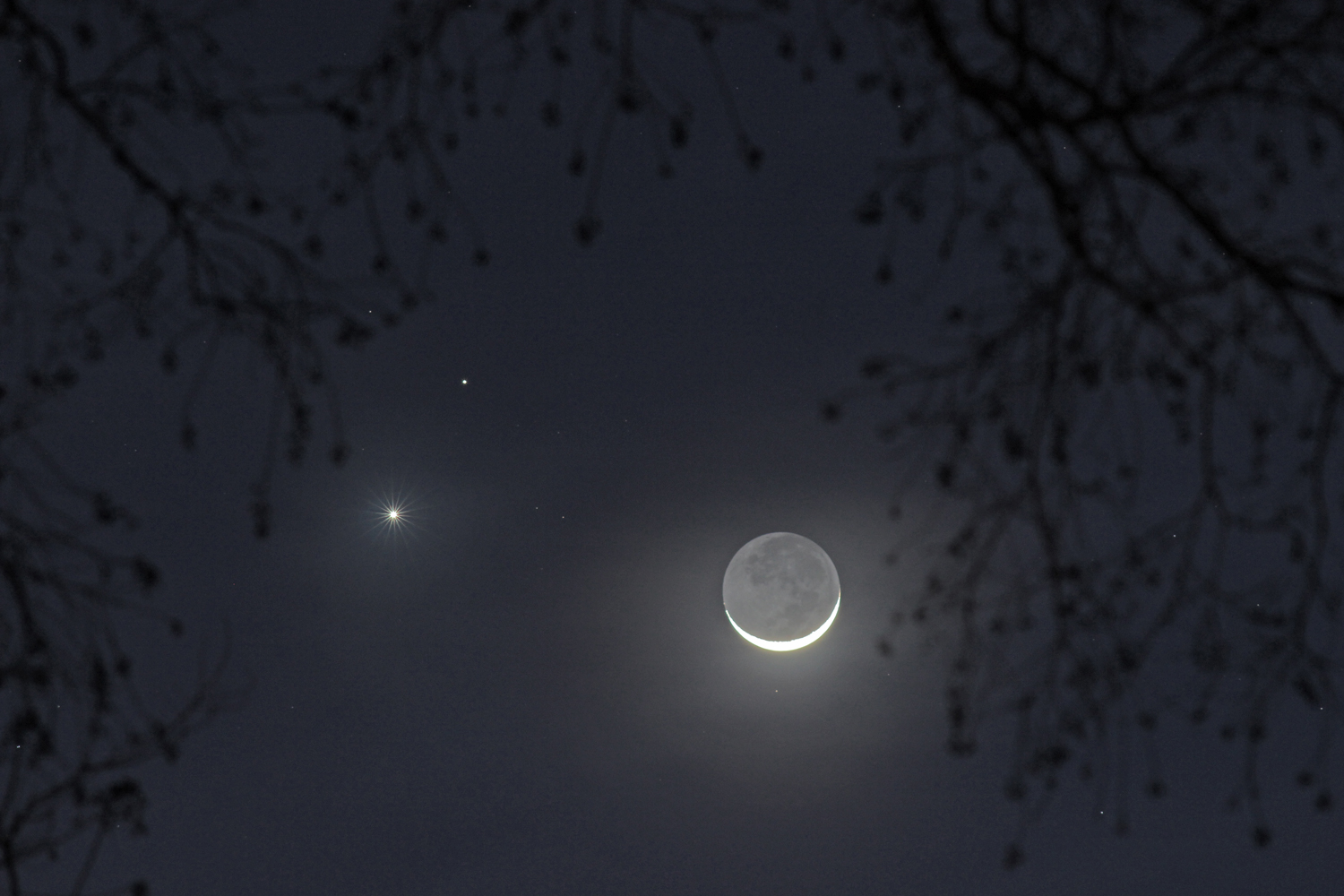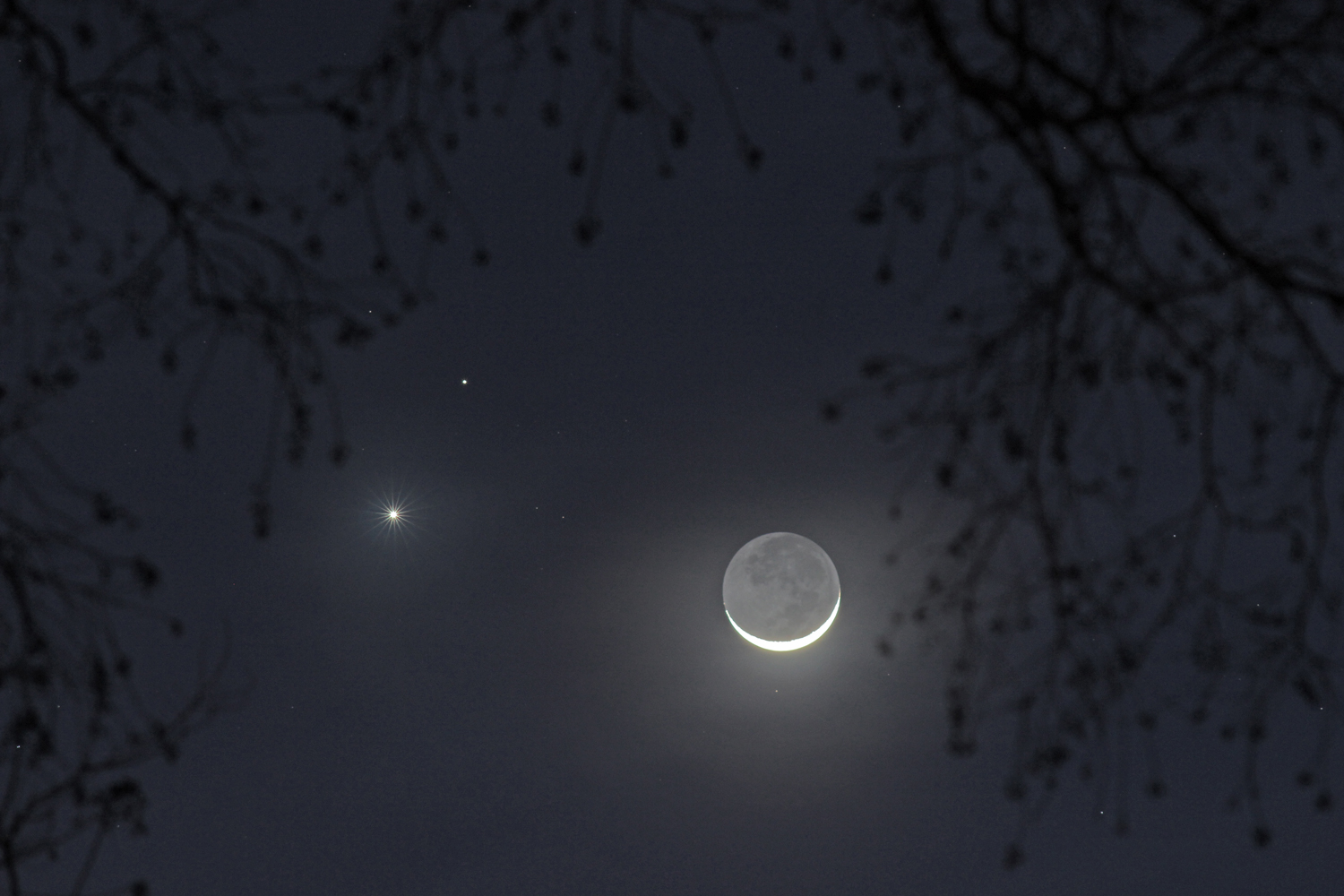
Venus, named for the Roman goddess of love, and Mars, the war god's namesake, came together by moonlight in this lovely skyview, recorded on February 20 from Charleston, South Carolina, USA, planet Earth. Made in twilight with a digital camera, the three second time exposure also records earthshine illuminating the otherwise dark surface of the young crescent Moon. Of course, the Moon has moved on from this much anticipated triple conjunction. Venus still shines in the west though as the evening star, third brightest object in Earth's sky, after the Sun and the Moon itself. Seen here within almost a Moon's width of Venus, much fainter Mars approached even closer on the following evening. But Mars has since been moving slowly away from brilliant Venus, though Mars is still visible too in the western twilight.
Venus, nombrado en honor a la diosa romana del amor, y Marte, el planeta que lleva el nombre del dios de la guerra, se unieron bajo la luz de la luna en esta hermosa vista del cielo, capturada el 20 de febrero desde Charleston, Carolina del Sur, Estados Unidos, en el planeta Tierra. Tomada durante el crepúsculo con una cámara digital, la exposición de tres segundos también registra la luz terrestre iluminando la superficie oscura del joven cuarto creciente de la Luna. Por supuesto, la Luna ya ha cambiado de posición desde esta esperada conjunción triple. Venus sigue brillando en el oeste como la estrella de la tarde, el tercer objeto más brillante en el cielo terrestre, después del Sol y la Luna misma. Aquí se ve Marte, mucho más tenue, dentro de casi un ancho lunar de Venus, y Marte se acercó aún más a Venus la noche siguiente. Pero Marte ha estado moviéndose lentamente alejándose de brillante Venus, aunque Marte sigue siendo visible también en el crepúsculo del oeste.