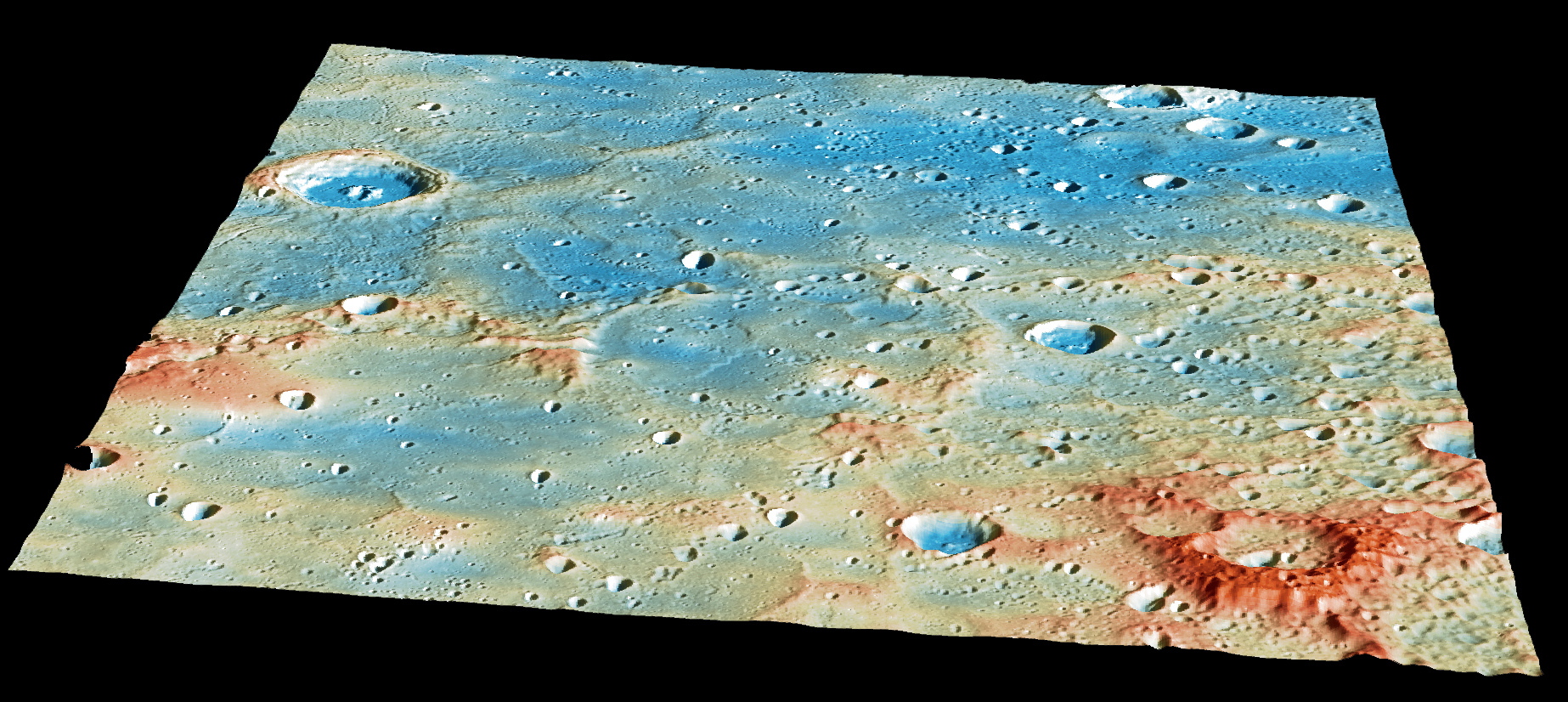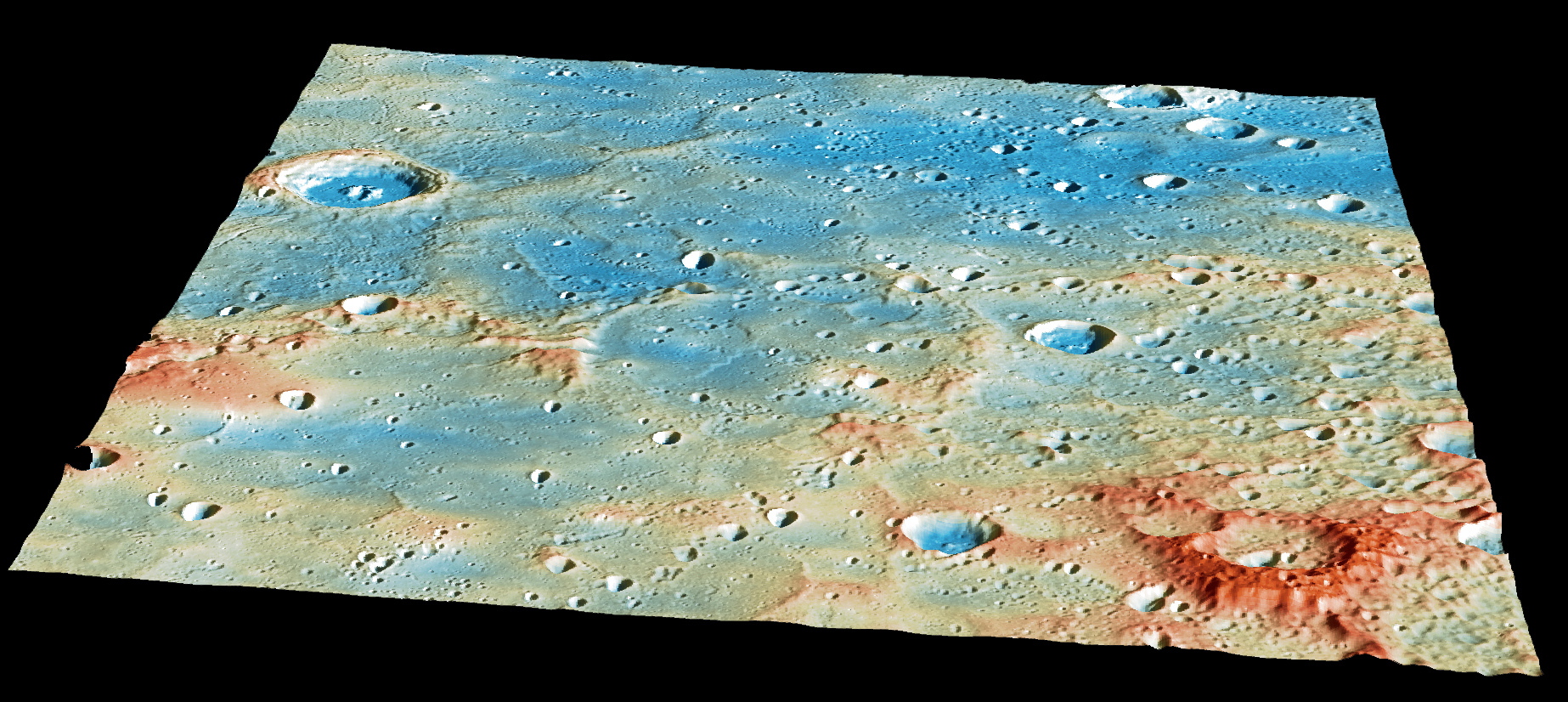
The first to orbit Mercury, the MESSENGER spacecraft came to rest on this region of Mercury's surface yesterday. Constructed from MESSENGER image and laser altimeter data, the scene looks north over the northeastern rim of the broad, lava filled Shakespeare basin. The large, 48 kilometer (30 mile) wide crater Janacek is near the upper left edge. Terrain height is color coded with red regions about 3 kilometers above blue ones. MESSENGER'S final orbit was predicted to end near the center, with the spacecraft impacting the surface at nearly 4 kilometers per second (over 8,700 miles per hour) and creating a new crater about 16 meters (52 feet) in diameter. The impact on the far side of Mercury was not observed by telescopes, but confirmed when no signal was detected from the spacecraft given time to emerge from behind the planet. Launched in 2004, the MErcury Surface, Space ENvironment, GEochemisty and Ranging spacecraft completed over 4,000 orbits after reaching the Solar System's innermost planet in 2011.
La primera nave espacial en orbitar Mercurio, MESSENGER, se detuvo en esta región de la superficie del planeta ayer. Construida a partir de imágenes y datos del altímetro láser de MESSENGER, la escena mira hacia el norte sobre el borde nordeste del amplio basamento de Shakespeare, lleno de lava. El gran cráter Janacek, de 48 kilómetros (30 millas) de ancho, se encuentra cerca del borde superior izquierdo. La altitud del terreno está codificada en colores, con las regiones rojas aproximadamente 3 kilómetros por encima de las azules. La órbita final de MESSENGER se predijo que terminaría cerca del centro, con la nave impactando la superficie a casi 4 kilómetros por segundo (más de 8,700 millas por hora) y creando un nuevo cráter de aproximadamente 16 metros (52 pies) de diámetro. El impacto en el lado opuesto de Mercurio no fue observado por telescopios, pero se confirmó cuando no se detectó señal de la nave, teniendo tiempo suficiente para salir detrás del planeta. Lanzada en 2004, la nave espacial MErcury Surface, Space ENvironment, GEochemisty and Ranging completó más de 4,000 órbitas después de llegar al planeta más interno del Sistema Solar en 2011.